
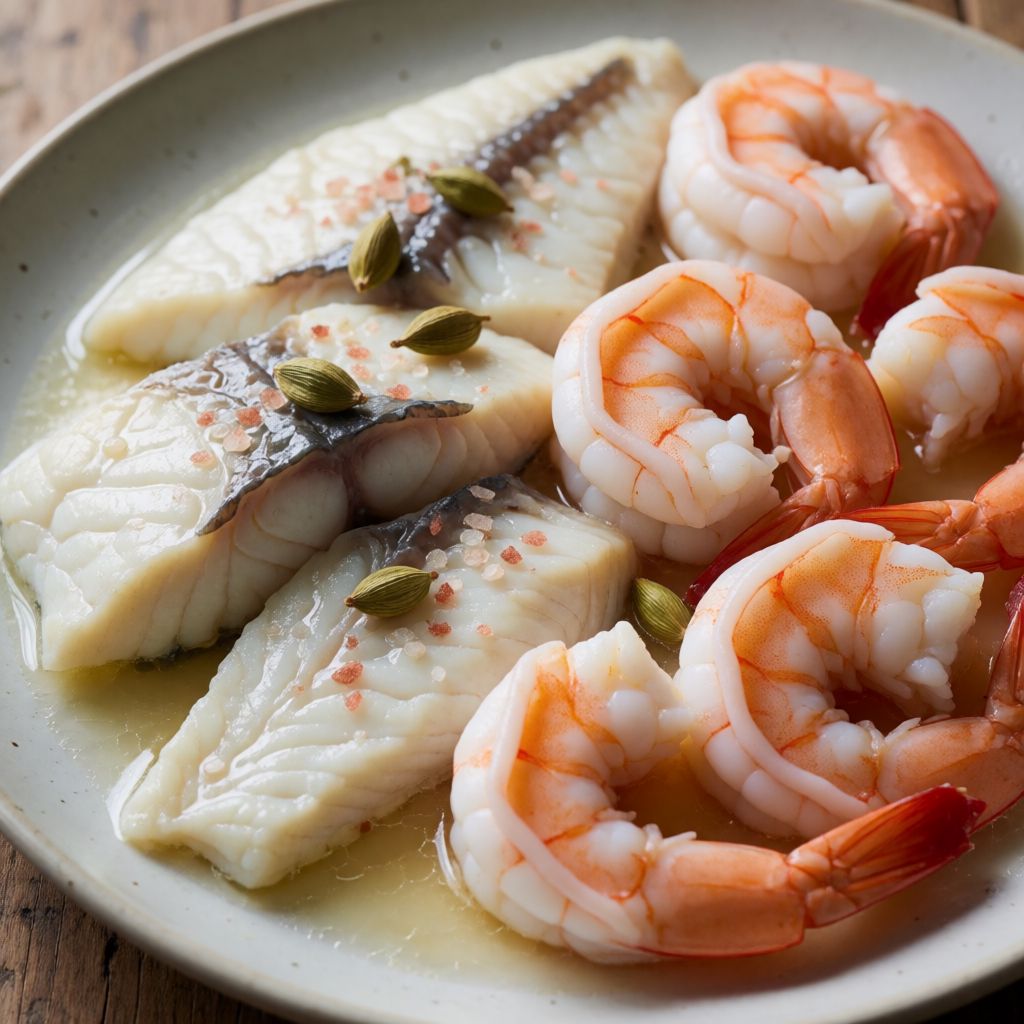
 AI photo
Steamed Flounder Fillet and Tiger Prawns with Cardamom
A light steamed dish of flounder fillet and tiger prawns infused with cardamom, finished with a citrus dressing.
Labels are worked out automatically from the ingredients and can be wrong. Check the packaging if it matters to you.
Ingredients
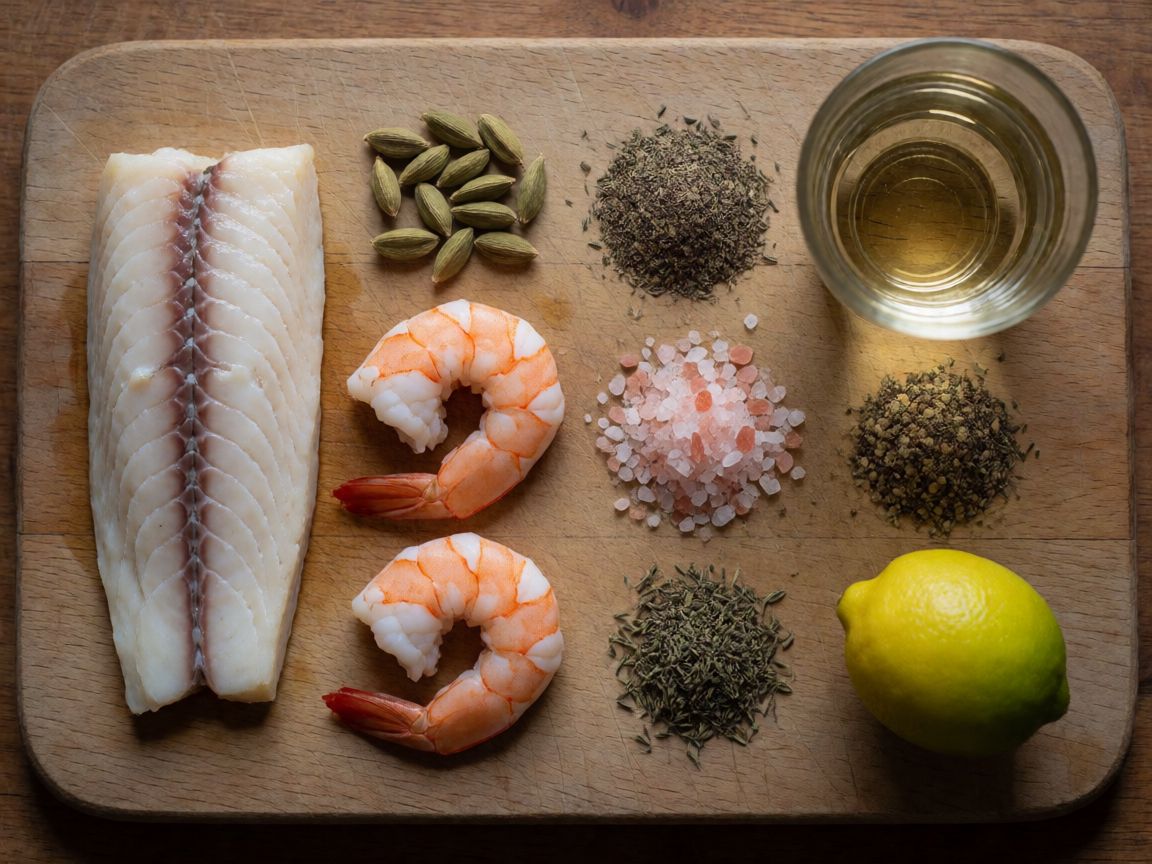
- 500 g Flounder fillet
- 300 g Tiger prawns
- 2-3 pcs Cardamom pods
- 8 tbsp White wine
- 1 tbsp Olive oil to taste
- Himalayan pink salt to taste
- Black pepper freshly ground, to taste
- Creole spice mix to taste
- Dried thyme to taste
- 1 pcs Lemon or lime








Steps
Add the white wine to the steaming water, place the flounder fillet and tiger prawns in the steamer basket together with the cardamom, and steam for 12 minutes. The fish is ready when it reaches 63°C at its thickest point.
12 minMake the dressing: mix the olive oil, juice of the lemon or lime, Himalayan pink salt and black pepper.
Arrange the flounder fillet and prawns on a serving plate, drizzle with the dressing, sprinkle with dried thyme and serve.
This isn't fish cooked in water, and it isn't fried — it's fish cooked in vapour. The flounder and the prawns never touch the wine or the cardamom directly; they sit above it in the basket and breathe in what rises off it. That's the whole point of steaming: heat that surrounds without agitating, flavour that arrives as a cloud instead of a splash. The flesh keeps its shape instead of getting knocked about by boiling water.
What decides whether it works isn't minutes on a timer — it's one number: 63°C at the thickest part of the fillet. Flounder is flat and thin, and thin fish has almost no margin for error. Overshoot that mark, even by the minute or two of carry-over heat after you take it off, and the proteins that just set start squeezing water back out. You end up with fish that's dry despite having spent its whole life in a cloud of steam.
Some say cook the fish until it flakes — no, because by the time it flakes on its own under a fork, it's already gone past the point. Flaking means the muscle fibres have pulled apart because the moisture holding them together has cooked away. What you want still holds its shape when you lift it off the plate, and only gives in gently at the fork.
Flounder's main job here is to have almost no taste of its own — it's a canvas for the cardamom and the citrus, not a flavour to compete with them. In a UK fishmonger, lemon sole or plaice do the same work for less money: same flat-fish family, same thin fillet, same fast cook. Don't chase the name on the label — chase the thickness. Anything thicker than the flounder here just needs longer under the same 63°C rule.
Tiger prawns bring the bite the fish doesn't have. Buy them raw — they travel from grey-pink to opaque-pink in roughly the same window the fish needs, and that colour shift is your second visual cue alongside the thermometer. Pre-cooked prawns have no business going back into a steamer: they only need warming through, and by the time the fish is actually done, they've turned to rubber.
Crack the cardamom pods before they go into the water — don't drop them in whole. Whole and unbruised, they just sit there looking decorative; cracked open, they let the steam carry their oil up into the fish instead of holding it sealed inside the pod. It's the same reasoning as tearing a bay leaf instead of leaving it whole in a stock: the skin is what's keeping the flavour locked away from the heat.
The wine in the steaming water does two things: its acidity rises with the steam and settles onto the fish before any dressing touches it, and its alcohol evaporates fast, dragging aromatic compounds up with it that water alone wouldn't release. No wine in the house — a splash of dry vermouth does nearly the same work; failing that, water with a strip of lemon zest in it is weaker, but not nothing.
The dressing is made separately and added after cooking, not before, for a reason: salt put on raw fish before it goes into the basket would pull moisture out of flesh that's already losing plenty to the steam, and oil poured on beforehand would just run off into the water below and never reach the plate. Any oil with no smell of its own works here — a light olive oil, a plain sunflower oil — anything that lets the lemon or lime do the talking instead of competing with it. The pink salt is, chemically, salt with trace minerals too small to register in a dish this size; use it if it's in the cupboard, don't buy a bag specially — any salt without an iodine bite does the same job. Pepper matters more freshly ground than the salt does: its aromatic oils are sharp for minutes after grinding and mostly gone from a pre-ground tub weeks before it reached your spoon.
The creole mix and the dried thyme go on at the very end, off the heat, because dried herbs have little aroma left to begin with and cooking them into the fish would burn off what remains — they're there for smell and for colour on the plate, not for flavouring the cooking. And leave the lid alone while it's steaming. Every time you lift it to check, the trapped steam escapes and the pan has to build it back up from nothing — minutes the recipe's twelve never accounted for. Treat the time as your floor, the thermometer as your ceiling, and don't go looking in between.