
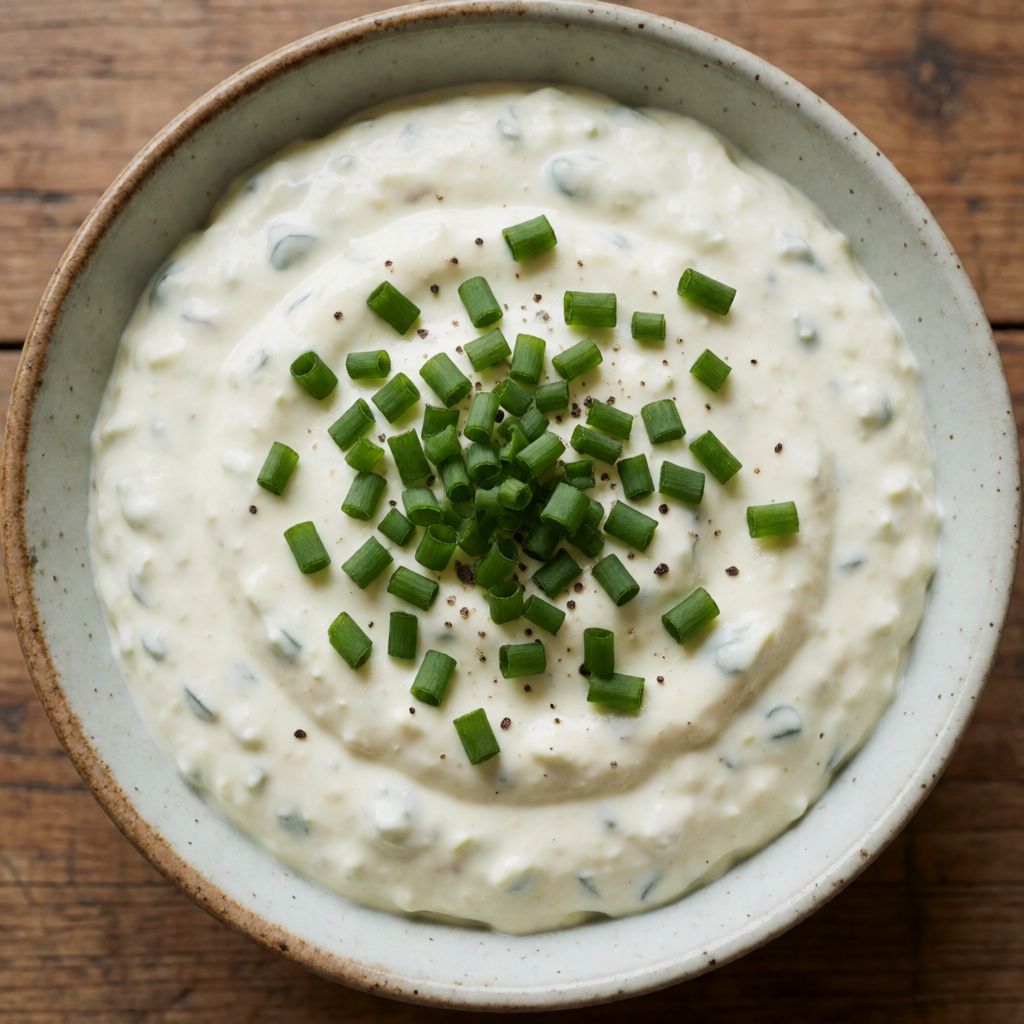
 AI photo
Fish Roe Dip with Crisps
A creamy dip of fish roe and chives, served with potato crisps.
Labels are worked out automatically from the ingredients and can be wrong. Check the packaging if it matters to you.
Ingredients
- 150 ml Crème fraîche
- 0.5 pcs Lemon juice and finely grated zest
- 200 g Lumpfish roe
- 100 ml Chives finely chopped
- Salt to taste
- Black pepper freshly ground, to taste
- 130 g Potato crisps






Steps
Mix the crème fraîche, lemon juice, lemon zest, salt and pepper until smooth and creamy.
5 minStir in half of the lumpfish roe and the finely chopped chives, then spoon the mixture into a bowl.
2 minTop with the remaining roe, more chives and some freshly ground pepper.
1 minServe, for example, with potato crisps.
What was changed
We've used Lumpfish roe in place of the original roe, as it's much easier to find in UK supermarkets.
This isn't caviar, and it isn't trying to be. It's crème fraîche sharpened with lemon, studded with roe and chives, built to be scooped with a crisp before you've even switched the oven on — because nothing here gets cooked at all. The whole dish is one contrast: cold, rich cream against the salty little pop of fish eggs. That contrast is the only cooking happening, and it happens on your tongue, not in a pan.
What decides whether it works is how gently you handle the roe. Each egg is a tiny sac of brine and fish liquor held in by a membrane that gives way the second you press too hard. Fold it in, don't beat it. Stir rough, by accident or by habit, and you end up with a uniform grey-pink paste that tastes of salt and nothing else — all the pops gone, all the texture gone, and no amount of extra chive brings that back.
There's a myth worth naming here: that fish roe dip means posh food, a little cousin of caviar for people who can't run to sturgeon. No — lumpfish roe exists for the opposite reason. It's cheap, it's brined, it's dyed black or red because the real colour is a pale nothing, and it was invented precisely so ordinary kitchens could have the pop and the salt without the price. There's no shame in that economy. The dip is built around it and tastes exactly as good as that economy allows — which, handled right, is plenty.
Start with the crème fraîche, because the choice of dairy is really the choice of the whole texture. You want something thick enough to sit up on a crisp without sliding off, and acidic enough that it doesn't need much extra lemon to taste bright — but not so sharp that it curdles visibly the moment citrus hits it, the way single cream or some soft cheeses will. Crème fraîche is cultured, full-fat, and stable under acid for exactly that reason; it was built in French dairies as a way of using cream that had gone slightly sour on purpose, long before anyone thought to put fish eggs in it. If you haven't got it, the criterion to match is thick, cultured, mildly tangy, high fat — strained Greek yoghurt gets close, mascarpone loosened with a spoon of lemon juice gets close from the other direction.
Lemon does two separate jobs that people tend to collapse into one. The juice is acid, cutting the fat so the dip doesn't sit heavy on the tongue. The zest is aromatic oil, carrying lemon smell without adding any more liquid to loosen the mix. Some will tell you bottled lemon juice does the same job — no, because what you lose isn't the acid, it's the zest oil, and that's half the point of reaching for a lemon at all. Grate the zest first, before you juice, and take only the yellow — the white pith underneath is bitter and will sit wrong against the fish.
Lumpfish roe is lumpsucker fish eggs, brined for keeping, then dyed black or red because their natural colour is a flat, unappetising grey. Look in the jar before you buy: you want the eggs separate and glistening, not clumped together in their own liquid, which is usually a sign they've started breaking down. If you can't find lumpfish roe specifically, any cheap brined roe — capelin, mullet — follows the same logic and works the same way. Diced smoked salmon is a fallback if roe genuinely isn't available, but understand the trade: you keep the salt and the smoke, you lose the pop entirely, and the dip becomes a different, flatter thing.
Chives go in raw and stay raw, so they need to carry their own sharpness without any cooking to soften or mellow them. The green tops of a spring onion are the nearest substitute if chives are out — criterion is a mild, grassy onion bite, not the raw harshness you'd get from a white onion, which would overpower the roe rather than sit alongside it.
Crisps matter for structure, not flavour. You need something thick enough or ridged enough to carry the weight of the dip to your mouth without snapping halfway there — the crisp equivalent of a carrot that bends rather than breaks. Flavoured crisps fight the salt already in the roe, so go plain. If you want something closer to how roe has traditionally been served in the UK, buttered brown bread cut into triangles, or blinis, does the job with less crunch and more history behind it — crisps are just the modern, lazier stand-in, and there's no shame in using them, only worth knowing what they replaced.