
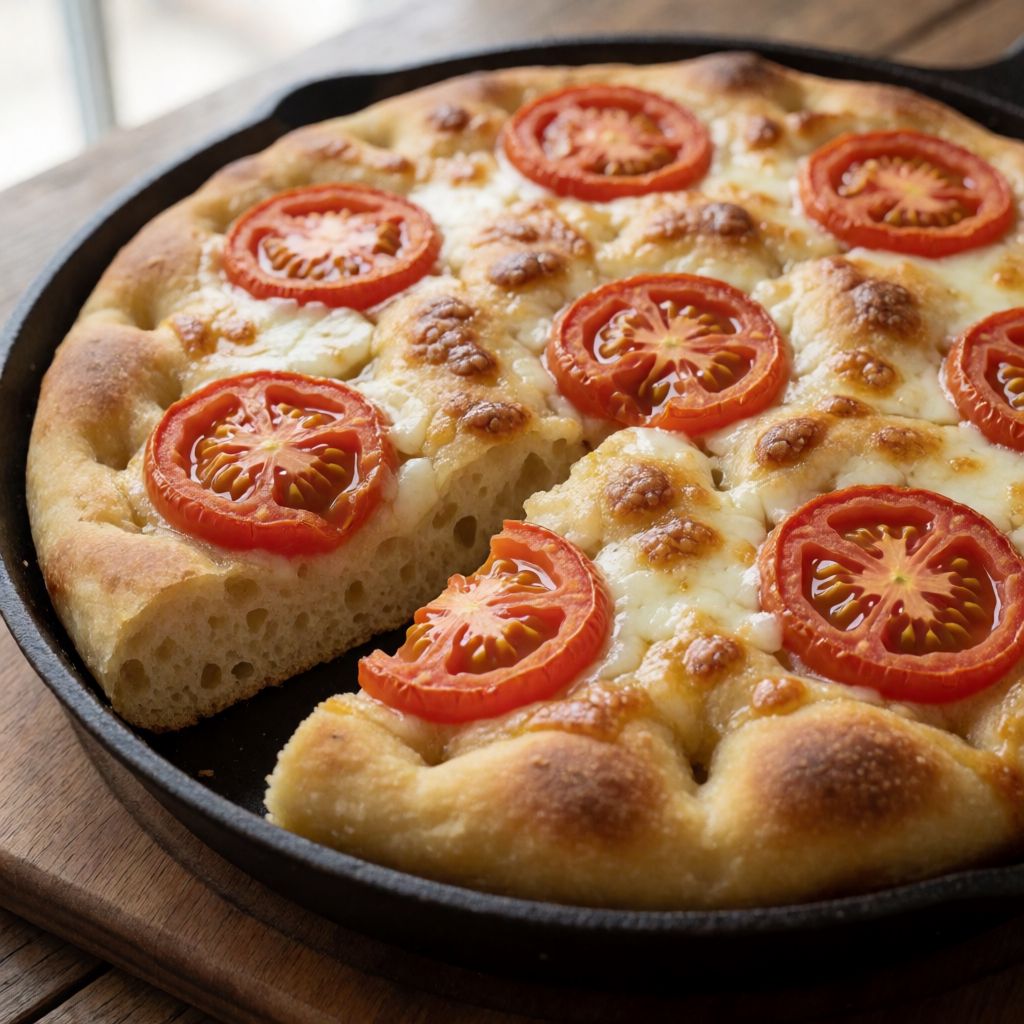
 AI photo
Skillet Focaccia with Pizza Flavours, Filled with Tomato and Mozzarella
A quick skillet focaccia with a pizza twist, filled with tomato purée and mozzarella and cooked entirely on the hob.
Labels are worked out automatically from the ingredients and can be wrong. Check the packaging if it matters to you.
Ingredients
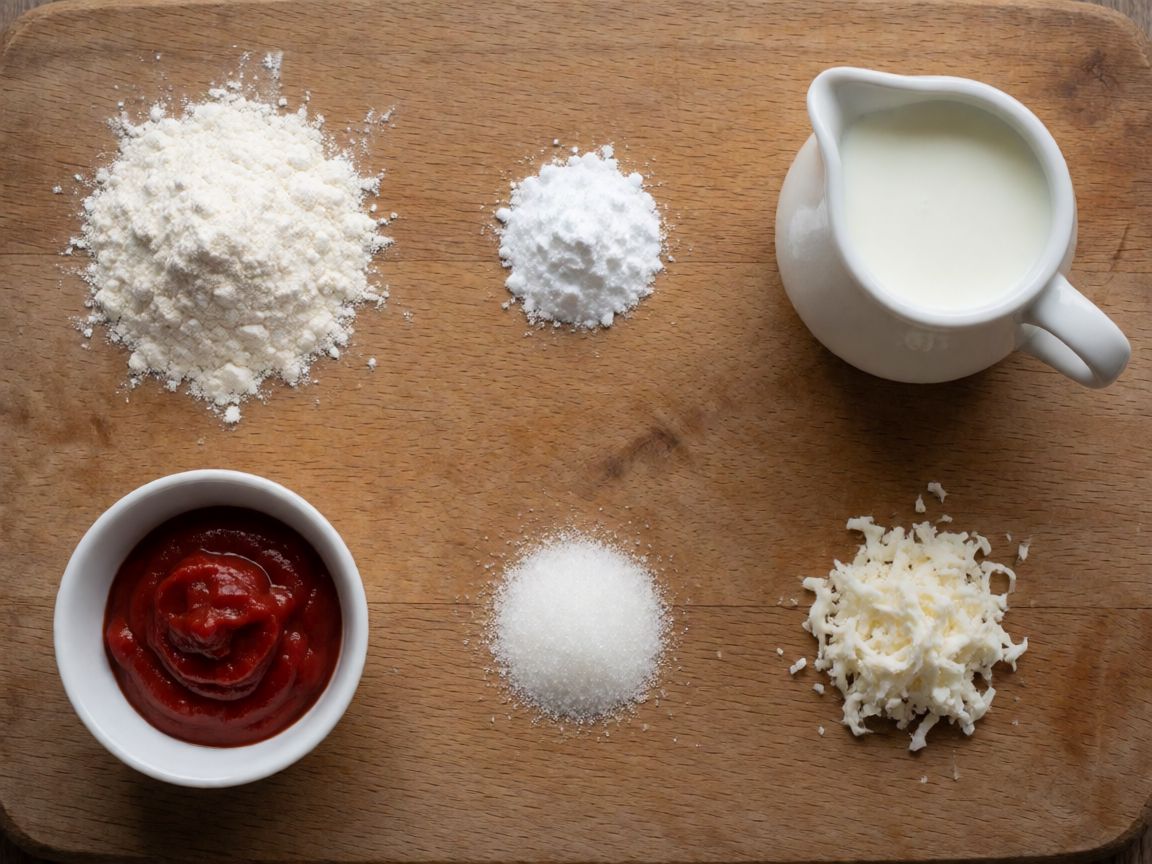
- 250 g Flour
- 8 g Baking powder
- 120 g Water
- 2 tbsp Milk
- 1 pinch Salt
- 1 pinch Sugar
- Olive oil to taste
- Tomato purée to taste
- 100 g Mozzarella








Steps
In a bowl, mix the flour with the baking powder, a pinch of salt and a pinch of sugar. Add the water and milk.
Stir with a spoon, then knead by hand until the dough is firm and elastic.
Divide the dough into two pieces and roll out with a rolling pin into circles the size of the base of your frying pan.
Pour the olive oil into the pan and spread it evenly with a pastry brush.
Place the larger dough disc in the pan and fill with tomato purée and sliced mozzarella.
Cover with the smaller dough disc, pinch the edges together and press down with a fork.
Cover the pan with a lid and cook over low heat.
5 minFlip the focaccia and cook on the other side.
7 min
This is not focaccia in the Genovese sense — that one ferments for hours, gets dimpled by hand, drowned in olive oil, and baked in an oven hot enough to set the crust in a few minutes flat. What you have here is quicker and more honest about what it actually is: a flatbread stuffed with tomato and mozzarella, risen by baking powder, cooked under a lid in a frying pan like an oversized filled pancake. The name borrows some prestige; the method belongs to a different family entirely — closer to a Georgian khachapuri or a Turkish gözleme, sealed pies cooked on heat rather than in it.
What decides whether this works is not the dough, which is forgiving, but the seal at the edge and the lid on top. Pinch the rim loosely and the tomato purée finds the gap as it warms, leaks down, and you get a soggy underside sitting in its own juice instead of browning. The fork marks round the edge aren't decoration — a pinch alone relaxes as the dough heats through; the fork locks the seam so it holds against the filling pushing outward.
The dough isn't bread dough, whatever the name implies — it's a quick batter-dough lifted by baking powder, the same mechanism behind a scone: an acid-base reaction set off by moisture and heat, not yeast slowly feeding on sugar. That's the entire economic point of the dish — no proofing, no standing around waiting for fermentation, because this is meant to go from bowl to pan to table inside an hour, on a stove, with no special equipment. Some say a dough this fast doesn't need kneading, that kneading is only for yeast bread chasing a rise — no, because here the kneading does a different job: it makes the dough elastic enough to be rolled thin and sealed round a wet filling without tearing open at the seam. The rise comes from the powder; the kneading is structural, nothing to do with air.
Flour can be the plain flour already in the cupboard — you're not after chew here, you're after a dough that rolls out thin and holds its seal. Strong bread flour works too, just knead it a touch less, since it tightens up faster than plain. Baking powder, though, has no honest substitute in this recipe: bicarbonate alone needs an acid to react against — buttermilk, yogurt, lemon — and none of that is here, so swapping it in without an acid simply won't lift the dough.
Water and milk together: water gives structure, milk gives a little fat for softness and colour. Any liquid with some fat in it does the same job — if all you've got is water, stir a spoon of oil into the dough itself and you'll land in roughly the same place.
Tomato purée wants to be thick, close to paste, not a thin passata. A thin sauce means more liquid sitting behind that seal, which is exactly the leak problem the fork marks are fighting. If what you've got is watery, cook it down on the hob for a couple of minutes first, until it sits on a spoon rather than running off it.
Mozzarella here is doing a job, not carrying flavour, so the cheap block sold for pizza topping actually performs better than the soft ball in brine — it holds less water, so it won't flood your seal from the inside as it melts. If a ball of fresh mozzarella is what you have, pat it properly dry and don't overfill, or you're fighting the leak twice over.
Olive oil in the pan isn't there to flavour the dough — it stops the bottom sticking and gives you a thin fried crust rather than a steamed, pale one. Any oil with no strong smell of its own does the same thing: sunflower, rapeseed, whatever's already open. Keep the good extra virgin for drizzling over once it's out of the pan, where you can actually taste it. And treat patience here as a real ingredient, small as the dish is — lifting the lid every thirty seconds to check lets the trapped steam straight out, and you're back to cooking with heat from underneath alone, which is the exact problem the lid was there to solve.