
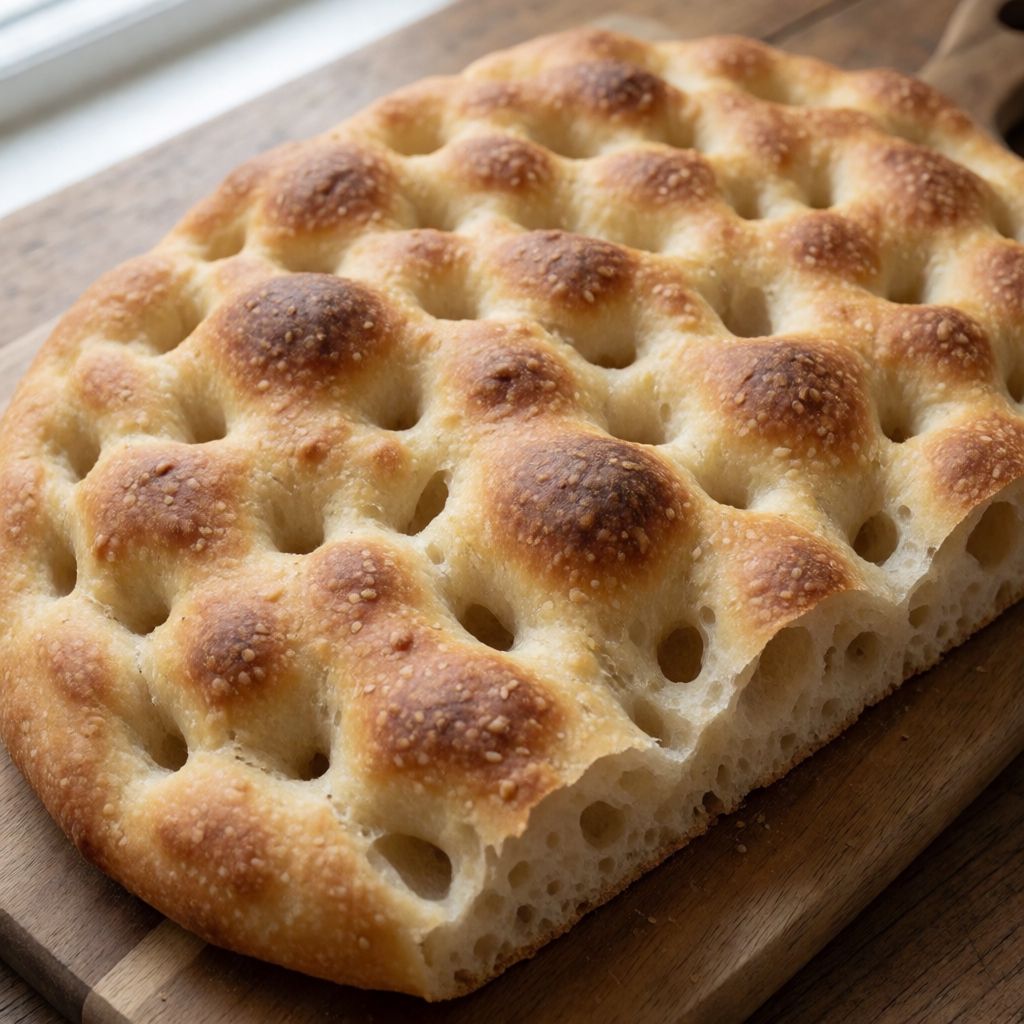
 AI photo
Sourdough Focaccia
A soft, airy focaccia made with active sourdough starter, dimpled with olive oil and sea salt.
Labels are worked out automatically from the ingredients and can be wrong. Check the packaging if it matters to you.
Ingredients
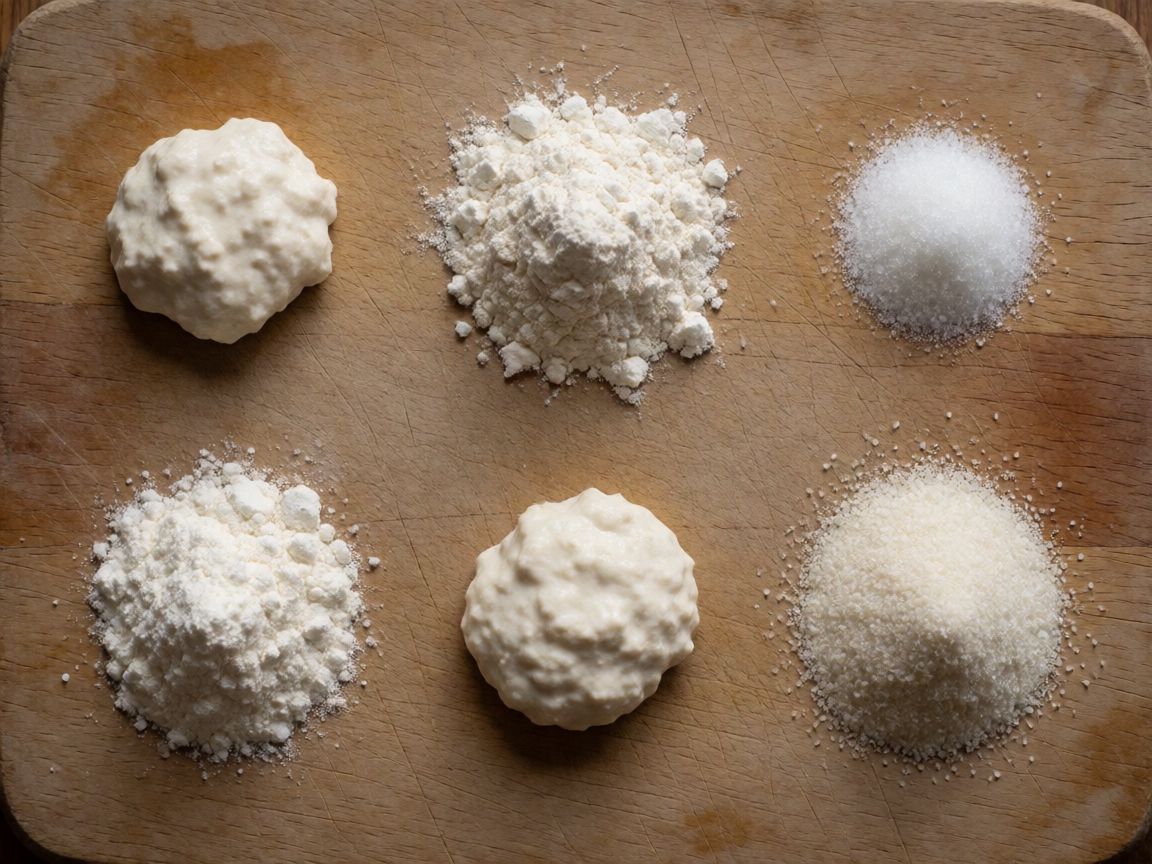
- 80 g sourdough starter
- 80 g plain flour
- 35 ml water
- 600 ml water
- 2 g caster sugar
- 290 g plain flour
- 200 ml water
- 85 g sourdough starter
- 7 g salt
- plain flour semolina or rice flour, to taste
- 50 g olive oil
- 60 ml water
- 5 g salt





Steps
Refresh the starter: mix 80 g sourdough starter, 80 g plain flour and 35 ml water, knead, roll out with a rolling pin, roll up into a log a few times, shape into a bar with two criss-cross cuts and place in a jar to double in size.
Cut 85 g sourdough starter into pieces and soak in 600 ml water with 2 g caster sugar for 1 hour, then squeeze out and weigh 85 g.
60 minMake the dough: mix 290 g plain flour and 200 ml water, add the starter and 7 g salt, stir with a wooden spoon, cover and leave to rise for 30 minutes.
30 minFold the dough: stretch an edge of the dough, fold it in half, turn 90° and repeat on all 4 sides, tuck the edges underneath, cover with cling film.
Leave the dough to rise for 20-30 minutes, repeat the folding three times at 20-30 minute intervals.
25 minGrease a bowl with olive oil, dust the dough with flour, leave to rise until doubled in volume.
Transfer the dough to a table dusted with semolina flour, stretch it out with your fingers and place onto a greased 30x40 cm baking tray.
Leave the dough for 30 minutes at room temperature, covered with a clean tea towel.
30 minMix 60 ml water, 50 g olive oil and 5 g salt, whisk well with a hand blender, pour over the focaccia, spread with your hands and make dimples with your fingers.
Bake in a preheated oven at 225°C for about 15 minutes.
15 min
What was changed
The oven is set to for one exact temperature rather than the original range.
Focaccia is not bread with oil poured on top. It's bread built around oil and water held in suspension together, and that emulsion is what gives you the craters and the crust that shatters slightly before it chews. If the dough doesn't end up slack and wet — properly sticky, not "a bit tacky" — none of the rest matters. Everything here, from the starter refresh to the four folds, exists to get a dough that's too loose to shape by hand but strong enough not to collapse when you dimple it.
The thing that decides success isn't the oven, it's the gluten you built before the oven ever gets switched on. A stiff dough gives you a flat, dense slab with a tight crumb — that's focaccia gone wrong, and it's always a hydration problem, not an oven problem. A wet dough, properly folded rather than kneaded, traps air in big uneven pockets, and that unevenness is the point: holes of different sizes mean you handled it gently and let fermentation do the work instead of forcing it with your hands.
Some say you need a stand mixer for a dough this wet. No — you need patience and a wooden spoon, because wet dough doesn't want kneading, it wants folding at intervals, which builds strength without knocking out the air you're trying to keep. This is a recipe that punishes impatience and rewards nothing else.
The starter-feeding step at the start looks like faff but it's doing one job: giving you a starter active enough to lift 290 g of flour without stalling halfway. Skip it and you're gambling on however lively your jar happens to be that day.
Two starters appear in this recipe and that's not a mistake — one gets refreshed and shaped into a loaf-like test to prove it's strong (that criss-cross cut, that doubling in the jar, is your proof it's ready to leaven anything), the other gets soaked apart in sugar water. That soak isn't about feeding — it's a dilution trick. Soaking and squeezing the starter softens and spreads its yeast activity evenly through liquid before it meets the flour, instead of dropping in one dense lump that would leaven unevenly, strong in the middle, weak at the edges. The sugar in that water is a trace amount, just enough to wake the yeast a little faster — it's not sweetening anything.
The flour is just plain flour, twice — once for the starter paste, once for the dough — and that's deliberate simplicity. You don't need bread flour's extra protein here because the long folding and resting does the strength-building that kneading would otherwise do in a stiffer dough. If you only have strong bread flour, use it, but add a touch more water — higher protein drinks more.
Water appears in four different places and each one has a different job: the 35 ml binds the starter paste, the 600 ml is a soaking bath (most of it gets poured away, only the squeezed starter matters), the 200 ml hydrates the dough itself, and the 60 ml at the end isn't dough water at all — it's the base of an emulsion with the oil. That last mix, whisked hard with a hand blender, is what makes the olive oil cling to the surface instead of pooling and frying one corner of your focaccia while the rest stays pale. Without proper whisking you get patches, not a sheen.
Salt does two jobs, split in two amounts for a reason: 7 g goes into the dough to slow fermentation down and tighten the gluten network so it can hold gas rather than collapse; 5 g goes into the topping emulsion, dissolved rather than sprinkled, so you don't get salt-burnt spots where crystals sat. If you only have table salt, use slightly less — it's finer and saltier gram for gram than coarse sea salt.
Olive oil needs to be one with actual flavour here, unlike most baking where you want neutral oil — this is one of the rare times the oil is a stated ingredient of taste, not just a non-stick measure. If you must substitute, use any good cold-pressed oil without a strong flavour of its own only as a last resort — the character of the crust depends on it.
On semolina or rice flour for dusting: this isn't decoration, it's ball-bearings. Plain flour dusting absorbs moisture and gums up against wet dough, semolina or rice flour stays gritty and lets the dough slide off your hands and off the table without sticking — useful given how slack this dough is.
On your oven: 225°C is hot enough that most UK domestic ovens will run close to their ceiling, and that's fine — this bake wants aggressive top heat fast, to set the crust before the crumb overdries. If your oven runs cooler than its dial claims (most do, by a surprising margin), give it the full heat-up time before the tray goes in rather than trusting the preheat light.
A 30x40 cm tray matters more than it sounds — too small and the dough piles up thick and steams instead of crisping; stretch it out properly with your fingers rather than a rolling pin, because pressing flat with a pin knocks out the air bubbles you spent two hours building, while fingertips just nudge the dough sideways and leave the gas pockets where they are.