
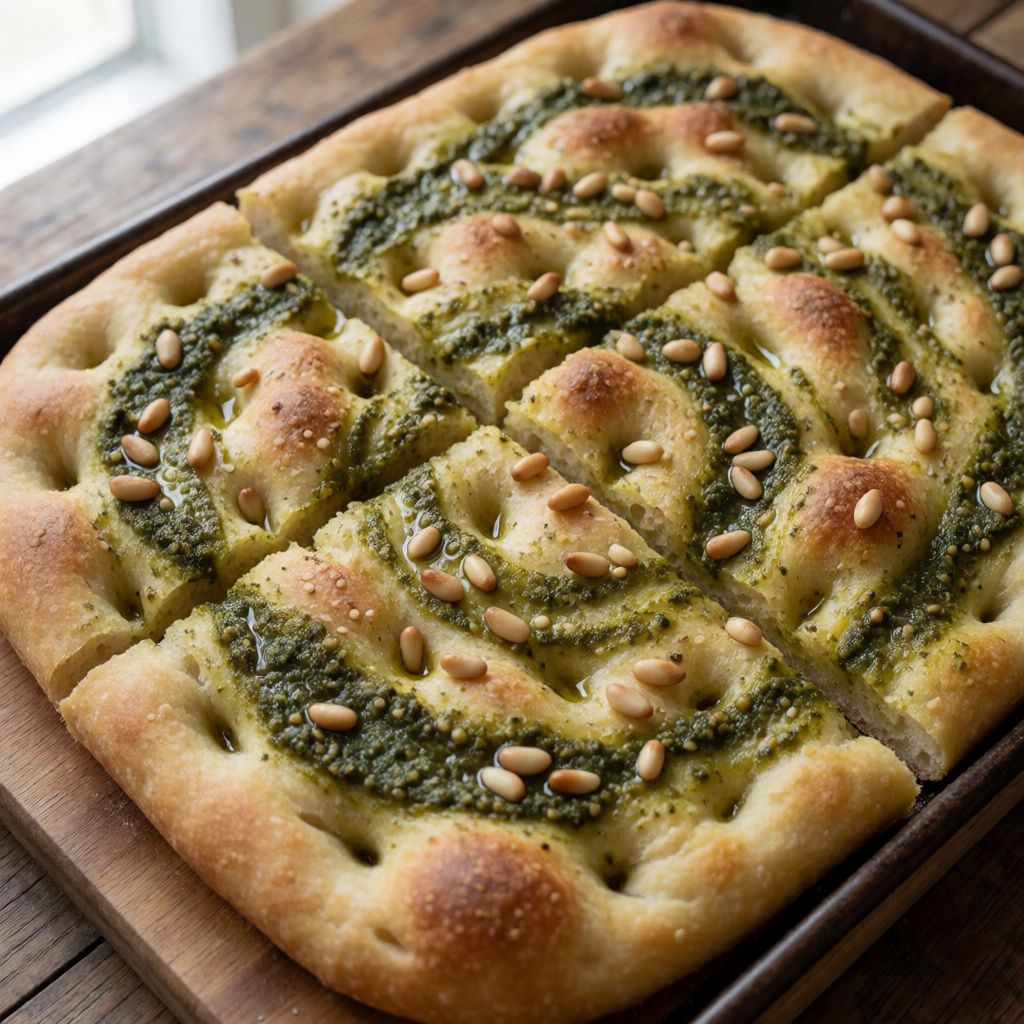
 AI photo
Pesto Focaccia
A soft Italian-style focaccia topped with pesto, finished with soft cheese, thin bacon and a pumpkin cream.
Labels are worked out automatically from the ingredients and can be wrong. Check the packaging if it matters to you.
Ingredients
- 360 g strong white flour
- 4 g Yeast crumbled
- 6 g Salt
- 250 ml Water
- 8 g Pine nuts
- 40 g Pesto
- 35 ml Water
- 2-3 g Salt
- 25 ml Olive oil
- soft cheese
- bacon thinly sliced
- pumpkin cream






Steps
In a large bowl combine the strong white flour, crumbled yeast and about half the water. Start mixing with a wooden spoon.
Add the pine nuts, salt and the remaining water.
Thin the pesto with the remaining water and pour into the dough. Mix until smooth, then knead by hand for a few minutes.
Cover the bowl with a tea towel and leave to rise at room temperature.
30 minTurn the dough onto a work surface and fold it: stretch the edges of the dough and fold them over themselves, repeating on all sides, then gather the dough with your hands.
Return the dough to the bowl, cover with a tea towel and leave to rise.
20 minRepeat the folding twice more, greasing the base and sides of the bowl with olive oil just before the final rest.
Leave to rise at room temperature for at least 1 hour.
60 minTurn the dough onto a surface dusted with semolina or rice flour, and stretch it out by pressing with your fingers.
Remove excess flour and place the dough into a 30x40 cm tray greased with olive oil. Leave to rest.
60 minMix water, olive oil and salt; pour this mixture over the dough and spread it over the whole surface, pressing with your fingers.
Bake in an oven preheated to its maximum temperature.
15 minRemove the focaccia and spread the soft cheese over half the tray. Return to the oven for 3-4 minutes.
4 minDecorate the other half with thinly sliced bacon and pumpkin cream. Bake for a couple more minutes.
What was changed
The soft certosa cheese has been swapped for soft cheese, a similar soft cheese that is easier to find in UK shops.
Focaccia isn't bread with stuff on top — it's a wet dough you deliberately undermix, then let the folds do the kneading for you. At 69% hydration (250ml water to 360g flour, plus what's in the pesto) this dough is slack, almost sloppy. You can't knead it properly on a worktop without it welding itself to your hands. So you don't. You fold it — stretch the edges over the middle, turn, repeat — and you let time build the structure that force would otherwise have to.
What decides whether this works is the air, not the oven. Each fold traps a new layer of gas bubbles inside gluten sheets that are getting stronger with every rest, not because you're "developing" them by bashing the dough, but because wet flour given time hydrates and the gluten links up on its own — Jim Lahey built a whole no-knead bread cult on exactly this fact. Skip the folds or rush the three rises and you get a flat, dense slab that bakes into something closer to a thick cracker than the open, holey crumb a good focaccia has.
The second decision point is the oven. You need it as hot as it goes, full stop — this is a 15-minute bake because the heat has to hit the dough hard enough to set the crust and inflate those trapped bubbles before the structure collapses. A UK domestic oven tops out lower than the ovens this method was built around, and your fan oven runs hotter and drier than a traditional one — so expect a touch more colour at the edges and check at the lower end of the time, not the stated minutes as gospel.
Strong white flour (360g) is non-negotiable here, not snobbery — "strong" means more protein, which means more gluten, which means the dough can actually hold the gas from three long rises without tearing into a flat puddle. Plain flour will rise once, gamely, then give up by fold two. If you've only got plain flour in the cupboard, you're better off reaching for bread flour at the shop than pushing on — this dough asks a lot of its gluten.
The yeast (4g, crumbled) is doing a slow job across roughly two and a half hours of resting, not a fast one. That's why it's crumbled in cold, not dissolved in warm water, and why there's no rush to "activate" it with heat — at room temperature it works steadily, and steady is what gives you the big irregular bubbles rather than the tight, even crumb you'd get from forcing a fast rise with extra heat. Patience is genuinely the main ingredient in this list; everything else just flavours what the time builds.
Salt appears twice for different reasons. The 6g in the dough controls the yeast's pace and firms the gluten network — too much salt too early and you slow the yeast right down, which is why it goes in with, not before, the bulk of the liquid. The 2-3g in the water-and-oil mixture poured over the top near the end is seasoning for the crust itself, since the inside of the dough never really tastes the outside unless you salt the surface directly.
Pine nuts (8g) and pesto (40g) are mixed straight into the dough rather than scattered on top, which tells you something: this isn't a focaccia that's decorated, it's one that's flavoured all the way through, closer to a herb bread than a plain base with pesto smeared on at the end. The pesto gets thinned with water before going in — pesto on its own is too oily and too thick to distribute evenly through a wet dough; thinning it lets it marble through properly instead of sitting in oily streaks.
Olive oil shows up three times and each has its own job — greasing the bowl (stops the dough sticking as it rises, not flavour), greasing the tray (so the base fries slightly against the hot metal rather than steaming and going soft), and in the water mixture poured over before baking (this is what gives focaccia its characteristic dimpled, slightly crisp top — without it you get a dry crust instead of that glossy, salty skin). Use any oil with no smell of its own if you must substitute for the tray — a neutral oil won't hurt the texture — but for the topping and dough itself, you want an olive oil you'd actually taste, because here it's not just lubrication, it's flavour.
Semolina or rice flour under the dough before it goes in the tray is there to stop sticking without working more flour into the dough itself — plain flour would do the same job but risks getting kneaded back in as you handle the dough, toughening the parts it touches. Semolina stays put as a dusting and gives a little extra crunch on the base, which is a nice bonus rather than the point.
The toppings — soft cheese, bacon, pumpkin cream — go on after the first bake, not before, because the dough needs its own dry heat to set and rise properly; wet toppings on raw dough would stop the base ever crisping and you'd get a soggy middle under a nice crust. Soft cheese melts in a few minutes at the same high heat; bacon and pumpkin cream need less time still, since you're warming and glazing them rather than cooking them from raw — bacon this thin will crisp quickly on its own, and pumpkin cream just needs to heat through and not go dry.