
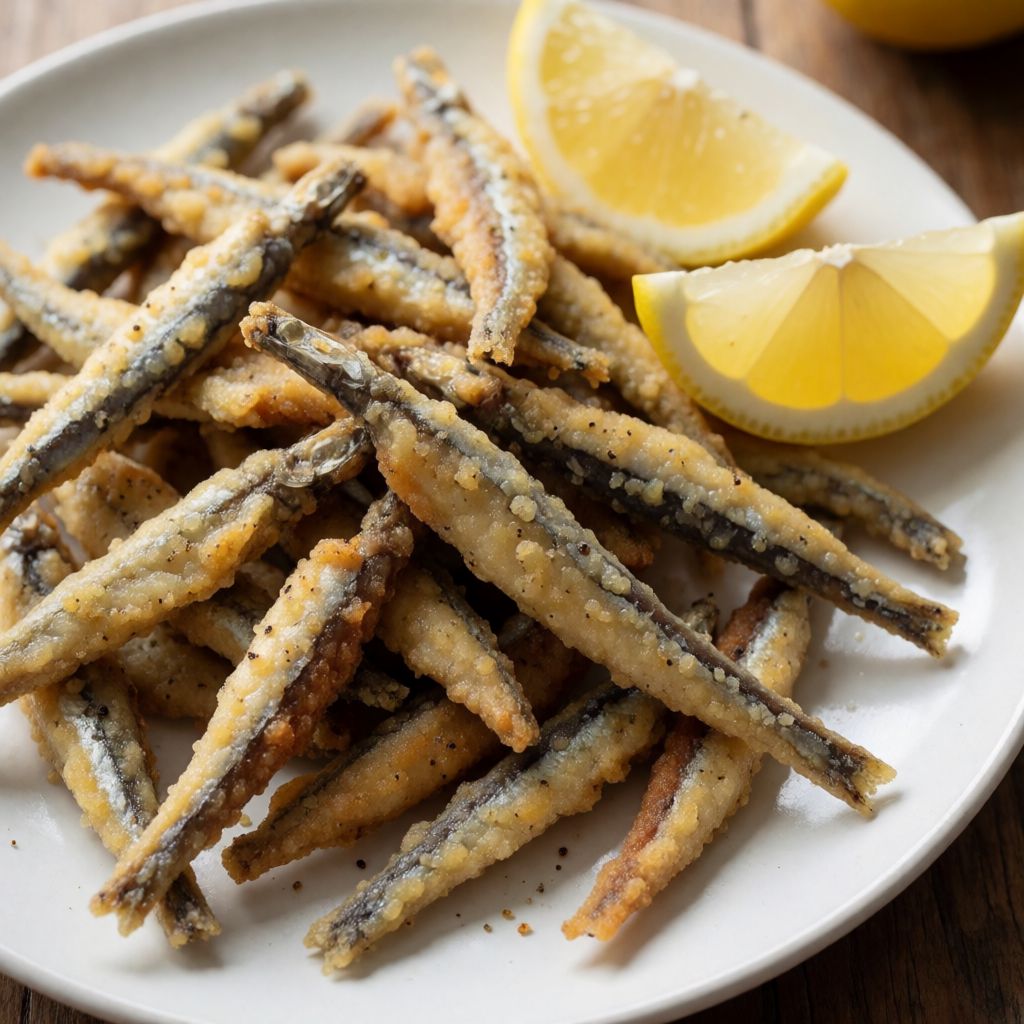
 AI photo
Fried Anchovies
Crispy pan-fried anchovies, coated in flour and finished with a squeeze of fresh lemon juice.
Labels are worked out automatically from the ingredients and can be wrong. Check the packaging if it matters to you.
Ingredients
- 500 g Fresh Anchovies
- 1 pcs Lemon
- Plain Flour for dredging
- Peanut Oil for frying
- Salt to taste
- Black Pepper to taste




Steps
If necessary, clean the anchovies, removing the guts and heads.
Coat each fish in flour on all sides.
In a large non-stick frying pan, pour in the peanut oil and heat it well.
Add the anchovies and fry, turning carefully, until golden brown on all sides and the temperature reaches 63°C.
Place the anchovies on a plate lined with paper towel to remove excess oil.
Season with salt and black pepper.
Serve the anchovies hot, sprinkled with a few drops of lemon juice.
Fried anchovies are not a recipe so much as a timing trick: cover something delicate in flour, drop it into oil that's already hot, and get it out before the inside overcooks while the outside is still turning gold. That's the whole mechanism. Everything in the method exists to protect that one small window.
What decides whether it works is the oil, not the fish. If the oil isn't properly hot when the anchovies go in, the flour coat won't seal fast — it'll sit there turning gummy, soaking up oil instead of crisping against it, and the fish steams inside its own jacket instead of frying. You want the oil shimmering and moving before anything touches it; a scrap of flour dropped in should sizzle and float up at once, not sink and sulk.
Doneness here isn't a clock, it's a colour and a feel. The crust goes from pale flour-white to a deep gold, almost amber at the edges. Push a fork into the flesh and it should give — soft, opaque, white right through, not the dull translucent grey of raw fish. The 63°C some recipes quote is just a number standing in for that moment; nobody is sliding a thermometer into a sardine-sized fish mid-fry. Trust your eyes and a prod with the fork instead.
Anchovies, fresh — not the salted tinned kind, which are a different food entirely, cured and intense. Fresh anchovies are soft, oily, small, and perishable fast, which is exactly why they were historically fried the same day they were caught rather than kept. If your fishmonger doesn't have them (and in most of the UK that's the normal case, not the exception), whitebait or small sprats behave the same way under flour and hot oil — same small bones, same quick fry, same rule about watching colour, not the clock. Don't bother filleting them: the bones in a fish this size go soft and brittle in the oil and are no trouble to eat, and boning them is wasted work for no gain.
Flour is there to do one job: give the oil something to grip and crisp, and to seal the surface fast so moisture inside the fish turns to steam that cooks it, rather than oil that soaks in. A thin, even coat matters more than a thick one — shake off the excess, because a heavy clumped coating burns on the outside before the fish underneath is even warm. Plain flour works because it has no flavour of its own to argue with the fish.
Peanut oil is specified for one reason: it has no smell or taste of its own and takes real heat before it starts to smoke or turn bitter. That's the whole criterion for a frying oil — flavourless, and a smoke point you won't reach on a domestic hob before the fish is cooked. Sunflower or rapeseed oil both pass that test and are easier to find in a British kitchen; olive oil does not — it has its own smell, and it starts breaking down at a lower heat, so it'll taste burnt before your fish is golden.
A non-stick pan matters more here than it would for a steak, because a home hob rarely gets hot enough to sear a crust onto fish fast the way a professional burner does — without the non-stick surface, delicate fish skin will tear itself apart trying to peel off the metal. Paper towel after frying isn't fussy kitchen theatre; it pulls off the surface oil that would otherwise sit and make the crust go limp while it waits to be served.
Lemon goes on at the end, not before, and that's deliberate. Lemon juice is an acid — add it to raw fish and it starts changing the flesh on contact, the way it does in a ceviche, and the flour won't sit properly on a surface that's gone slightly cooked and wet. Squeeze it on at the table, over the hot fish, and it lifts the oil rather than fighting the coating.
Salt and pepper go on after frying too, for a plainer reason: salted fish release moisture, and that moisture meeting hot oil is what makes it spit and the crust go patchy. Season the finished fish, hot off the paper towel, and you keep the crust intact and the kitchen counter clean. None of this needs rushing — the whole dish takes thirty minutes because frying in batches without crowding the pan is what keeps the oil hot and the fish crisp, and that's patience doing real work, not decoration.