
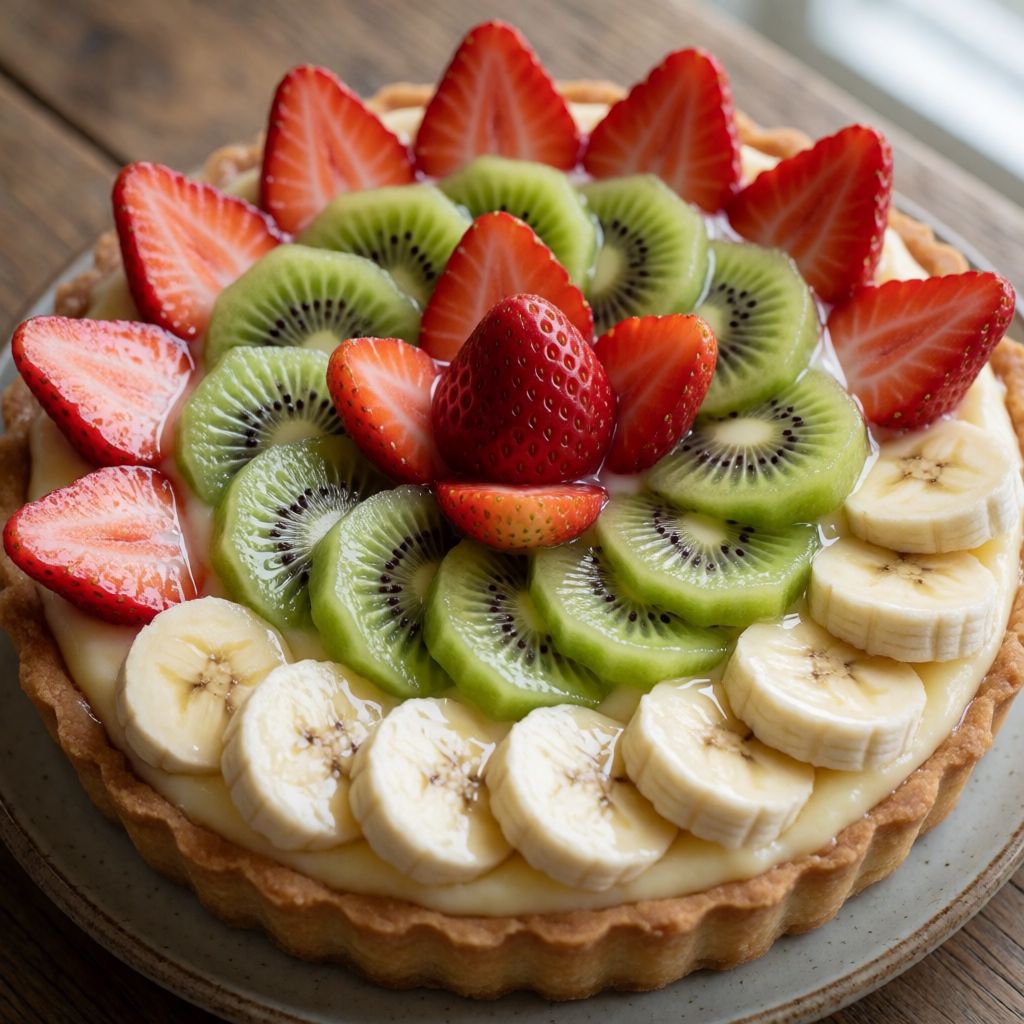
 AI photo
Fruit Tart
A fresh fruit tart with a shortcrust base, pastry cream and a sponge layer, topped with fruit of your choice.
Labels are worked out automatically from the ingredients and can be wrong. Check the packaging if it matters to you.
Ingredients
- 300 g Shortcrust pastry
- 200 g Pastry cream
- 1 pcs Sponge cake layer
- Strawberries to taste
- Kiwi to taste
- Banana to taste
- 1 pinch Icing sugar for dusting, to taste

Steps
Roll out the shortcrust pastry with a rolling pin to a thickness of 1 cm, dusting with flour so it does not stick.
Line a 22 cm baking tin with the pastry, pressing it firmly into the base and up the sides.
Trim off the excess pastry with a knife.
Prick the centre of the pastry with a fork.
Bake in an oven preheated to 185°C until the pastry is golden.
45 minLet the pastry cool completely, then carefully remove it from the tin.
Spread a thin layer of pastry cream over the base.
Slice the sponge cake layer into pieces 2-3 cm thick and arrange over the pastry cream.
Cover the sponge with another layer of pastry cream.
Decorate the top with sliced fresh fruit of your choice.
If you like, dust the finished tart with icing sugar or brush with apricot jam or honey.
This is a tart built in layers for a reason, not for show: a shell that can hold weight, a cushion of cream that stops the sponge going soggy too fast, a slab of sponge that bulks it out cheaply, and fresh fruit on top because fruit cooked inside this tart would just weep and ruin the cream underneath. Whether it works comes down to one thing above all: does the shell have structural integrity, or does it collapse into crumbs the second a knife touches it. That depends almost entirely on how the pastry was baked and rested.
Blind baking without weights here relies on the fork pricking and the thickness of the dough — 1 cm is thick enough that it won't tear itself apart from steam, but it still needs an escape route, which is what the pricking is for. Skip that and you get a pastry case that puffs and blisters, with air pockets that crack under the first spoon of cream. "Some say" you need ceramic baking beans for every blind bake — no, because at this thickness, with a dough this short (meaning high in fat, low in gluten), the dough doesn't have the elastic memory to shrink and bubble the way a leaner pastry does. The fork is doing the beans' job.
Colour, not the clock, tells you when it's done: golden, not pale, not dark at the edges while pale in the centre. 45 minutes at 185°C is where it usually lands in a British fan or conventional oven, but ovens lie, especially older ones in rented flats, so treat that number as a floor, not a finish line.
The shortcrust itself is doing a specific job: fat coating flour so gluten barely develops, which is why it shatters rather than chews. If you're making it rather than buying it ready-rolled from the chiller aisle (common enough in the UK, and nothing to be embarrassed about — commercial shortcrust is reliable and saves you a step), the fat should be cold and the dough handled as little as possible. Butter gives flavour; a butter-and-lard or butter-and-shortening mix gives a crisper, more fragile crumb, which is traditionally why older British pastry recipes lean that way — lard was cheap, butter wasn't, and the texture difference was a bonus discovered by accident, not design.
Pastry cream (crème pâtissière) is milk, egg yolk, sugar and a little flour or cornflour, cooked until thick. Its job in this tart is twofold: it's the glue between pastry, sponge and fruit, and it's a moisture buffer — a barrier that slows the sponge from soaking up damp from the fruit above and the slight grease of the pastry below. A "thin layer" at the base is deliberate: too much cream directly on a crisp base and you've built yourself a soggy-bottom problem, the single most common failure in any tart with a baked shell and a wet filling.
The sponge layer is not there to be tasted on its own — it's a cheap, absorbent spacer that lets you build height and gives the tart some bite without needing two full batches of cream. Any plain sponge works: Victoria sponge trimmings, a bought Madeira cake, even stale sponge, since it's about to be sandwiched in moisture anyway. If you've no sponge, a layer of crushed biscuit bound with a little melted butter does a similar structural job, though it changes the texture from soft to crumbly-crunchy.
Fruit goes on raw and at the end because heat and time are the enemy of both colour and texture here — cooked strawberries turn dull and release water onto the cream below; raw, they hold their shape and their red. Kiwi and banana are chosen as much for colour contrast and availability as flavour — swap freely for whatever's actually ripe: this is a tart that forgives substitution on top, because the fruit is decoration and freshness, not foundation.
The glaze — apricot jam warmed and brushed on, or honey — isn't just shine. It's a thin seal that slows the fruit's cut surfaces from drying and browning in the air, buying you a few more hours before the tart looks tired. Icing sugar dusted on does none of that; it's purely for the eye, and it's the one step here that's genuinely optional with no mechanism to defend.
On tin size for two people: 22 cm is generous for two but sensible if you want leftovers, since a tart this layered doesn't suffer from being cut again tomorrow — if anything, a night in the fridge lets the cream firm and the layers settle, which makes the second slice cleaner than the first.