
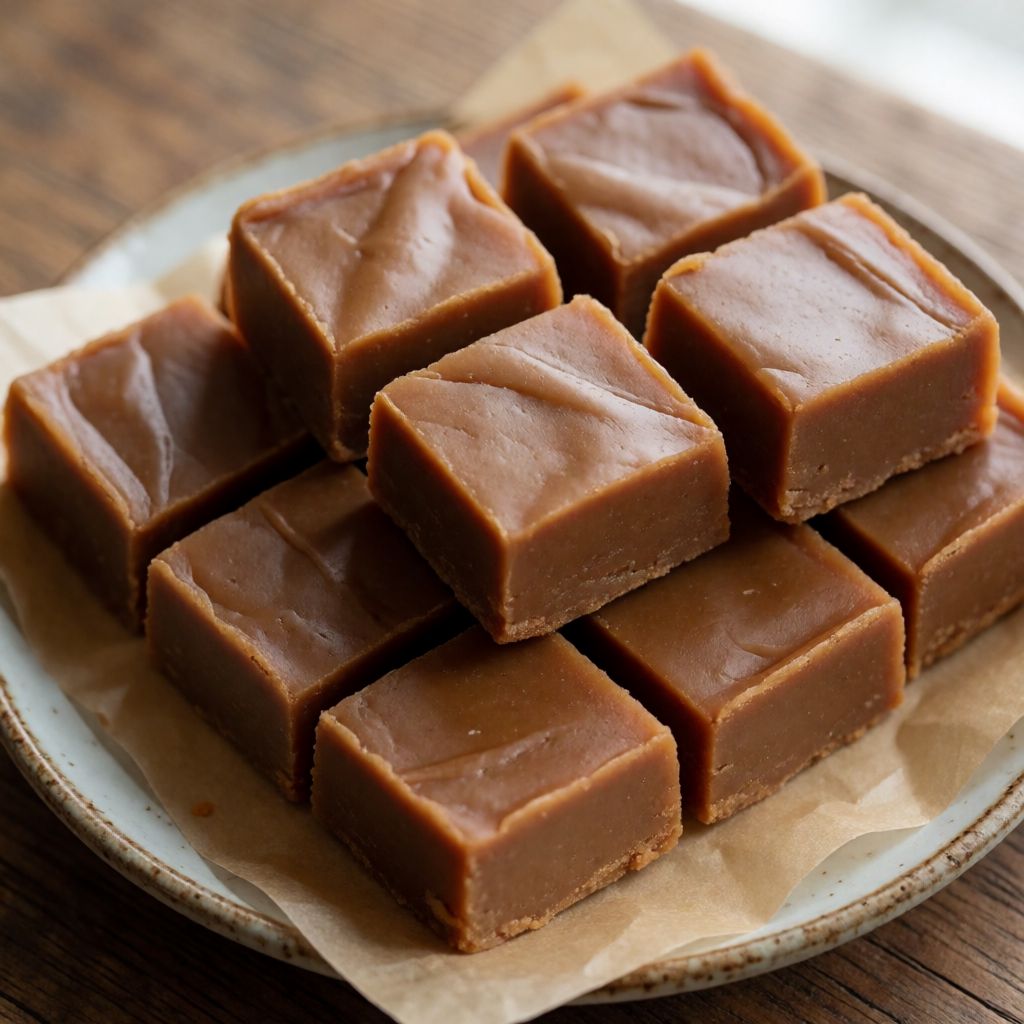
 AI photo
Fudge
A rich, creamy fudge made with condensed milk and butter, boiled until soft and cut into squares.
Labels are worked out automatically from the ingredients and can be wrong. Check the packaging if it matters to you.
Ingredients
- 400 g Condensed milk
- 100 g Butter
- 350 g Caster sugar
- 150 ml Milk
- 0.5 tsp Vanilla extract
- 1 pinch Salt






Steps
Put all the ingredients except the vanilla and salt into a saucepan and heat slowly, without stirring at first. Once the mixture starts to warm up, stir occasionally.
Stir occasionally until the temperature reaches 100°C.
Stir constantly until the temperature reaches 117°C.
Remove the pan from the heat, add the vanilla extract and salt, and mix well.
Pour the mixture into a stand mixer bowl fitted with the whisk attachment and beat on high speed for 10-15 minutes.
10 minSpread the mixture into a 20×20 cm tin lined with baking parchment and smooth the top.
Leave to cool until the next day, or for at least 6 hours.
360 minCut into squares about 2 cm in size.
What was changed
The vanilla powder has been swapped for Vanilla extract, which is easier to find in UK shops.
Fudge is not a poor relation of chocolate - there's no cocoa in this one at all. It's a sugar candy: a syrup cooked to a precise concentration, then forced to set as thousands of tiny crystals instead of a few big ones. Whether it melts smooth on the tongue or crunches like wet sand comes down to one number and one motion, and almost nothing else.
The number is 117°C. That's the point where enough water has boiled off the syrup that the remaining sugar, once disturbed, would rather turn solid than stay liquid. Stop short of it and the fudge never properly sets - stays a soft paste that slumps off a spoon forever. Push past it and the syrup's too dry: it sets glassy and hard, and starts tasting of scorched sugar rather than caramel.
The motion is beating it, hard, while it's still hot and just starting to want to crystallise. Beating shatters every crystal trying to form into something too small to feel on the tongue - that's the whole trick of fudge versus rock candy. Stop beating too soon and the slower, lazier crystals win: you get the grainy, sandy texture people shrug off as 'bad luck with fudge.' It isn't luck. It's unfinished beating.
Some say you should stir the pan the whole time so nothing catches - no, because stirring too early throws syrup up the sides of the pan, it dries there, and those stray dried crystals fall back in and seed the whole batch into grittiness before you're even near 117°C. That's why the recipe asks you to leave it alone at first and only start stirring once it's properly warm.
Caster sugar, not granulated, because the finer grain dissolves fully before the syrup gets hot enough to start forming crystals on its own terms. Granulated will work - it just takes longer to vanish, and every grain still clinging undissolved to the spoon or the pan wall is a tiny seed crystal waiting to ruin your smooth set. Rinse the spoon, don't leave it resting in the pan.
Condensed milk is doing a job that old fudge recipes did by simmering fresh milk down for an hour before the sugar even went in - reducing it, concentrating its proteins, building those faint caramel notes. Tinned condensed milk became cheap and shelf-stable in the early twentieth century and home cooks happily skipped the hour of reduction. That's the whole reason it's in modern fudge: not magic, just somebody noticing a shortcut that tasted just as good.
Butter is fat getting physically between sugar crystals as they try to find each other and clump. That's a second line of defence against graininess, on top of the beating. It also carries flavour that isn't replaceable by function alone - if you must go dairy-free, use a neutral baking margarine with the same fat content, but know you're trading away part of the taste, not just a texture detail.
Milk is simply water with a little fat and protein riding along, there to dissolve the sugar at the start. It boils off as you climb toward 117°C. Swap it for single cream if you want a softer, richer set - more fat slows the crystals down a touch, so the finished square feels less snappy, more yielding.
Vanilla and salt go in only once the pan's off the heat, and for the same reason: heat drives off vanilla's aromatics before you ever get a chance to taste them, and salt's job here isn't to taste salty, it's to sharpen the sweetness by contrast - a pinch, not a seasoning.
Use a heavy-based saucepan. A thin one develops hot spots on a domestic gas or electric ring, and the sugar touching that hot spot scorches before the rest of the pan even reaches 100°C - that bitter taint doesn't cook out, it stays. A clip-on sugar thermometer earns its keep here; without one, drop a little syrup into a cup of cold water at the point you think it's close - at 117°C it gathers into a soft ball you can flatten between two fingers, not a thread, not a puddle. A stand mixer isn't essential tradition, it's just mercy on your arm - beating a thickening, hot sugar mass by hand for ten minutes is real work, and the mixture starts fighting you as it sets. Line the tin with parchment rather than greasing it: bare metal and cooling fudge bond, and you'll be chiselling instead of cutting. And give it the full rest before you cut - the crystal structure keeps settling for hours after it looks set, and a knife through it too early just smears the squares instead of slicing them.