
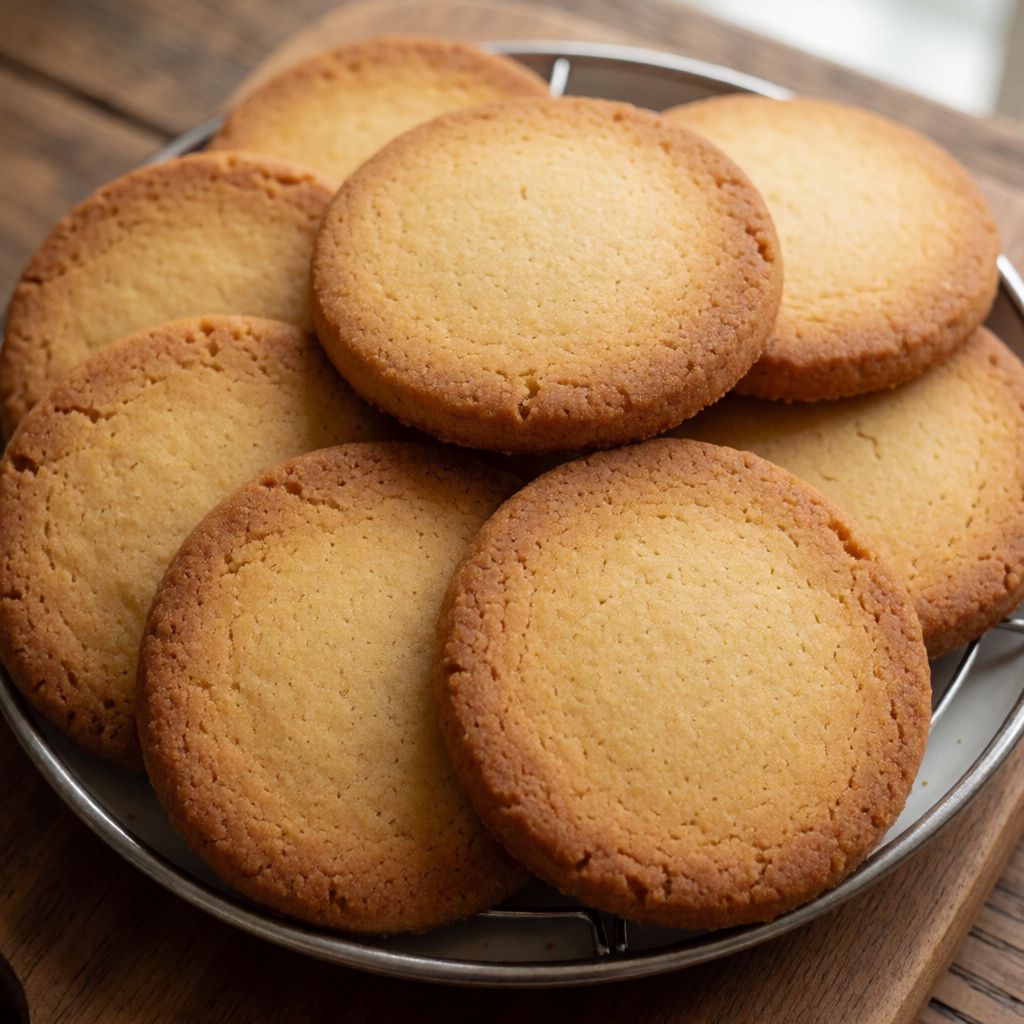
 AI photo
Ginger Biscuits
Small, warmly spiced ginger biscuits made with butter and maple syrup.
Labels are worked out automatically from the ingredients and can be wrong. Check the packaging if it matters to you.
Ingredients
- 100 g Butter
- 200 g Sugar
- 1 tbsp Fresh Ginger finely grated
- 60 g Maple Syrup
- 275 g Flour
- 1 tsp Baking Powder
- 0.5 tsp Vanilla Powder
- 2 tsp Ground Ginger
- 1 tsp Ground Cinnamon
- 1 pinch Ground Cloves
- 1 pinch Salt
- 1 pcs Egg










Steps
Put the butter, sugar, fresh ginger and maple syrup into a small saucepan and heat, stirring, until the butter melts.
3 minTake the saucepan off the heat straight away.
Mix the flour, baking powder, ground ginger, ground cinnamon, vanilla powder, ground cloves and salt in a clean bowl.
2 minStir the egg, along with the flour-spice mixture, into the saucepan with the warm butter-sugar mixture and mix everything well.
3 minRoll the dough into small balls about the size of a hazelnut and place on a baking tray lined with baking paper, leaving a little space between them.
5 minBake in a preheated fan oven at 175°C for 10–12 minutes.
11 minLet them cool on the tray.
This is a small, hard spice biscuit — the kind that turns up by the dozen on a plate with tea, because the recipe is built to be made in batches of seventy and forgotten about in a tin. What decides whether it works isn't the oven, it's the saucepan stage: you melt butter, sugar, maple syrup and fresh ginger together just until the butter gives up and goes liquid, and then you pull it off the heat immediately. Go a beat too far and the sugar starts to caramelise, which sounds nice until you realise it means the finished biscuit will be brittle and a bit bitter at the edge instead of evenly snappy. The saucepan is doing a job here that a cold mixing bowl can't: it's melting fat and sugar together so they coat the flour evenly, rather than creaming them, which is why this dough comes together in minutes instead of needing a stand mixer.
The second thing that decides the outcome is size and spacing on the tray. Hazelnut-sized balls, a little room between them — not because they spread dramatically, but because biscuits this small with this much butter will merge into one sheet of biscuit if they're touching, and then you can't tell when any individual one is done. Some say you should flatten them before baking "so they cook evenly" — no, because the point of a ball is that it collapses under its own fat as it bakes, giving you that slightly domed, cracked top. Flatten it yourself and you just get a flat biscuit with less character and no advantage.
Fresh ginger and ground ginger are doing two different jobs, not the same job twice. The fresh ginger, finely grated, goes into the hot butter and sugar — heat pulls its sharp, almost peppery oils out and mellows them into the fat, so you get a background warmth rather than a bite. The ground ginger goes into the dry mix with cinnamon and cloves, and that's the part that gives you the actual "ginger biscuit" flavour you recognise from the tin at Christmas — concentrated, a bit dusty, the kind of spice that needs no heat to release because it's already been dried and ground for exactly that. Leave the fresh ginger out and the biscuit tastes flatter even with the same amount of ground spice; leave the ground spice out and you lose the identity of the biscuit entirely, no matter how much fresh ginger you grate in.
Butter here is for flavour and for that short, sandy crumb — any flavourless, solid fat with a similar fat content would physically work, but butter is also what browns and smells like biscuits as it melts, which margarine or a neutral vegetable fat won't give you honestly. Don't swap for olive oil or anything with its own smell; the whole point of this dough is that butter carries the spice, it doesn't compete with it.
Maple syrup is here as a liquid sugar with its own flavour note and, just as importantly, as moisture — it's part of why this dough stays soft enough to roll into balls by hand rather than needing to be rolled out and cut. Golden syrup or treacle will do the same structural job; treacle will darken the biscuit and push it toward a more bitter, old-fashioned gingerbread flavour, which isn't wrong, just a different biscuit. Honey works too, though it browns faster in the oven, so watch the edges a shade earlier.
The egg is the binder — it's what turns a sticky butter-sugar-flour mixture into a dough you can actually shape into a ball that holds its shape on the tray rather than oozing. One egg for this quantity of dry ingredients is a lean amount; there's no cream or extra fat to carry, so don't be tempted to add a second "for richness" — you'll just get a softer dough that spreads thinner and loses the slight dome.
Baking powder, in a dough this dense with spice and sugar, gives you the crack across the top and a little lift so the biscuit isn't a flat disc — it's not there to make these light, because they're not meant to be light; they're meant to have a little give.
On weights: flour by grams rather than cups is the right instinct here regardless of habit, because a cup of flour can vary by as much as 20% depending on how it's scooped, and in a dough this small-batch and spice-heavy, that's the difference between a biscuit that holds its ball shape and one that's too wet to roll. Seventy biscuits from this amount of dough sounds like a lot until you remember hazelnut-sized balls are small — this is a tin-filling quantity, meant to sit out with tea for a week, not a one-afternoon tray. Patience matters twice here: once while the saucepan mixture cools enough to take the egg without scrambling it, and once on the tray after baking, where the real setting happens in silence, not in the oven.