
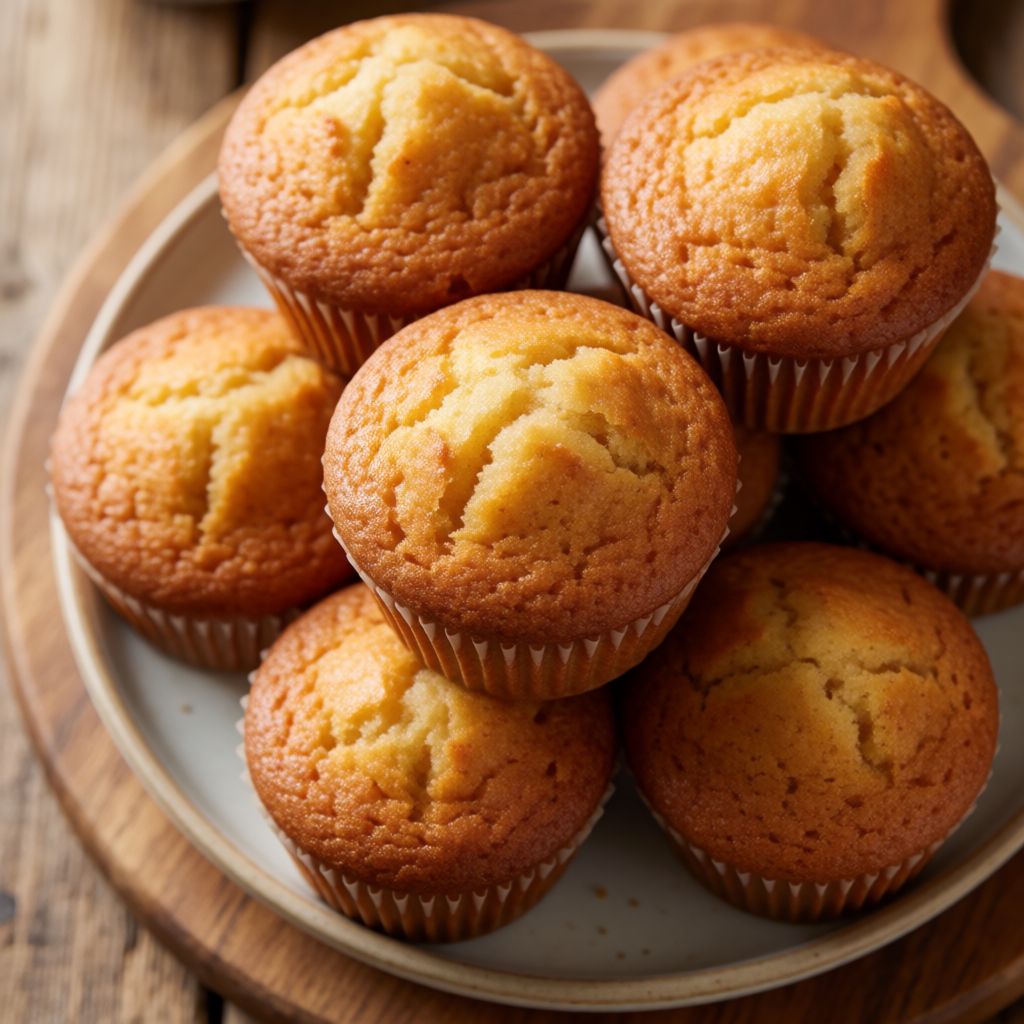
 AI photo
Ginger Muffins
Soft muffins flavoured with marzipan and fresh ginger.
Labels are worked out automatically from the ingredients and can be wrong. Check the packaging if it matters to you.
Ingredients
- 125 g Butter at room temperature
- 175 g Caster sugar
- 0.5 tsp Vanilla sugar
- 150 g Marzipan coarsely grated
- 30 g Fresh ginger freshly grated
- 3 pcs Eggs
- 200 g Plain flour
- 1 pinch Salt
- 1 tsp Baking powder









Steps
Put the butter, sugar, vanilla sugar, marzipan and ginger in a bowl and beat until light and fluffy.
Add the eggs one at a time, beating well after each addition.
Mix the flour, salt and baking powder, sift into the batter and fold in gently.
Divide the batter among muffin cases and bake in a preheated oven at 180°C for 18–20 minutes.
19 minLeave to cool on a wire rack before serving.
What was changed
The baking temperature was adjusted to match the 10°C increments typical of British ovens.
These are not fairy-cakes with a pretence of spice — they're a marzipan cake that happens to be baked in cases, carrying a shot of fresh ginger through it. The structure comes from almond paste melting into butter and sugar, not from the flour, which is why the crumb stays moist for days instead of drying out by Tuesday, the way a plain sponge muffin does.
What decides whether it works is the creaming at the start. You beat butter, sugar, grated marzipan and ginger together until the mass turns pale and looks like it's grown — that's air going into the fat, air that will expand later in the oven and give you most of the lift, with baking powder only finishing the job. Skip this step, or do it with cold butter, and no amount of baking powder saves you: baking powder makes gas, but gas needs space already built in to expand into, or it just bursts out and runs instead of rising evenly.
Some say muffins want a firm hand folding in the flour, "to make sure it's all mixed in properly." No — the more you work wet flour, the more gluten forms, and developed gluten in a muffin means tough and tight, not soft. Fold just until the dry streaks disappear, the way you'd turn over a spade of soil, and stop there.
The ginger goes in raw, not dried or powdered, because its heat and its lemon-sharp aroma live in the juice that comes out when you grate it. Dry that root down to powder and you keep the burn but lose the brightness — it's a different spice wearing the same name.
Butter must be at room temperature, meaning a thumb pressed into it leaves a dent instead of sliding off. Cold butter won't trap air when beaten — it shatters into little nuggets instead. Melted butter is worse still: it has no structure left to hold bubbles in, so they form and collapse before the flour ever meets them. In a British flat where the kitchen runs cold half the year, give the block an hour out of the fridge, or grate it first — grating breaks the cold mass into thin curls that warm through in ten minutes rather than sixty.
Marzipan here isn't the stiff roll-out kind sold for covering a Christmas cake — that's stretched with extra sugar and gum to make it pliable, and it won't melt into a batter. You want the plainer block sold for baking, mostly ground almonds and sugar bound with a little syrup, soft enough to grate. Its job is moisture and a fat that stays tender at oven heat instead of drying to crumb. If you have none, ground almonds plus a touch more sugar and a spoon of golden syrup gets you close, though the result will be a shade drier.
For the ginger, look for a root that feels heavy and firm with taut skin — a wrinkled one has already lost the moisture that carries its heat. If dried powdered ginger is genuinely all you've got, use roughly a third of the weight; you'll get warmth without the citrus lift, which is a different muffin, not a ruined one.
The eggs go in one at a time, each beaten fully in before the next, because what you built with the butter and sugar is an emulsion — tiny air bubbles and bits of marzipan suspended in fat. Add all three eggs together and you flood that structure with water faster than the fat can absorb it, and it splits, turning grainy. It will still bake, but most of the air you worked to trap has already escaped by the time it goes in the oven, and the muffin sits heavier for it. Sifting the flour, salt and baking powder together before folding has one specific purpose too: baking powder is a fine powder that clumps on contact with wet batter, and a clump in one muffin case while the next has none means one rises like a soufflé and its neighbour stays flat. Sifting spreads the chemical evenly through the flour — it doesn't make the flour itself lighter, whatever the old wives say.
180°C is the point where baking powder's two stages of gas release finish just as the egg protein and the starch around it are setting — catching the structure while it's still expanded. Go in cooler and it sets before it's fully risen, dense; go in hotter and a crust forms on the outside before the inside finishes expanding, and you get that cracked dome where trapped gas had nowhere to go but straight up through the top. Every oven in the country runs a few degrees off its own dial regardless of what the knob says, so treat eighteen to twenty minutes as a floor, not a verdict — push a skewer into the centre of one muffin, and it should come out dry, maybe one crumb clinging to it, with the top springing back under a light finger press rather than holding the dent.
Cool them on a wire rack, not stacked on a plate under a tea towel — a muffin out of the oven is still cooking on its own residual heat, and resting it flat on a plate traps steam underneath, turning the base soggy where it should set with a slight chew. If there's no rack to hand, tip the muffins onto their sides in the tin, angled, so air can move under them. Twelve from this mix suits a pot of tea's worth of people, or a Sunday when the oven's already busy with the joint and you want something ready for afterwards without extra fuss — and thanks to the marzipan, they'll still be good two or three days later, when most sponge has given up.