
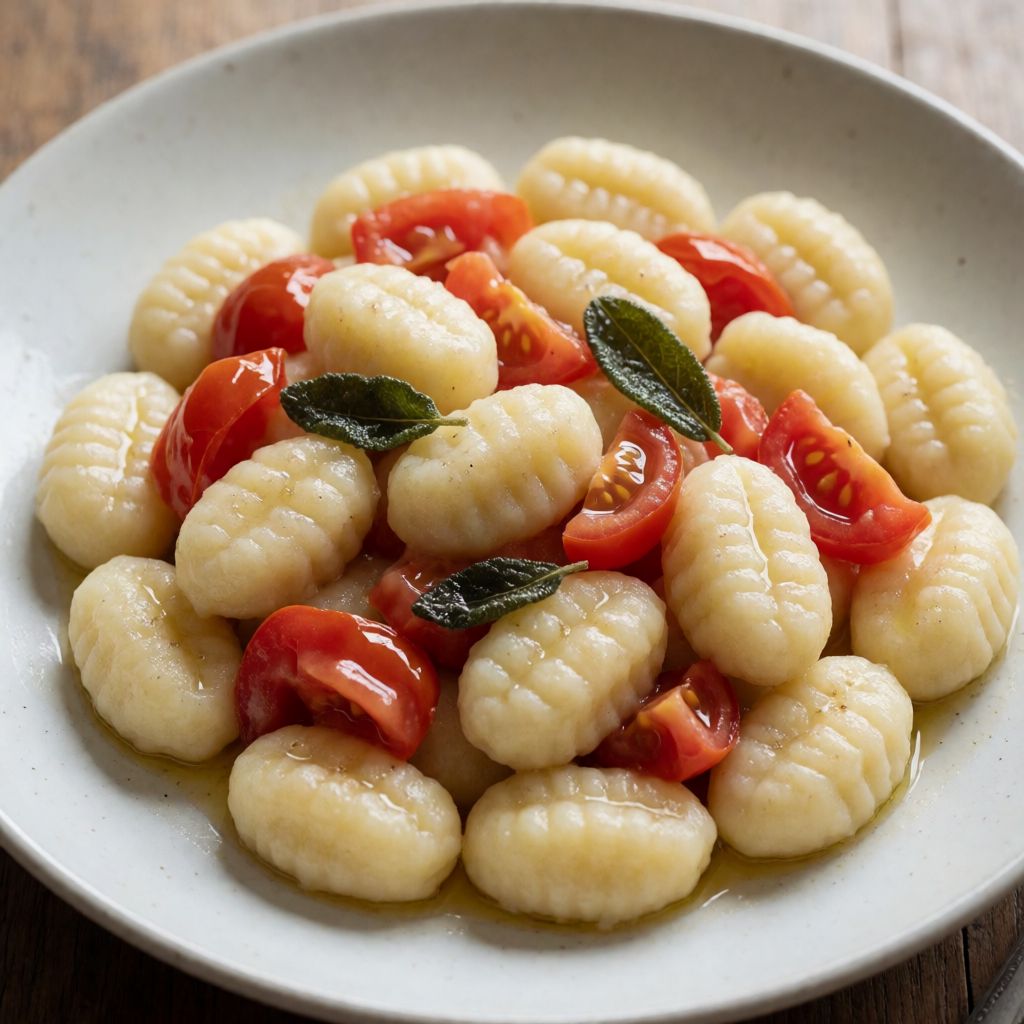
 AI photo
Gnocchi with Sage Butter and Tomatoes
Soft potato gnocchi tossed in sage butter with roasted tomatoes and parmesan.
Labels are worked out automatically from the ingredients and can be wrong. Check the packaging if it matters to you.
Ingredients

Steps
Place the halved tomatoes cut-side up on a baking tray lined with parchment, and drizzle with a little olive oil.
Put the tray into a cold oven and set the temperature to 100°C with the fan setting.
Roast for 45 minutes.
Boil the unpeeled potatoes in unsalted water until tender, then peel them while still hot.
Mash the potatoes with a fork and combine with the egg, salt and durum flour, mixing just until the dough comes together - don't overwork it.
The dough will be very soft - be careful not to add too much flour: it just needs to come together, not be kneaded.
Roll the dough into finger-thick ropes on a floured surface.
Cut the dough into 1 cm pieces and roll each over the back of a fork to create ridges.
Lay the gnocchi on a clean cloth, making sure they don't touch each other or sit in layers.
Let them air-dry for 15 minutes.
Cook the gnocchi in a large pot of salted boiling water.
Remove the gnocchi with a slotted spoon as soon as they float to the surface.
Melt the butter in a pan, add the sage leaves and let it cook gently until fragrant.
Stir the parmesan and roasted tomatoes into the sage butter, then add the cooked gnocchi before plating.
Garnish with freshly ground black pepper and freshly grated parmesan.
Gnocchi is potato pretending to be pasta — and the whole dish depends on the pretending being thin. Not thin like sheets of dough, thin like: barely enough flour to hold the potato together, so the inside stays almost like mash and the outside gets just enough grip to survive a pot of boiling water. Add flour like you're apologising for it. Every extra spoonful is a gnocchi that bounces off your teeth instead of giving way.
Some say the potato has to be baked, never boiled, because boiling "waters it down". No — the problem was never the water in the potato, it's the water that stays trapped if you peel and mash a cold, wet potato. Boil it unpeeled, so the skin is a barrier keeping the water out while the inside cooks dry and floury. Peel it hot — hot potato releases steam as you work it, cold potato just sits there damp and sulky, and that dampness is what forces you to add more flour later, which is exactly the thing you were trying to avoid.
The sauce side of the plate is almost a cheat, and that's fine — the gnocchi is doing the hard work, the sauce just needs to not get in the way. A low, slow roast turns watery supermarket tomatoes into something closer to concentrated tomato, because that's what low heat over time does to anything with water in it: it leaves. Butter and sage is the other half, and it's deliberately simple — this is a dish that forgives you for not making a reduction.
Doneness here is not a clock question, it's a floating question. The gnocchi tells you itself.
Start with the potato, because it decides everything downstream. You want floury — Maris Piper or King Edward, the ones British bakers reach for when they want a potato that falls apart rather than holds its shape. That falling-apart tendency, which ruins a roast potato, is exactly the texture you're buying for gnocchi: more starch, less water, a drier crumb when mashed. A waxy potato — new potatoes, Charlotte — holds water in its cells stubbornly, and that water has nowhere to go except into your dough, where it has to be mopped up with flour, and flour is the enemy of soft gnocchi. If floury potatoes aren't to hand, you compensate by drying the mash harder — a few minutes in a dry pan over low heat, just enough to see steam lift off, no colour on the pan.
The egg is a binder, not a flavour — one egg for a kilo of potato is barely there. If you're nervous about structure because your potatoes ran wetter than expected, resist adding a second egg; add a little more flour instead, in small amounts, stopping the second the dough holds together without sticking to your palm. Durum flour (sometimes sold as "00" or pasta flour here) gives a slightly firmer bite than plain flour because of its higher protein — not essential, plain flour works, but the gnocchi will be a touch softer and more fragile, so handle it gently and don't crowd the pot.
Butter: use it, don't swap it, because this sauce has nowhere to hide flavour — it's butter, sage, cheese, tomato, and that's the whole list. If you must substitute, the rule is any fat with a clean, neutral-to-pleasant flavour of its own that can carry sage without a fight — a mild olive oil will do it, but you lose the slight nuttiness that butter gets from browning gently in the pan, which is the only real flavour development happening in that step. Fresh sage, not dried — dried sage turns musty and a bit like hay once warmed in fat; fresh releases its oil slowly in the heat and that's the whole point of the "cook gently until fragrant" instruction — you're not frying the leaves crisp, you're asking the fat to borrow their smell.
Parmesan at the end does two jobs: salt and a thin coating of savouriness that melts slightly in the warm butter. Grate it fresh — the pre-grated stuff is cut with anti-caking starch and won't melt the same way, it clumps instead of clinging to the gnocchi. If parmesan isn't available, a hard, salty, aged cheese of similar character — a mature Pecorino, even a strong cheddar in a pinch, though you'll trade some of the nuttiness for sharpness.
On the tomatoes: a cold oven set low and slow isn't fussiness, it's economics of time versus water. High heat would char the skins before the water inside had a chance to leave, so you'd get tomatoes that are burnt on the outside and still wet in the middle — the opposite of what you want. Low heat gives the water time to evaporate evenly, concentrating what's left into something closer to flavour than juice. This is a job you can start and walk away from — put the tray in, go do something else in the flat for most of an hour, it needs none of your attention.
Last thing, on patience, because this dish punishes rushing in two specific places. Rolling the dough too hard, worried it looks too soft and sticky, is rushing — the softness is correct, trust it. And skipping the air-dry on the cloth is rushing too: a wet gnocchi surface sheds starch into the boiling water and can split open as it cooks, same as a dumpling with a weak seam. Fifteen minutes of nothing, letting a skin form, is the dumbest-looking step in this recipe and the one most people cut first — don't.