
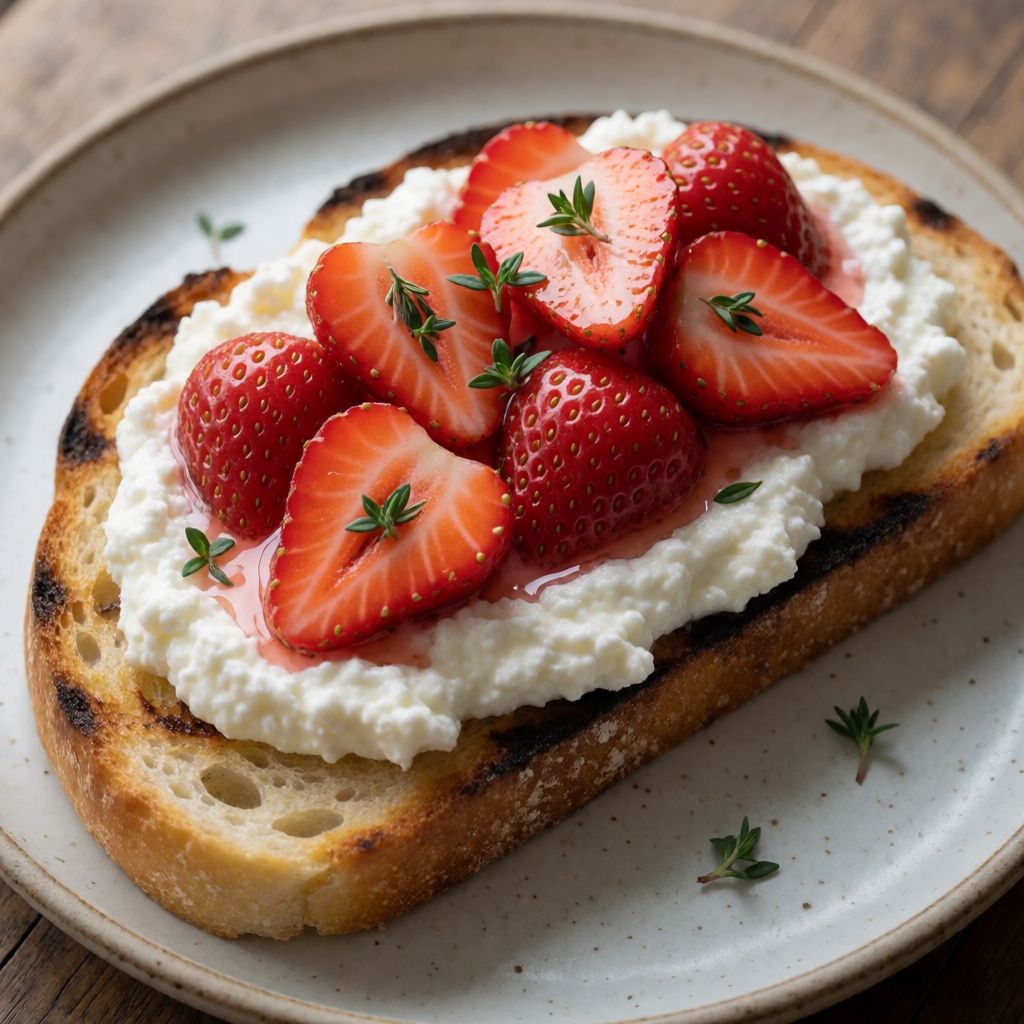
 AI photo
Grilled Goat Cheese with Strawberries and Balsamic Sauce
Crisp baguette slices topped with melted goat cheese, fresh strawberries, thyme and a drizzle of honey and balsamic glaze.
Labels are worked out automatically from the ingredients and can be wrong. Check the packaging if it matters to you.
Ingredients
- 8 pcs Baguette sliced baguette
- 100 g Soft goat cheese sliced
- 8 pcs Strawberries
- 1 bunch Thyme fresh
- 1 tsp Honey
- 1 tbsp Balsamic glaze
- 1 pinch Black pepper freshly ground



Steps
Place a slice of goat cheese on each piece of baguette and arrange on a baking tray lined with parchment paper.
Bake in a preheated oven at 220°C for 10 minutes.
10 minTransfer to a plate, top each slice with a quarter of a strawberry, sprinkle with thyme and freshly ground black pepper, drizzle with honey and a little balsamic glaze.
This is bread toasted under a blanket of warm goat cheese, with cold strawberry and herb laid over it after the heat has done its job. Nothing about it should taste cooked except the bread and the cheese — the fruit stays raw, the honey stays raw, the balsamic stays raw. That contrast between hot and cold on the same bite is the whole dish; take it away and you just have cheese on toast with jam.
What decides whether it works is the order of what goes on when. The cheese and bread go into the oven together because they need the same heat for the same ten minutes — bread to crisp at the edges, cheese to go from cold and dense to soft enough to give under a knife, without turning to liquid and running off the crust. Everything else — strawberry, thyme, honey, balsamic — goes on after, on the plate, cold. Put the strawberry on before baking and you get a different, worse dish: the fruit weeps its juice into the hot crumb, the bread goes soft instead of crisp, and the berry turns from a fresh bite into something stewed. Oven heat is for the base. Everything bright stays out of it.
Some say goat cheese can't be baked without running everywhere — no, because the log-style, rindless chèvre you slice for this holds its shape as it softens. It doesn't melt the way a brie or a soft cream cheese does; it goes glossy and yields under a knife but keeps its outline. That's the cheese to look for, and the cue you're after in the oven: matte going to glossy, not a puddle.
Start with the bread, because that's what decides whether you get a crisp base or a soggy one. A baguette works because its crust is thin and its crumb dense — sliced into rounds, it stays rigid even once it's carrying warm cheese, instead of bending the way a slice of ordinary sandwich loaf would. Any firm, close-crumbed white bread does the same job — a baton of sourdough, a ciabatta cut thin — the criterion is a bread that holds its shape warm, not one built to be soft and airy. This whole dish, by the way, is the crostini idea in different clothes: stale bread toasted hard, then dressed with a small amount of something expensive on top. It's an economical trick wearing an antipasti label — bread is cheap, goat cheese isn't, so you use plenty of one and a little of the other.
The cheese is where people go wrong if they buy the wrong shape of it. You want the firm, rindless log kind of chèvre — the sort sold already as a cylinder you slice into rounds — not the whipped, spreadable tub kind, which has nowhere to go but down into the bread, and not an aged, crumbly goat cheese either, which dries out under heat instead of softening. The log holds its round shape as it warms, going from matte and slightly crumbly at the edge to glossy and giving — that's your doneness cue, more reliable than the clock. If you can't find goat cheese, another firm soft cheese will melt in its place, but you lose the tang that's the whole reason this isn't just cheese on toast — there's no real substitute for that sourness, only cheeses that sit closer or further from it.
Everything that lands on top after the oven is there raw on purpose. The strawberry needs to be properly ripe — this dish has nothing cooked to hide a pale, sour one behind. Thyme wants to be fresh, leaves stripped from the stem and scattered whole or lightly bruised between your fingers rather than chopped fine; dried thyme will do in a pinch but tastes of the jar, not of the garden, and on a dish this small that difference shows. Honey just needs to be mild — a clover or plain blossom honey, nothing strong enough to argue with the thyme — its job is to round off the sharp edges of the balsamic and the cheese's sourness, not to dominate them. And balsamic glaze, if you don't keep a bottle of it, is nothing mysterious: ordinary balsamic vinegar reduced slowly in a small pan with a spoon of sugar until it coats the back of the spoon rather than running off it. That's the whole trick of a glaze — vinegar that's lost its water and gained body.
Pepper goes on last and freshly ground, because pepper that's sat pre-ground in a tub has already lost the oils that make it smell like pepper rather than just taste hot. It's a small thing on a small dish, but across eight bites of toast, small things are most of what you've got.