
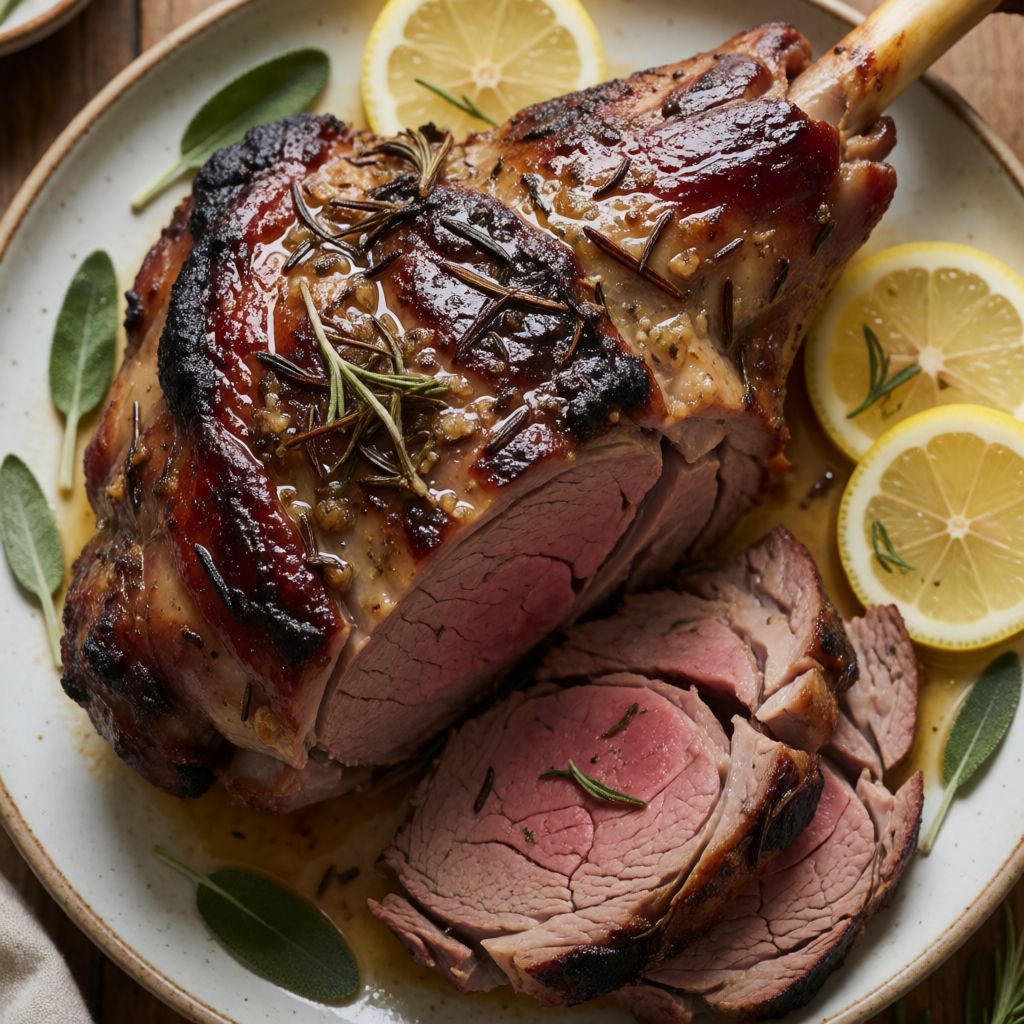
 AI photo
Barbecued Leg of Lamb
A whole leg of lamb marinated with garlic, rosemary, sage, lemon and ginger, then slow-barbecued over indirect heat.
Ingredients
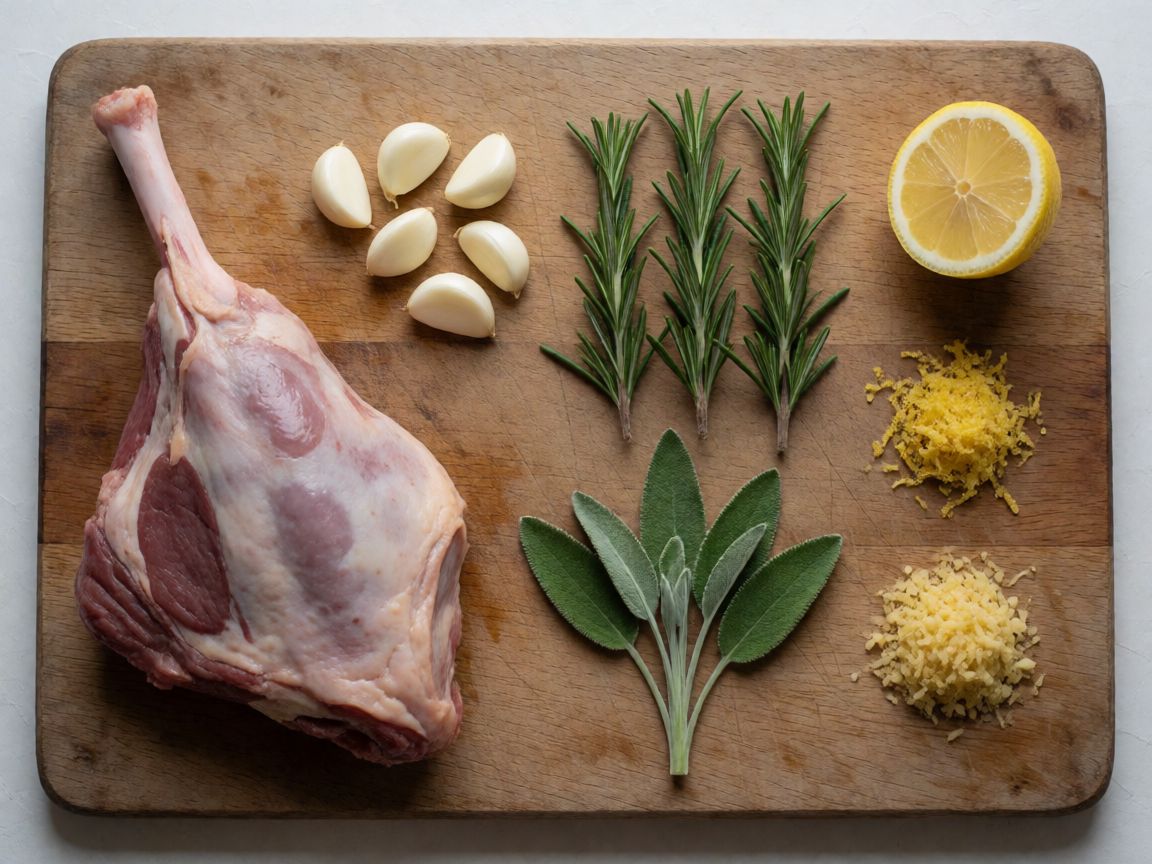
- 1 pcs leg of lamb approx. 2 kg
- 5 clove garlic
- 3 pcs rosemary leaves picked off the sprigs
- 1 pcs fresh sage 5 leaves picked off the sprig
- 0.5 pcs lemon finely grated zest
- 1 tsp ginger finely grated
- 1 tbsp salt
- 1 tbsp black pepper freshly ground








Steps
If there is a good layer of fat on the lamb leg, score it crosswise into a diamond pattern, being careful not to cut into the meat.
Pat the lamb leg dry with kitchen paper.
Put all the marinade ingredients into a mortar and crush them together into a fragrant green spice paste.
Rub the lamb leg all over with the marinade mixture.
Leave the lamb leg to marinate for at least 2 hours, or ideally up to a day.
120 minArrange the coals on either side of the barbecue for indirect heat under the lid.
Place the lamb leg on the barbecue and cook for about 1–1.5 hours, until the internal temperature reaches 61–63°C.
90 minRemove the lamb leg from the barbecue and let it rest for 20–25 minutes before carving.
22 min
This is a whole leg of lamb, rubbed with a crushed green paste and cooked slowly under a closed lid until it's rosy in the middle, then rested and carved at the table — the barbecue version of a Sunday roast, for when the oven feels like the wrong tool in June.
Three things decide whether it works. First, how you handle the fat cap: score it in a shallow diamond, through the fat only. Fat left whole just sits there, rubbery, insulating the meat from the heat instead of basting it. Cut too deep and you've opened a road for the juices to run out as the fibres contract — score, don't carve.
Second, the coals go to the sides, not underneath. With the lid down that's not grilling, it's an oven running on charcoal instead of gas — heat moves round the meat rather than blasting it from one side. Put the coals under a 2kg leg and the outside is grey and dry long before the middle gets anywhere near pink. Some say you sear meat hard first to "seal in the juices" — no, because there's no seal to make; what hard heat gives you is flavour on the crust, not water kept inside. That's a different job, and this recipe correctly skips it.
Third, 61–63°C is not a suggestion, it's the actual point where the proteins in lamb muscle are set but the fat and connective tissue haven't dried the meat out yet. Time — an hour to ninety minutes — is the floor, not the answer; a leg from a different animal, a different fridge, a different day will get there at a different minute. A probe thermometer earns its keep here. A joint this size and this price isn't one to guess at by sticking a fork in it.
Garlic, rosemary and sage together are the old pairing for lamb for a reason that has nothing to do with romance: lamb fat carries a strong, slightly tallowy smell, and all three of these are resinous enough to cut straight through it rather than disappearing underneath it. Crush them in a mortar rather than chopping them with a knife — bruising ruptures the cell walls and lets the oils out properly, a blade mostly just slices around them. If you've no fresh sage, dried doesn't behave the same (the oils that make sage sage have mostly gone by the time it's dried and jarred), so reach for woody thyme or even a little savory instead, on the same logic: resinous, a bit bitter, holds up to long cooking.
The lemon zest is there for its oil, not its acid — that's why it's zest and not juice. Juice would just add water to a paste that's meant to cling to the meat, and acid this close to raw meat for a day starts to firm the surface like a ceviche, which isn't what you want here. Ginger, freshly grated, brings warmth without heat — it's doing an aromatic job, not a chilli's job. Ground ginger is a reasonable stand-in only if you accept it's a paler version: use half the amount and crush it into the mortar with the salt so it at least gets wet and comes back to life a bit.
On the marinating time — two hours at the least, a day if you can manage it — here's the thing worth knowing: the herb oils don't travel far into the meat no matter how long you leave it, a few millimetres at most, because muscle is a dense, mostly-water structure that resists oil. What does travel, slowly, over hours, is the salt. It draws moisture to the surface, dissolves into it, and migrates back in, carrying flavour and loosening the protein structure as it goes — closer to a dry brine than a marinade in the French sense. So the extra hours you give it aren't about the garlic getting deeper, they're about the salt getting there at all. A tablespoon on a 2kg leg is a modest, sensible seasoning for the whole joint, not just a crust — don't be tempted to double it because the paste looks thin.
Resting for twenty to twenty-five minutes afterwards is not a polite pause, it's mechanical: heat makes muscle fibres contract and squeeze juice toward the centre and the surface tension there holds it in, cut into that straight off the heat and it floods the board instead of staying in the meat. Give it the rest and the fibres relax as they cool, and the juice redistributes through the whole leg rather than pooling under the knife. That twenty minutes isn't dead time — it's the last ingredient, and it's free.
If you're in a flat with no garden and no barbecue, the mechanism still works in an oven — coals either side under a lid is just a crude, smoky way of getting convection heat from all directions, which a closed oven does on its own. Run it at a gentle, even heat with no fan blasting one side of the meat, and lean on the thermometer rather than the clock, since you've lost the visual and smell cues a real fire gives you. You'll miss the smoke, honestly, there's no way round that one — but the lamb inside will cook the same way, because 61°C doesn't care what's burning outside it.