
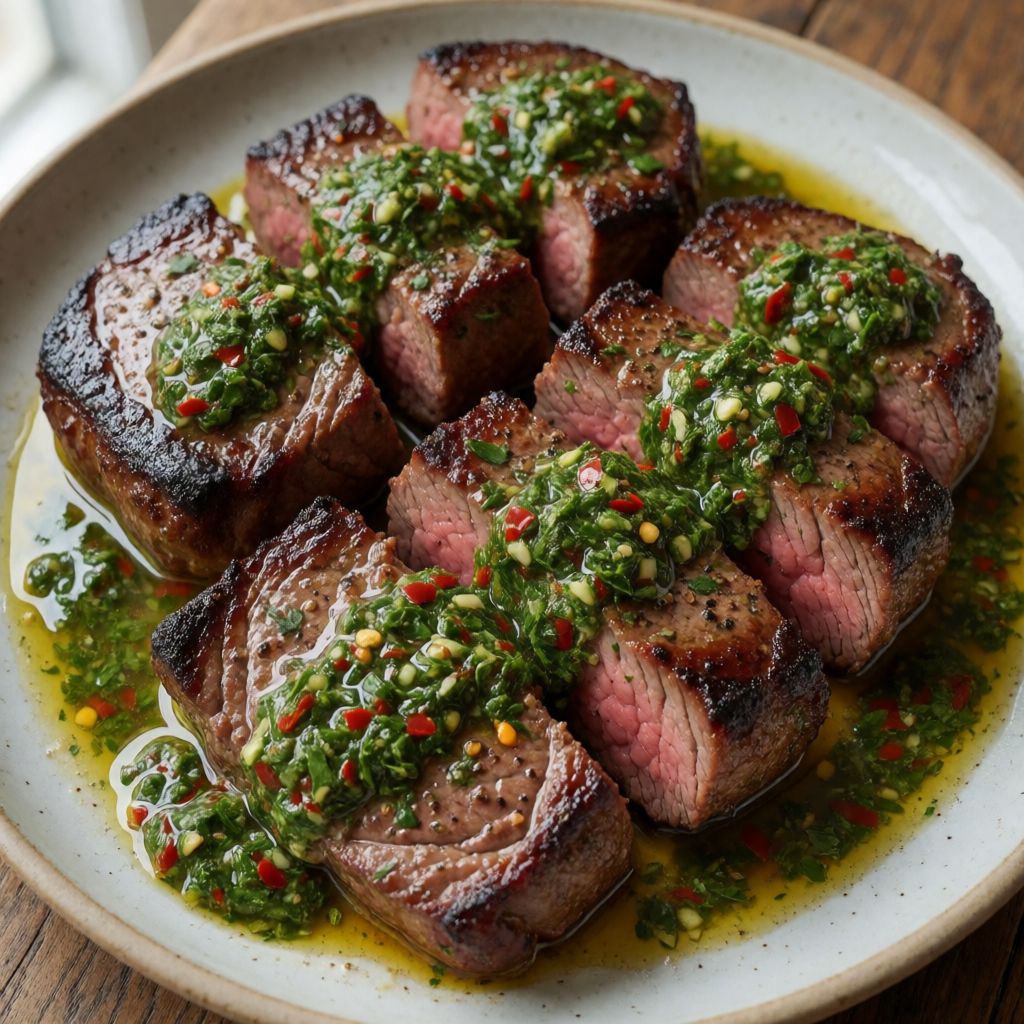
 AI photo
Grilled Lamb with Chimichurri
Juicy grilled lamb served with a fresh herb and garlic chimichurri sauce.
Ingredients
- 500 g Lamb loin
- Salt to taste
- Black pepper freshly ground
- 2 clove Garlic finely grated
- 0.5 tsp Chilli flakes
- 2 tbsp Oregano fresh, finely chopped
- 2 tbsp Mint fresh, finely chopped
- 1 bunch Parsley finely chopped
- 0.5 pcs Lemon zest and juice
- 100 ml Olive oil










Steps
Place the garlic, chilli flakes, oregano, parsley, mint, lemon zest and a little lemon juice in a bowl and mix together.
Season to taste with lemon juice, salt and freshly ground black pepper.
Heat the grill and brush the rack with oil.
Rub the lamb loin with salt and freshly ground black pepper, then brush with a little chimichurri.
Grill on all sides for about 3 minutes on each side, until the lamb loin develops nice char lines.
3 minLet the meat rest for 10 minutes, then slice thinly.
10 minArrange on a platter and drizzle with chimichurri before serving.
This is two separate jobs stitched together: a scorched piece of lean meat, and a raw sauce thrown together with a knife and a bowl. Nothing in the sauce goes near heat — that's the whole point. Fire does one thing, the herbs do the opposite, and the plate needs both or it's just grilled meat with parsley on top.
Lamb loin is a muscle that never did much work in its life. No marbling to speak of, almost no connective tissue — which is exactly why it cooks in minutes and turns to rubber a minute after that. There's no "medium heat" that rescues this cut. The surface needs to be hot enough to brown before the centre catches up. That's the whole gamble here: get in fast, get out faster.
Some say searing "seals in the juices." It doesn't — a crust holds flavour, not liquid, there's no membrane being welded shut. What actually keeps this loin moist is two things: pulling it off the heat before it's cooked all the way through, and then doing nothing for ten minutes. Skip the rest and you'll watch the juice you worked for run straight onto the board the moment your knife goes in — the meat hasn't had time to pull it back in from the surface where the heat pushed it.
And "done" here is something you see, not something you count. Proper char lines, or a dry brown crust — not the pale grey of meat that's been steaming in its own damp instead of browning. Three minutes a side is a floor, not a fact: a properly hot pan gets you there quicker, a half-warm one never gets you there at all, no matter how long you leave it.
A word on "grill," because in a British kitchen it means two different things and only one of them gives you char lines. The oven grill is an element overhead — radiant heat, no contact, it browns evenly but it can't draw lines on anything, because lines need something ridged actually touching the meat. A ridged griddle pan on the hob does that job by conduction: metal against meat, hot ridges, cool grooves, hence the stripes. If all you've got is the oven grill, accept colour instead of lines and don't chase something the equipment can't give you.
Loin is chosen for the same reason it costs more than most of the lamb in the butcher's case: it's small, lean, and doesn't need long cooking to be tender, which in meat terms is a rare and expensive combination. It's the opposite of the Sunday leg or shoulder, which got traditional precisely because a tough, fatty cut thrown in low and slow for hours was the cheap way to feed a family over a weekend with no watching required. Loin asks for your attention for about six minutes total and gives you no leftovers — a different economy entirely. If you haven't got loin, a well-trimmed leg steak, cut thin, cooked by the same logic — hot, fast, off before it's grey through — will behave the same way.
In the chimichurri, the olive oil isn't there to cook anything — it's the carrier, the thing that catches the fat-soluble flavour out of the garlic and herbs and holds it in suspension until it hits your tongue. So it needs to actually taste of something; smell it before you buy it, and if it smells of nothing, it'll give nothing back to the sauce. No olive oil in the house — any oil you can genuinely taste works, a decent rapeseed oil included. A flavourless vegetable oil defeats the purpose of the whole sauce.
Parsley does the bulk and the green freshness; oregano and mint are there for lift, not weight, which is why there's much less of them. Chilli flakes bring warmth, not real heat — don't mistake this for a spicy sauce. Garlic should be grated, not pounded to a paste, because over-worked raw garlic turns bitter and sharp in a way whole cloves grated finely don't. And don't make a big batch and leave it sitting at room temperature for days — raw garlic suspended in oil is one of the few genuinely risky combinations in a home kitchen, and the sauce is quick enough to make fresh each time anyway.
The lemon juice goes in gradually, tasted as you go, because lemons vary wildly in sharpness — one gives you two tablespoons of real bite, another gives you watery disappointment. This is the one place where bottled juice genuinely lets you down: it's a fixed acidity, so you lose the only reason for tasting as you build the sauce. Let the finished chimichurri sit for ten or fifteen minutes before it goes anywhere near the meat — the flavours want a little time to find each other, that's patience doing its job, not a step you can skip by stirring harder.
Slice the lamb thin and across the grain — a lean cut like this has no fat to lubricate long fibres, so shortening them with the knife is what makes the difference between tender and chewy. Four people, roughly 125g of lamb each once rested and sliced — smaller than a roast-dinner portion, because this isn't trying to be one.