
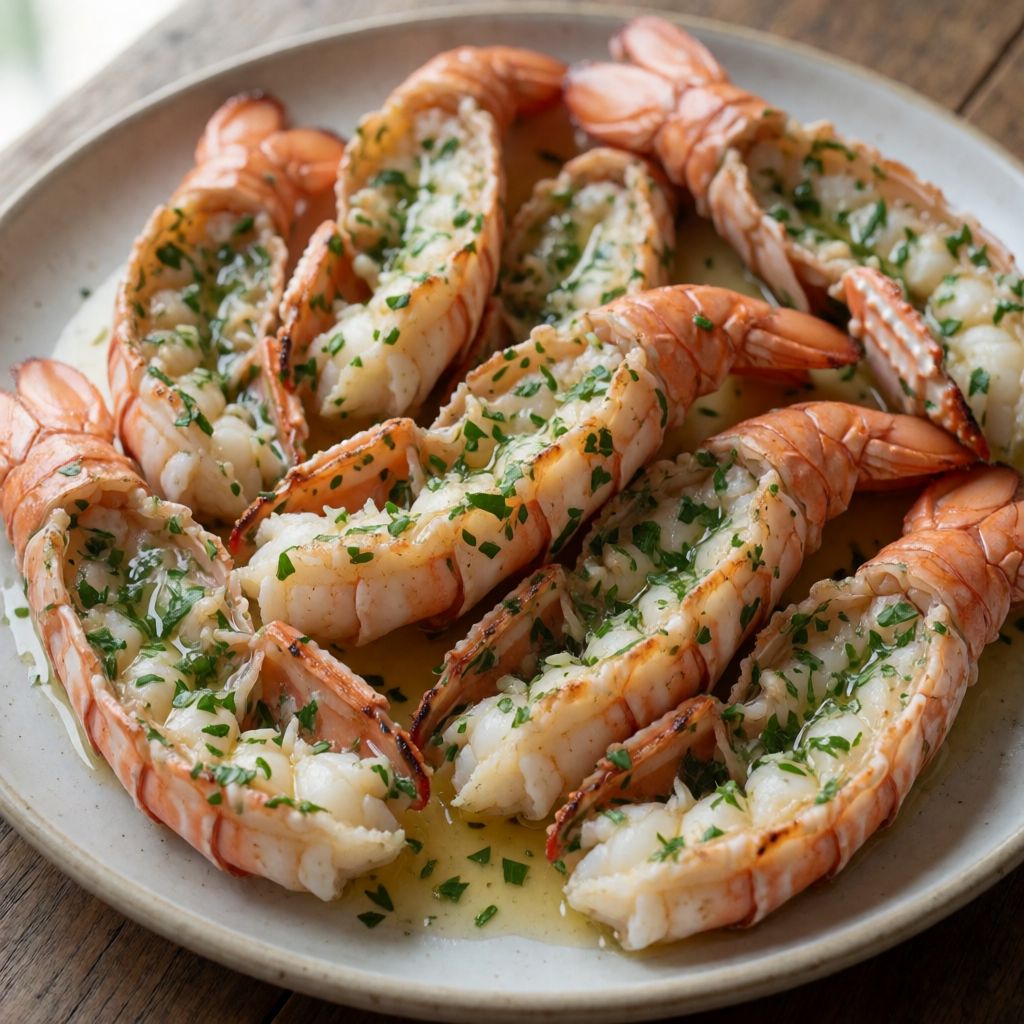
 AI photo
Grilled Langoustines with Garlic-Parsley Butter
Grilled langoustines finished with a quick garlic, parsley and lemon butter, served with good bread to mop up the juices.
Labels are worked out automatically from the ingredients and can be wrong. Check the packaging if it matters to you.
Ingredients









Steps
Turn on the grill and let it heat up well.
Cut the langoustines lengthwise with a sharp knife and remove the intestinal tract running along the back.
Generously brush the flesh side with olive oil and grill the langoustines on the hot grill, flesh side down, for 1-2 minutes.
2 minTurn over and grill for another 1-2 minutes, shell side down.
2 minArrange on a platter and immediately spoon over the butter gremolata, which will melt over the juicy langoustine meat.
Butter gremolata: on a board, finely chop the garlic, parsley, lemon zest, salt and pepper into a fine gremolata.
Mix it with the butter and a little lemon juice.
Mix well until you have a smooth, soft butter gremolata.
Langoustines are not prawns in fancy clothes — they're a different animal, with a sweeter, firmer flesh that can take real heat without turning to rubber the way a thin prawn will. The whole recipe hinges on two very short blasts of fierce heat and a cold, sharp butter that melts into the cracks afterward. Get those two things right and the dish makes itself.
What decides whether this works is heat and timing, not the seasoning. Your domestic grill or a ridged pan on the hob has to be properly hot — hot enough that the oiled flesh hisses and goes from translucent grey to opaque white and lightly gold in the time it takes to say "one, two" — before you even think about turning it. A grill that's merely warm will steam the langoustine in its own shell rather than sear it, and steamed shellfish goes tough and stringy, not tender. The 1-2 minutes per side in the method is a lower bound, not a stopwatch instruction: watch the flesh firm up and turn from glassy to white, that's your real signal.
Some say you need a charcoal grill or a kazan-sized barbecue for this. No — because what's actually doing the work is direct, high, dry heat meeting a thin piece of flesh for a very short time. A ridged cast-iron griddle pan on your highest hob setting, or even your oven's grill function on full with the pan close under it, does the same job. What you can't do on an ordinary flat is get smoky char-flavour from charcoal — be honest with yourself about that, it's a different, not lesser, result.
Start with the langoustines themselves. If you're in the UK and can't find fresh langoustines at the fishmonger, frozen ones (thawed slowly, in the fridge, overnight) are a perfectly honest substitute — langoustines are usually frozen at sea within hours of catching, so frozen is often fresher in practical terms than "fresh" that's travelled two days on ice. What you should not do is swap in tiger prawns and call it the same dish; they're thinner-shelled, cook faster, and the flavour is milder and sweeter in a different direction. If langoustines genuinely aren't available, large raw king prawns, shell-on, are the closest stand-in — just shorten your time on the heat, because their flesh is thinner.
Cutting them lengthwise and removing the dark intestinal tract isn't fussiness for its own sake — that line of grit will taste bitter and gritty if left in, and it's the one bit of prep that actually matters before the heat goes on. Do it with a sharp small knife, not a blunt one that tears the flesh instead of parting it.
The olive oil brushed on the flesh side is a conductor, not a flavour statement — any oil with no smell of its own and a reasonably high smoke point does the job: a light olive oil, a plain vegetable oil, even a neutral rapeseed oil (easy to find in Britain, and it won't smoke and bitter up on a hot pan the way a cheap extra-virgin will). Save your good peppery extra-virgin for drizzling at the table, not for the grill — heat destroys exactly the aromatic compounds you paid for.
For the gremolata butter: the garlic should be finely chopped, not crushed to a paste — a paste turns harsh and can scorch bitter in the residual heat of the shellfish, while a fine chop stays rounded and mellow. One clove is right for four people; if your garlic is very young and mild, you can be generous, but old, sprouting garlic turns acrid, so trim it hard or use a touch less. Parsley should be flat-leaf if you can get it — more flavour, less bitterness than curly — but curly parsley from the corner shop will not ruin anything, it just won't sing as much. The lemon does double duty: zest goes into the chop for aromatic oil, juice goes in afterwards for acid, and you want both, because zest alone is perfume without brightness, and juice alone is sharp without scent.
Butter, 30g in the gremolata and 50g alongside for serving, needs to be a plain unsalted or lightly salted butter with no additives — it's there to carry fat and melt cleanly over hot flesh, not to contribute its own personality. Margarine or a spread won't melt the same way; they emulsify oil and water artificially and tend to go greasy and split rather than pool.
The bread at the side isn't garnish — it's there to mop the garlic butter and lemon juice pooling on the platter, which is frankly half the point of the dish. A cold-proofed homemade loaf or a decent baguette with a real crust works because it has enough structure to drag through butter without collapsing into mush; a soft supermarket sandwich loaf will just go soggy and fall apart in your hand. If you're reaching for what's in the bread bin, go for the crustiest thing you've got — even a toasted slice of sourdough will do the job better than something pillowy.
And patience, briefly: the patience here isn't in the cooking, which is fast, but in letting the grill actually get hot before anything touches it, and in not turning the langoustines early because you're nervous. Rushing the heat-up is the single most common way to end up with shellfish that's grey, chewy, and sulking on the plate instead of sweet and firm.