
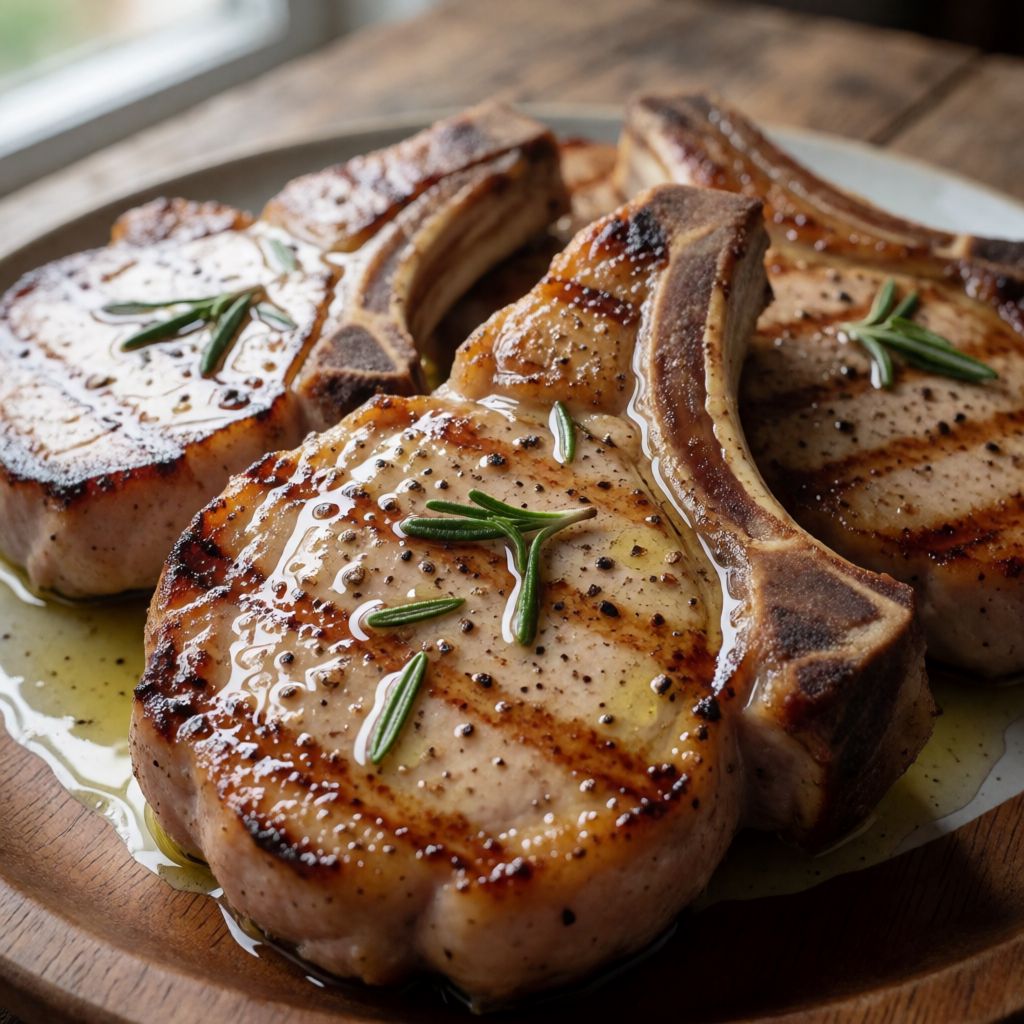
 AI photo
Grilled Pork Chops
Juicy grilled pork chops seasoned with rosemary, olive oil, salt and black pepper.
Ingredients
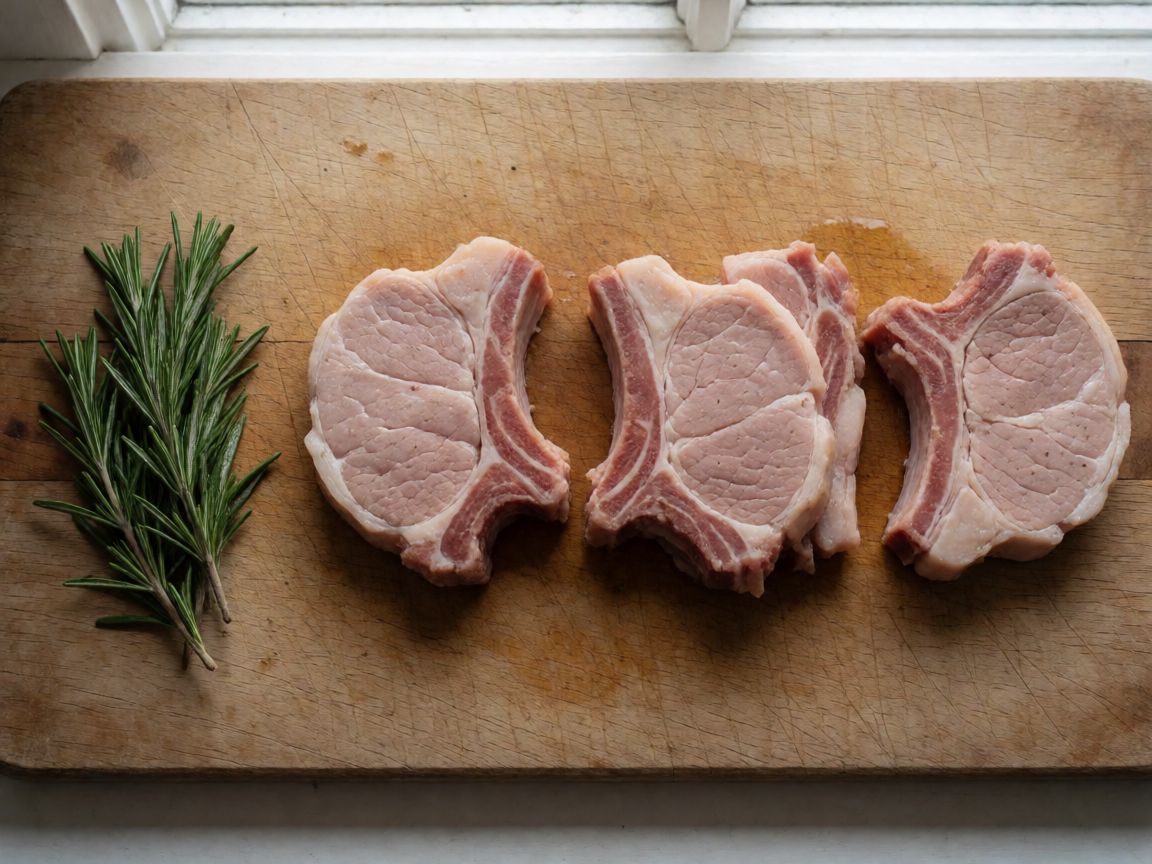
- 4 pcs Pork chop
- Rosemary to taste, or sage
- 4 tbsp Olive oil
- Salt to taste
- Black pepper to taste





Steps
Take the pork chops out of the fridge and leave them at room temperature for at least 30 minutes.
30 minWash the fresh rosemary, pat it dry and strip off the needles.
Place the chops in a container, drizzle with olive oil, gently massage the meat, then add the rosemary, salt and black pepper. Leave to marinate for 30 minutes.
30 minHeat a griddle pan on the stove and add the chops.
Fry for 3 minutes on high heat.
3 minTurn the meat over without pressing on it, so as not to lose the juices.
Fry the other side for another 3 minutes. Doneness: 70°C internal temperature.
This is pork cooked hard and fast on a dry metal surface, not roasted, not braised. Everything that can go wrong with it goes wrong in those six minutes on the pan, and everything that makes it right happens in the thirty minutes before you ever turn the heat on. That's the whole shape of the dish: long rest, short fire.
The room-temperature rest isn't fussiness. A chop straight from the fridge has a warm surface and a cold middle by the time it hits the pan — you'll have seared the outside to leather before the centre has even started moving off 'raw'. Let it sit out and the whole piece climbs closer to one temperature, so heat doesn't have to fight such a steep hill to get to the middle. Thirty minutes is a lower bound, not a stopwatch target — a thinner chop gets there sooner, a thick one might want longer.
The marinating thirty minutes is doing something different: salt sitting on meat first pulls a little moisture to the surface, then — given time — both salt and that moisture work their way back in, taking seasoning with them. Skip the wait and you've only seasoned the crust, not the chop.
Some say a hard sear 'seals in the juices'. No — it doesn't seal anything, there's no membrane forming. What a hot pan actually does is brown the surface fast, through the Maillard reaction, before the meat has time to weep out its moisture and stew in it. A pan that isn't hot enough doesn't fail to seal — it fails to brown, and you get grey, boiled-looking pork instead of a crust. That's the real reason the heat has to be high at the start, not some mystical juice-trapping.
Doneness here is given as a number — 70°C — because a thermometer doesn't lie to you the way a clock does, and chop thickness varies between the four in your pack even if they look the same on the tray. If you don't own one, go by feel: press the chop with the back of tongs and it should push back rather than give like raw dough, and the juice that beads on the surface should run clear, not milky pink. That old rule that pork has to be cooked until it's grey through and through comes from a time when trichinosis in pigs was a real risk on small, mixed farms. Commercial pork today is about as likely to carry it as your milk is to carry TB — but 70°C is still a sensible, cautious number for a home kitchen with no thermometer culture built in, so the recipe isn't wrong to ask for it, just conservative.
Turning without pressing matters for a plain mechanical reason: the proteins near the surface haven't fully set in the first three minutes, and a flattened chop under a spatula will push liquid straight out through the cut edges. That's not about sealing, that's just squeezing a wet sponge. Let the crust firm up and lift it with tongs instead of a fish slice.
The chop itself: look for one with a rim of fat still attached rather than one trimmed bare — that fat is flavour and a bit of insurance against drying, and on a quick sear like this it doesn't get the time to turn properly chewy, so don't worry about rendering it down to nothing. Chops are the weekday cut from the same animal that gives you the loin joint for a Sunday roast — cheaper, quicker, no good being cooked low and slow like the joint is, which is exactly why this recipe treats it the opposite way: hot, fast, done in minutes rather than hours.
Rosemary or sage, and the recipe is right to offer both: these are resinous, oily herbs that survive contact with heat and oil without turning straight to ash and bitterness the way a soft herb like basil or parsley would. Strip the needles rather than leaving sprigs on, because a whole woody stem against a hot pan just burns and tastes of char, not rosemary. If you've got neither, thyme behaves the same way — anything tough-leaved and resinous will do; it's the structure that matters, not the specific plant.
The olive oil's job here isn't to be a neutral cooking medium — it's the carrier that gets the rosemary's aromatic oils and the salt to sit against the meat during the marinating half hour, and it stops the chop sticking to itself in the container. You don't need an expensive first-press oil for this; anything olive and unremarkable works, since by the time it's done its carrying job on the pan it's mostly been driven off as smoke or absorbed into the crust. Black pepper: ground fresh if you can, because pepper's aroma fades fast once cracked, and three minutes of high heat per side is more than enough time to cook that aroma away entirely — freshly ground buys you back what the pan takes.