
 AI photo
Savoury Puff Pastry Parcels with Ham and Provolone
Crispy puff pastry parcels filled with ham and smoked provolone, baked until golden.
Labels are worked out automatically from the ingredients and can be wrong. Check the packaging if it matters to you.
Ingredients
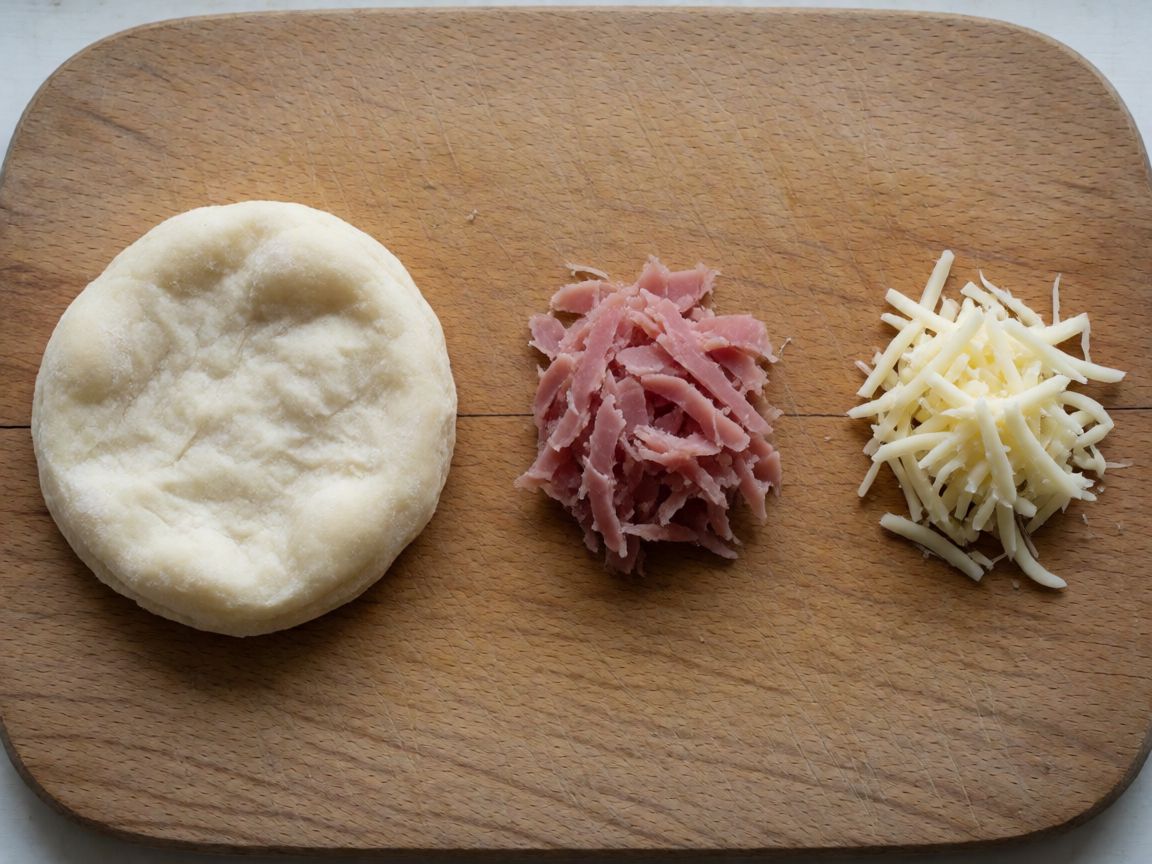
- 1 pcs Ready-rolled puff pastry
- 80 g Ham sliced
- 80 g Smoked provolone sliced


Steps
Cut the rectangular sheet of puff pastry into four equal rectangles. At the ends of each one, lay slices of smoked provolone, then ham.
Using a knife, make a few cuts in the part of the dough that has no filling.
Fold both edges over, pressing them firmly with your fingers, then seal with the tines of a fork.
Bake the parcels at 200°C in a preheated fan oven for 15 minutes.
15 minServe warm, with a glass of white wine if you like.
This is a turnover, not a tart: a rectangle of puff pastry wrapped around ham and cheese, baked hot and fast so the fat inside the dough turns to steam before it has time to leak out. Everything that matters here is mechanical, not magical — it's about what puff pastry is, and what heat does to it in the first few minutes.
Puff pastry works because it's dozens of thin sheets of dough with fat beaten flat between them. In the oven, the fat melts and the moisture trapped in the dough turns to steam, and that steam has nowhere to go but up, forcing the layers apart. That's the whole trick of "puffing." It only happens if the oven is already hot when the parcels go in — a slow climb to temperature lets the fat run out of the dough before it's sealed the layers apart, and you get a flat, greasy biscuit instead of a flaky one. So 200°C, fan, preheated, is not a suggestion — it's the heat shock the pastry is built to react to.
The cuts you make in the bare part of the dough aren't decoration. Fold a solid sheet of pastry over a filling with no vent, and the steam building up underneath will find its own way out — usually by splitting the seam in the ugliest possible place. Cut it first, in the part with no filling, and the steam escapes exactly where you told it to, through lines that also open up prettily as the dough rises round them. The same cuts solve a second problem: a plain fold of pastry is thick, and thick pastry under a fold often stays pale and gummy in the middle while the outside browns. Score it thinner there and it cooks through at the same rate as the rest.
Some say pastry should be left to warm up a little so it's easier to handle. No — the opposite. The fat between those layers needs to stay solid right up until it goes in the oven. Warm it on the worktop and the fat starts to soften into the dough instead of sitting as a distinct sheet, and once the layers have merged there's nothing left to separate under heat. Work fast, with cold hands if you can manage it, and keep the sheet out of the fridge for as little time as the cutting and filling takes.
On the pastry itself: ready-rolled is not a shortcut you should feel guilty about. Proper puff pastry, laminated by hand, is folded and chilled in stages over hours — rest, roll, fold, rest again — because the fat has to stay cold and solid at every turn or the lamination collapses. That's slow, fussy work, and it's exactly why almost nobody, bakery or home cook, does it fresh every day. Buying a sheet that's already been through that process industrially isn't cheating the dish; it's the same mechanism, done once at scale instead of in your kitchen every Sunday. If you've only got a block of puff rather than a ready-rolled sheet, roll it cold, roll it once, and don't go back over the same spot twice — every extra pass pushes the layers back together.
The ham wants one quality above all: not much water in it. A cured, thinly sliced ham gives you flavour without releasing liquid as it warms, and liquid against pastry is the enemy — it soaks straight into the layer touching it and stops that layer crisping, because crisping needs the surface to dry out, not steam gently from the inside. Thin slices of your Sunday roast ham or gammon, if there's any left over, do this job just as well as anything from a packet; the criterion is dryness and thinness, not a brand.
The cheese is chosen for how it behaves at heat, not for taste alone. Smoked provolone is semi-hard, it melts without turning to a puddle of whey, and it carries its own smoke so you're not relying on the oven for flavour. If you haven't got it, look for the same profile — a firm cheese that melts cleanly rather than weeping water: smoked cheddar, scamorza, a mild Gruyère. Soft, high-moisture cheeses will do to the pastry exactly what a wet ham does — soften it from the inside instead of letting it crisp.
A word on ovens, because a UK kitchen rarely has a kazan problem but it does have an oven-calibration one. Fan ovens run hotter for a given dial setting than conventional ones, which is why this is written for fan at 200°C — if yours is a plain oven without a fan, you're looking at roughly 220°C to get the same shock, or a few extra minutes and a closer eye. Don't trust the timer alone; trust the colour. You want deep gold, not pale, risen in visible separate flakes, not flat and dense — pale means the fat hasn't had the heat it needs to drive the steam; dense means the layers never had the chance to come apart.
Four parcels from one sheet, for three people, means someone gets the extra one — make that whoever's hovering by the oven when they come out, because they're better eaten within a few minutes than reheated. Patience here isn't about long hours; it's about not crowding the cuts, not overfilling the ends, and not opening the oven door in the first ten minutes to check — that drop in heat is exactly the moment the steam needs to be working undisturbed.