
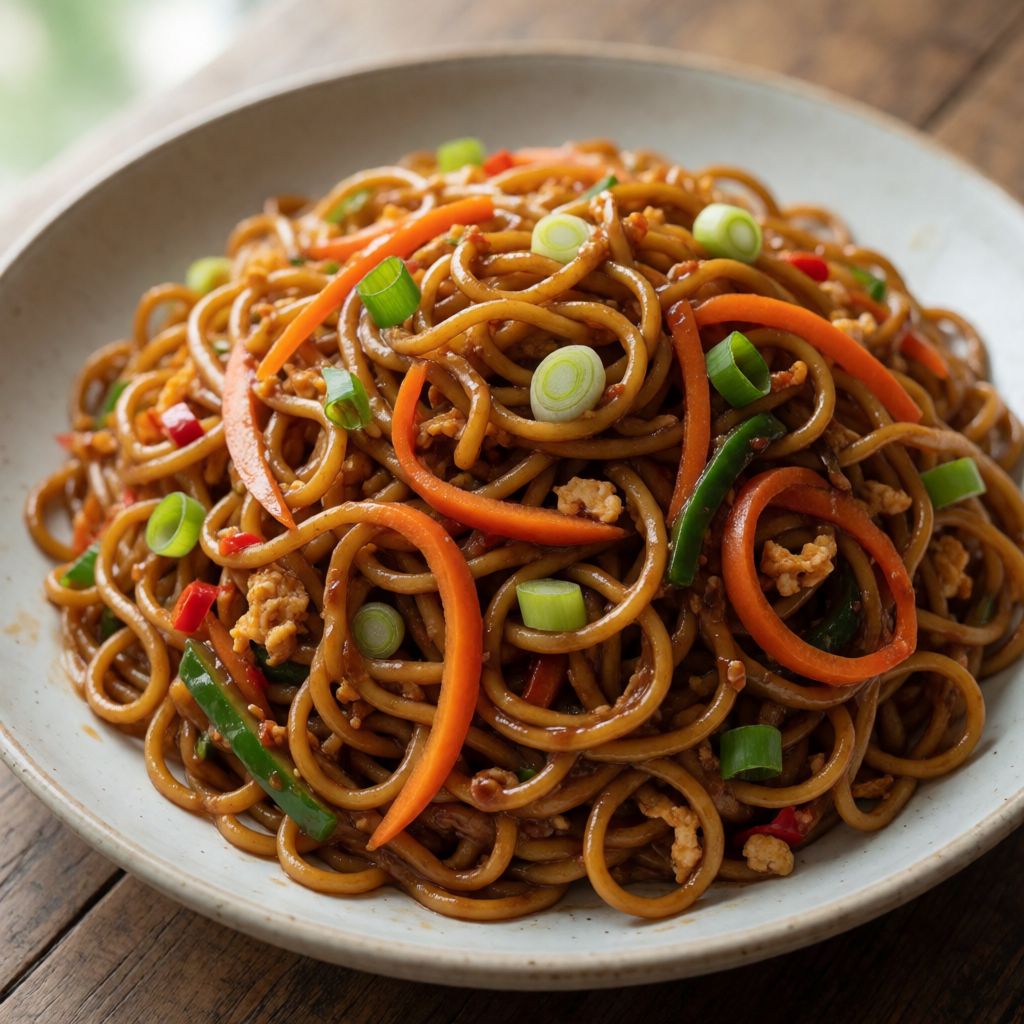
 AI photo
Noodles with Hoisin Sauce, Vegetables and Egg
Quick noodles tossed with a hoisin marinade, stir-fried vegetables and a crispy-edged fried egg.
Labels are worked out automatically from the ingredients and can be wrong. Check the packaging if it matters to you.
Ingredients
- 5 tbsp Hoisin sauce
- 1 tbsp Soy sauce
- 2 clove Garlic crushed
- 1 tsp Sriracha
- 1 pcs Lime
- 2 tbsp Sesame oil
- 2 pcs Carrot halved and sliced
- 400 g Pointed cabbage finely shredded
- 1 pcs Broccoli cut into florets
- 250 g Noodles
- 4 pcs Eggs
- 4 tbsp Sesame oil
- 1 tsp Chilli flakes
- 20 g Sesame seeds
- 1 bunch Coriander fresh











Steps
Mix the ingredients for the hoisin marinade into a sauce.
Cook the noodles for 1 minute less than stated on the packet.
Drain the noodles and immediately rinse them with ice-cold water so they don't stick together.
Stir-fry the carrot, pointed cabbage and broccoli in a pan with a little oil for 2 minutes over medium-high heat.
2 minAdd the noodles to the pan and pour over the hoisin marinade, mixing well.
Reduce the heat to low.
Heat oil in another pan.
Crack the eggs into the pan and fry over high heat so the edges turn crispy while the yolk stays runny.
Divide the noodles among bowls, top with the fried egg and sprinkle with sesame seeds, chilli flakes and coriander.
This is a stir-fry wearing noodle clothes — the vegetables cook properly and hot, the noodles arrive half-finished and get rescued by sauce, and the egg on top is the one thing in the dish that's allowed to be soft. Whether it works comes down to one thing: how dry everything is before it hits the pan.
A wide pan on a domestic hob is not a kazan. A kazan's curve lets you flick vegetables up the sides where they're not really cooking, just resting, while the centre stays blistering hot. A flat UK frying pan has no sides to retreat to — everything sits in the same heat, which means everything steams in its own water if you crowd it. So the carrot, cabbage and broccoli go in for a short, brutal time, not to cook through, but to take on char and heat while staying crisp. The cabbage especially — 400g is a lot of cabbage, and cabbage is mostly water held in cell walls. Give it too long and that water comes out, dilutes the sauce, and the whole thing turns from fried to boiled-in-its-own-juice. The carrot bends, doesn't snap, when it's ready; don't go by a clock here, the pan's own heat varies too much hob to hob.
Hoisin sauce is the backbone — fermented soybean, sugar, five-spice, built to be thick and sweet-salty on its own. Five tablespoons sounds like a lot until you remember it's carrying 250g of noodles and 400g+ of vegetables; thin, watery sauces disappear into bulk like that, so hoisin's job is to stay present. Soy sauce isn't there for more salt exactly, it's there for a different kind of salt — a sharper, thinner savouriness that hoisin alone doesn't have, since hoisin's saltiness is buried under sugar. If you've only got soy and no hoisin, you're not making this dish; hoisin's sweetness and thickness aren't optional background, they're half the identity.
Garlic, crushed rather than sliced, goes into the raw marinade — crushing breaks more cell walls than a knife does, so you get more of that sharp allicin bite in a sauce that never gets cooked down to mellow it. Sriracha and lime are the argument against the sweetness: chilli heat and acid, so the sauce doesn't just sit on the tongue as sugar. If sriracha isn't in the cupboard, any chilli sauce with vinegar in it does the same job — the criterion is heat plus acid together, not heat alone.
Sesame oil appears twice for two different reasons, and that's not an error in the recipe, it's two separate jobs. The 2 tbsp in the marinade is there cold, for smell — toasted sesame oil is aromatic, not really a cooking fat, it's closer to a seasoning you'd use the way you'd use a good vinegar. The 4 tbsp later is for the egg and the stir-fry heat, and here it's working as a medium that can take real heat without smoking and without fighting the other flavours. If your bottle of sesame oil smells faint, it's probably the wrong kind — the pale, "light" sesame oil sold for cooking is a milder cousin and won't carry the dish the same way. The honest substitute for the cold, aromatic one: there isn't a direct substitute by smell, because that smell is sesame oil's entire reason for existing, but a splash of light soy with a few crushed toasted sesame seeds gets you close.
Carrot, pointed cabbage and broccoli are chosen for texture contrast as much as flavour — one that bends, one that shreds and softens fast, one that stays slightly crunchy even cooked. If pointed cabbage isn't on the shelf, any pale, loosely-packed cabbage works, the dense tight winter cabbages take longer and behave differently in a quick stir-fry, so swap texture for texture, not just "cabbage for cabbage."
Noodles — the recipe doesn't specify the type, which tells you it's not the point here; wheat noodles, egg noodles, whatever holds its shape after a cold rinse and reheats in a pan without turning to paste. Chilli flakes, sesame seeds and coriander at the end aren't decoration for the photo — they're the last chance to put texture (seed crunch) and brightness (coriander, which wilts the second it's warm) onto a dish that's otherwise all soft noodle and soft egg. This feeds four as a proper bowl each, not four small tastes — it's a weeknight dish built around speed and one hot pan, the opposite economics of a Sunday roast's slow oven and patience measured in hours. Here the patience is shorter but just as real: patience is getting the vegetables out of the pan before they weep, and the egg out before the yolk sets. Rush that and you've got soup with noodles in it, not this.