
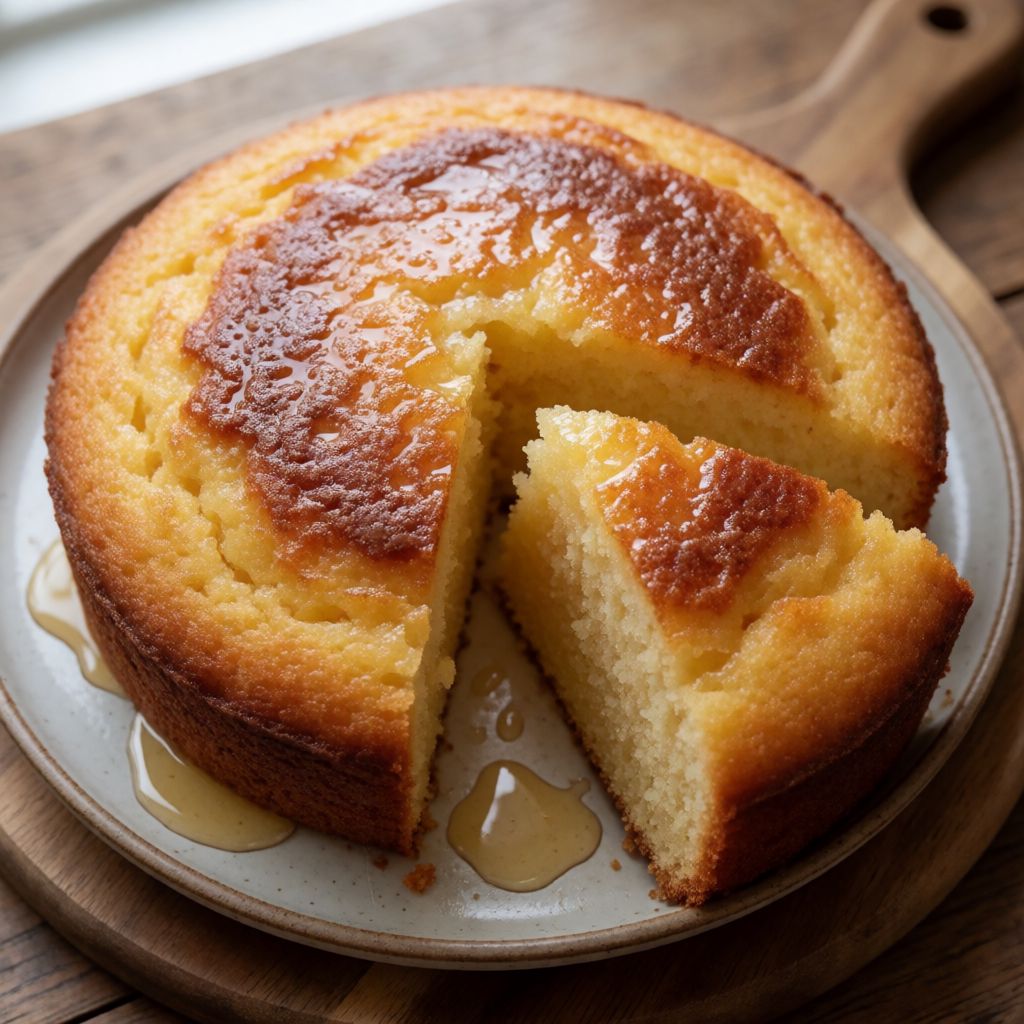
 AI photo
Milk and Honey Cake
A simple, moist cake made with milk and honey, baked until golden and finished with a dusting of icing sugar.
Labels are worked out automatically from the ingredients and can be wrong. Check the packaging if it matters to you.
Ingredients
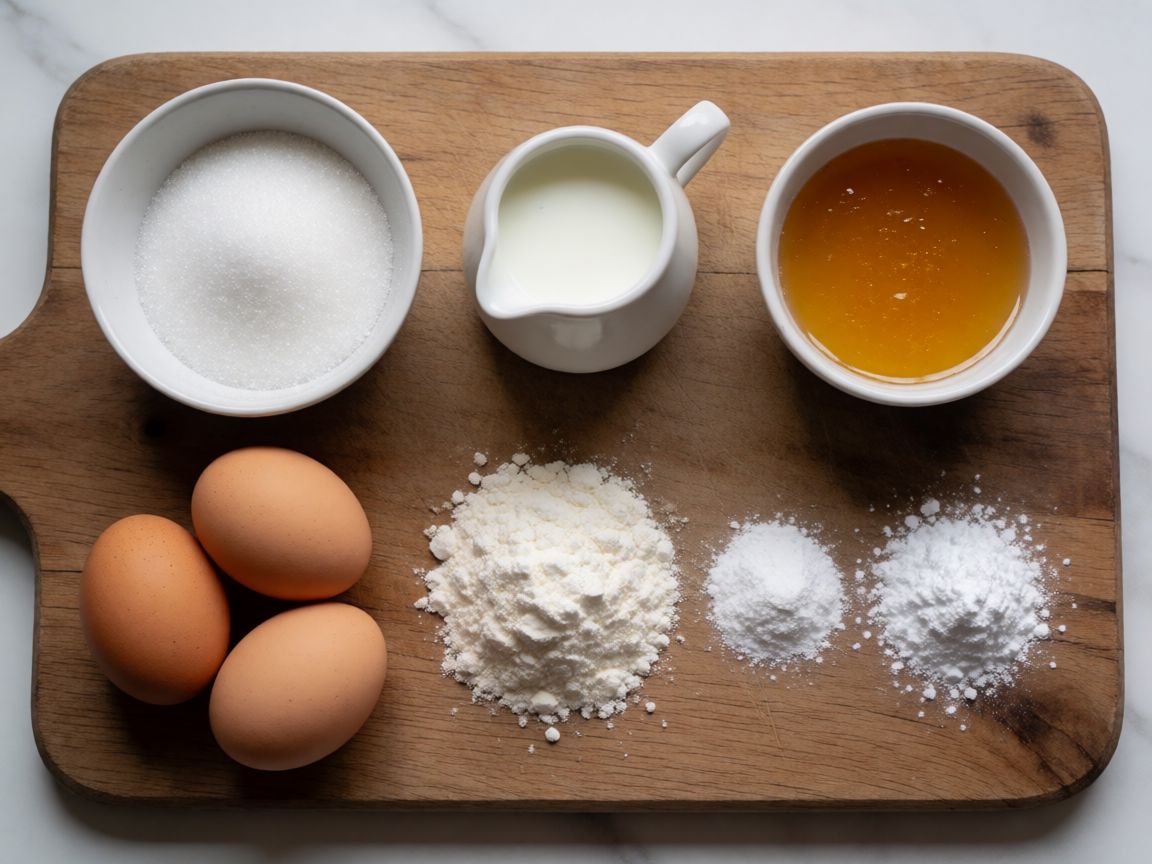
- 3 pcs Eggs
- 120 g Caster sugar
- 150 ml Milk
- 75 ml Vegetable oil
- 100 g Honey
- 150 g Plain flour
- 100 g Potato starch
- 15 g Baking powder
- pinch Icing sugar to taste, for dusting








Steps
In a large bowl, break the eggs and add the sugar, then beat with a mixer until pale and creamy.
Pour in the milk and vegetable oil, add the honey and mix well.
Sift the flour, potato starch and baking powder, then fold into the wet mixture. Mix thoroughly until you have a smooth, even batter.
Transfer the batter into a 28 x 10 cm loaf tin, greased with butter and dusted with flour.
Bake in an oven preheated to 180°C for about 30-40 minutes.
35 minCheck it is done with a wooden skewer: if it comes out dry from the centre of the cake, it is ready.
Let the cake cool completely before removing it from the tin, then dust with icing sugar.
This is a loaf cake, not a showpiece — the kind you cut into thick slices for a Sunday tea after the roast has gone cold and the plates are stacked. The crumb is what you're after here: soft, slightly damp, holding together without being heavy. That texture comes from a fight between two forces — air you beat into the eggs, and gluten you deliberately weaken with starch — and if you get the balance wrong you either get a flat biscuit-dense loaf or a crumb that falls apart on the fork.
What decides whether it works is mostly invisible by the time it's in the oven. Eggs and sugar beaten until pale and thick aren't just "combined" — you're whipping bubbles into the eggs and coating them in dissolved sugar so they hold their shape; that trapped air is your first rise, before the baking powder ever does anything. Skimp on that stage and no amount of baking powder saves you, because chemical leavening expands existing bubbles, it doesn't create a structure from nothing.
Some say honey cakes are moist because of the honey alone. No — honey helps, it's hygroscopic and pulls in moisture over the following days, which is why this loaf keeps well wrapped on the counter rather than going stale like a plain sponge. But the softness on day one comes from the potato starch diluting the flour's gluten. Flour alone, beaten this long, would give you something chewy and bread-like. Starch breaks that up.
Eggs here do two jobs — binding, which every cake needs, and leavening, which this one leans on more than most because potato starch has weakened the gluten and can't trap gas as well on its own. That's why they're beaten with the sugar rather than just stirred in: sugar crystals act almost like tiny whisks, shredding the egg proteins into a stable foam and dissolving into it at the same time, so what you get is pale, thick, and holds a ribbon when you lift the beater. If your eggs are cold from the fridge, let them sit out first — cold egg white resists foaming, and you'll be beating twice as long for half the air.
Milk, oil and honey together are the moisture-and-fat side of the batter. Oil rather than butter is the sensible domestic choice because it stays liquid at room temperature — a butter-based batter can seize slightly when it hits cold milk, oil never does. The rule for it is simple: any oil with no smell of its own, so a refined sunflower or rapeseed oil, not extra virgin olive oil, which will sit on top of the honey's flavour and argue with it. Honey, besides sweetening, is why this cake doesn't dry out by Tuesday the way a plain Victoria sponge does — it holds onto water in the crumb. If you've only got golden syrup, use it, but know you're trading the honey flavour for pure moisture-retention; it's not the same cake, just a cousin.
Flour, potato starch and baking powder get sifted together for a reason beyond breaking up lumps — sifting spreads the baking powder evenly through the flour so you don't get a bitter patch where too much landed in one spoonful, and the same for the starch, which needs to be everywhere the gluten is, not pooled in one corner. If you've no potato starch, cornflour does the same diluting job; what you're looking for is a starch with no taste of its own, not a flavour substitute.
The tin matters more than it looks. A long, narrow loaf tin like 28 x 10 cm gives you more surface crust relative to the volume than a round or square tin of the same capacity, and it also means the centre has further to travel to reach the temperature where the egg proteins set and the starch swells — roughly the 65-70°C mark inside, while the surface runs well past 140°C to brown. That's the real reason the bake time has a 10-minute spread in the recipe rather than a fixed number: ovens vary, and a fan oven will push you to the shorter end, a conventional one to the longer. Grease and flour the tin rather than just greasing it — the thin starch layer gives the batter something to grip that isn't bare metal, which is what stops the sides tearing away when you turn it out.
The skewer test works on a simple fact: raw batter is wet and clings to anything you push into it, set crumb doesn't. Push it into the thickest part, the centre, not the edges — the edges set first and will lie to you. And once it's out, resist the tin and the knife both. The cake is still cooking its structure as it cools, starch firming as it drops in temperature, and cutting into warm cake is the single most common way to end up with a gluey stripe down the middle and the wrong idea about what went wrong.