
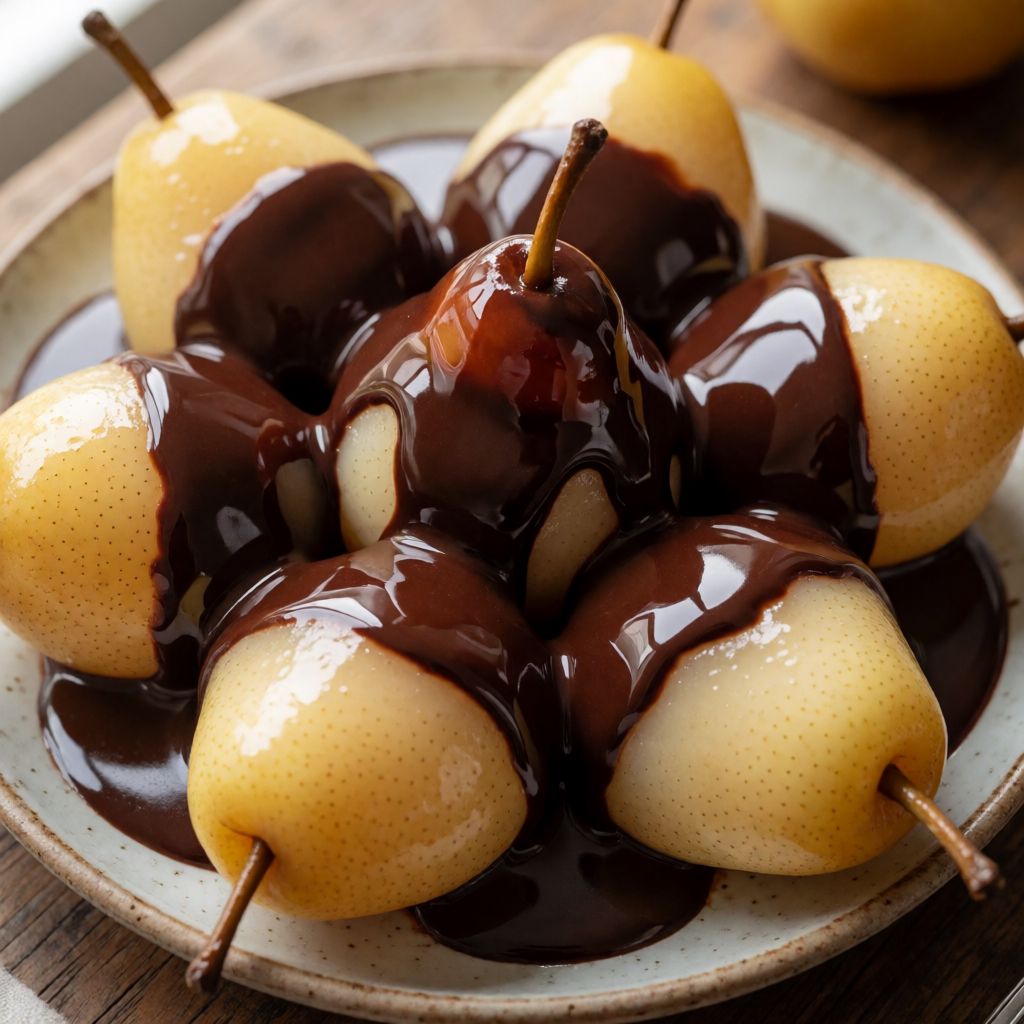
 AI photo
Pears in Chocolate
Pears gently poached in butter and wine, then draped in a silky dark chocolate glaze.
Labels are worked out automatically from the ingredients and can be wrong. Check the packaging if it matters to you.
Ingredients
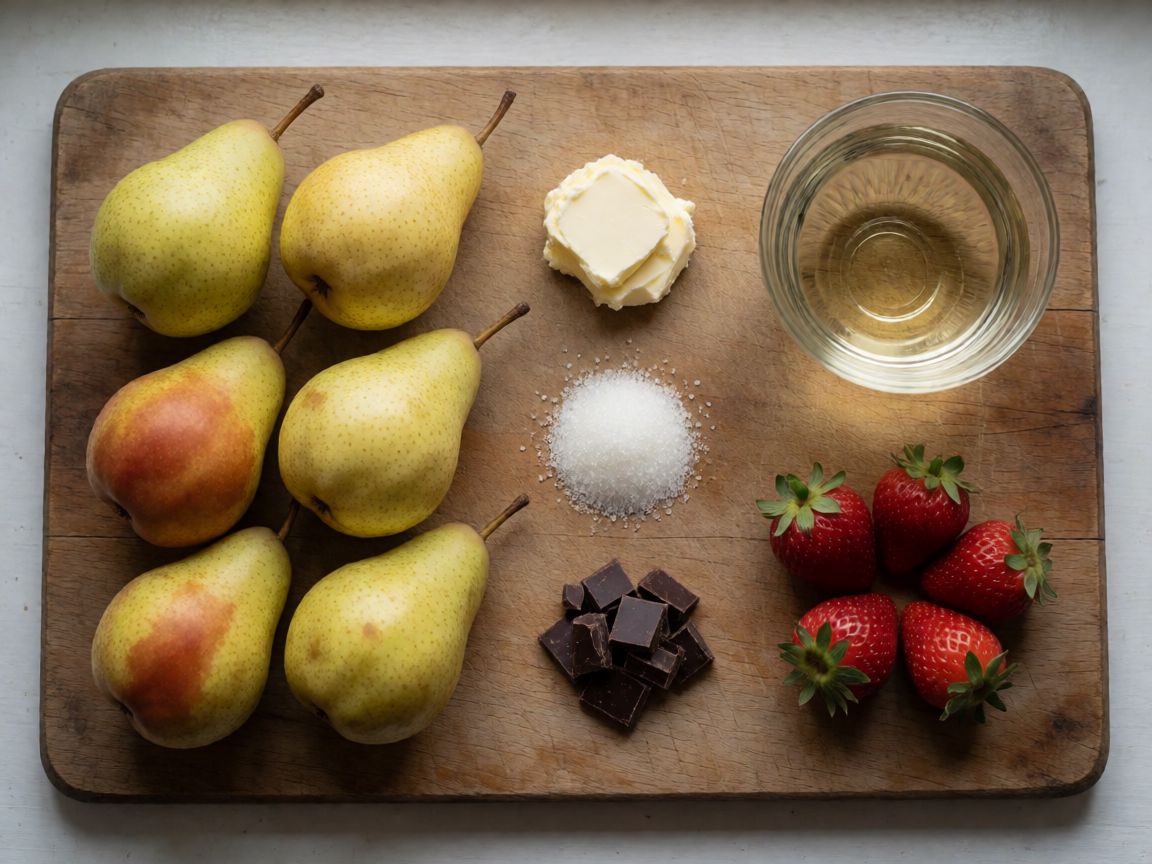
- 6 pcs Pear
- 50 g Butter
- 50 ml White wine
- 100 g Sugar
- 250 g Dark chocolate
- 6 pcs Strawberry or wild berries, for garnish





Steps
Peel the pears, removing the core but keeping the stalks intact.
Simmer the pears in a saucepan with the butter, splash with the wine and sprinkle with the sugar.
Finish cooking by adding the remaining wine, then drain the pears and let them dry.
Grate the chocolate and melt it in a bain-marie.
Arrange the pears on a serving dish, pour the chocolate cream over the top and chill in a cool place until ready to serve, garnished with strawberries.
This is a dessert built on two separate little operations that have nothing to do with each other, and the whole trick is not letting one wreck the other. You poach a pear until it goes from crunchy to tender without turning to mush, and you melt chocolate until it goes glossy without turning grainy. Neither step takes skill. Both take attention at the wrong moment and you lose the dish.
The pear itself is the quiet half of the job. Peeled, cored from below, stalk left on — that stalk isn't decoration for its own sake, it's the handle. You need something to hold while you drain and dry the pear later, and a bare naked pear rolling around a plate with no grip is how people end up fishing it out with a fork and bruising it. Keep the handle, keep your dignity.
The butter-wine-sugar bath is not really cooking the pear so much as finishing a ripening the orchard didn't get to do. Pears don't ripen evenly on the tree — that's an old grower's problem, not a myth, it's why pears are almost always picked hard and ripened off the branch. Poaching gently in fat, acid and sugar lets you push a slightly underripe pear the rest of the way without it collapsing into baby food, which is exactly what happens if you start with a pear that's already soft and give it more heat than it can take.
Simmering the pears means the liquid should be doing something closer to a tremble than a boil — small movement at the surface, no big bubbles breaking through. Butter burns if you push the heat, and a hard boil batters delicate pear flesh into rags from the outside while the centre is still raw. You're not reducing fast, you're persuading slowly. Test with a skewer or a thin knife: it should go in with no fight, the way it slides into softened butter, not the resistance of raw fruit and not the total surrender of mush. If it's still got a bit of bite in the very centre, that's fine — it firms up slightly again once it cools and chills.
Pears: go for something firm, barely ripe, not yet giving under thumb pressure — Conference or Comice work well and are easy to find in a British greengrocer's. A pear that's already soft and fragrant on the counter is lovely eaten as-is but will fall apart the moment it meets heat; save that one for the fruit bowl, not the pan.
Butter carries flavour into the fruit and stops it catching on the base of the pan, since pears release a fair bit of their own water as they soften and that water alone would leave them boiling in a thin puddle rather than basting in fat. Unsalted is right here — salted butter fights the sugar and wine instead of supporting them. If you've genuinely got none, a flavourless oil will stop the sticking, but you lose the slight nuttiness butter gives once it starts to brown at the edges, which is doing real work on the final taste, not just lubricating.
The wine's job is acid, not alcohol. A dry white cuts the sugar's flatness and keeps the syrup from tasting like plain sweet water — any dry white will do, there's no need to open something you'd actually want to drink. No wine in the house at all? A splash of water with a squeeze of lemon gets you most of the way; you lose a little of the depth but not the balance.
Sugar here isn't really for sweetness, the pear brings plenty of its own — it's drawing moisture out of the fruit and into the pan to build the syrup, and at the same time starting a gentle caramelisation with the butter. Ordinary caster or granulated sugar is fine; nothing fancy earns its keep in a syrup this short.
For the chocolate, go dark and reasonably high in cocoa — somewhere around 60–70% — because it sets with a clean, firm snap rather than staying soft and sticky, which is what you want once it's chilled over the pear and needs to hold its shape instead of sliding off in a puddle. Milk chocolate melts the same way but sets too soft and tastes mostly of sugar once it's cooled. Grating it before melting isn't fussiness either — smaller pieces melt evenly over gentle heat instead of leaving a lump in the middle still solid while the edges are already past the point of no return.
On an ordinary hob you won't have a proper bain-marie setup, and you don't need one — a heatproof bowl sitting over a pan with a couple of centimetres of water, the bowl not touching the water, water kept at a gentle simmer rather than a boil, does the job. The point of all that fuss with steam instead of direct heat is the same point as drying the pears: chocolate seizes with sudden heat or stray water just as readily as it does with a splash of liquid, and a rolling boil underneath sends up more moisture in the air than you'd think. Some say you can melt chocolate straight in a saucepan over a low flame and save the washing up — you can, once or twice, right up until the one time the heat creeps up on you and you're left scraping burnt chocolate off the bottom of a pan instead of pouring it, glossy, over fruit.
Strawberries at the end aren't just colour — their sharpness cuts through the richness of butter and chocolate together, which otherwise sits heavy after a few bites. Out of season, any berry with real tartness does the same job; a sweet, soft strawberry out of a punnet in January won't contribute much beyond looking the part.
This feeds six, one pear each, and it's worth doing the chilling properly rather than rushing it onto the table warm — the chocolate needs the cold to firm into something you can actually cut through with a spoon instead of chasing around the plate. Patience here isn't poetic, it's structural: a dessert served five minutes too soon is just a pear sitting in a puddle of warm cocoa.