
 AI photo
Christmas Jam-Filled Biscuits
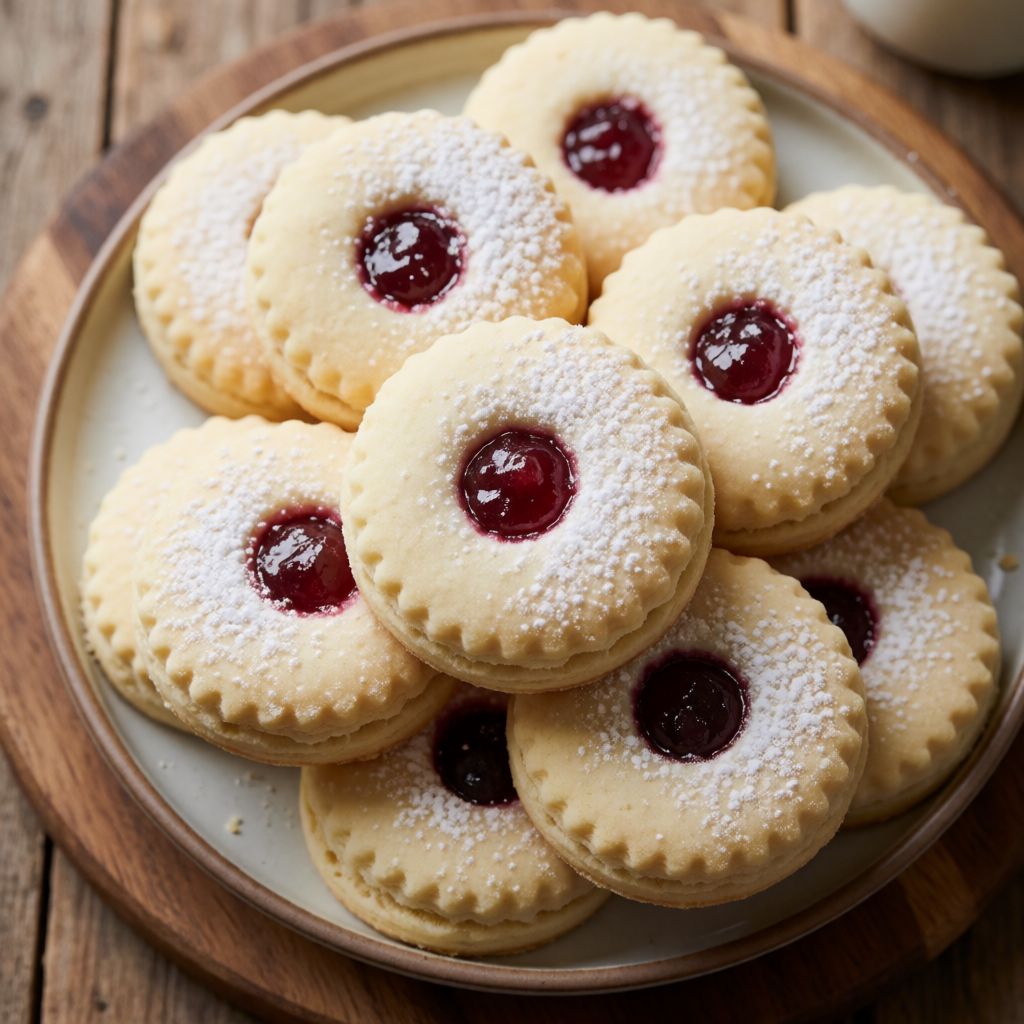
Festive sandwich biscuits filled with jam, cut into stars or flowers and dusted with icing sugar.
Labels are worked out automatically from the ingredients and can be wrong. Check the packaging if it matters to you.
Ingredients
- 300 g Plain flour
- 200 g Caster sugar
- 2 pcs Eggs
- 150 g Butter room temperature
- 1 pcs Baking powder
- 1 pinch Salt
- 1 pcs Vanilla extract
- 200 g Jam
- Icing sugar to taste









Steps
Sift the flour and baking powder, make a mound with a well in the centre and add the butter, sugar, eggs, vanilla extract and salt.
Mix all the ingredients energetically until the dough is smooth, elastic and free of lumps.
Wrap the dough in cling film, place in a bowl and leave in the fridge for about 1 hour.
60 minTake the dough out of the fridge and let it warm up slightly.
Roll out the dough with a rolling pin on a floured surface to a thickness of 2 centimetres.
Cut out biscuits with a star or flower cutter and repeat with the remaining dough.
Place jam in the centre of half of the biscuit shapes.
Using a smaller cutter, cut out the centre of the other half of the shapes and place them on top of the jam-covered biscuits.
Bake for about 12-15 minutes at 180°C, until the biscuits turn golden.
15 minLet the biscuits cool for a few minutes.
Dust the biscuits with icing sugar.
What was changed
Vanillin was replaced with Vanilla extract, as this is the ingredient familiar to British kitchens.
This is a jam sandwich dressed up for Christmas — two biscuits, one with a window cut in it, holding a spoonful of jam between them like a tiny edible stained-glass panel. Linzer biscuits is the family they belong to, though nobody in a British kitchen needs to know that name to get them right. What decides whether they work isn't the cutter shape, it's whether the dough stays short and snaps rather than bends, and whether the jam sits still instead of boiling out the sides.
The dough itself is a basic sweet shortcrust, really — flour, butter, sugar, egg, worked until smooth. Butter at room temperature means it blends into the flour rather than sitting there in cold lumps that melt unevenly in the oven and leave greasy patches. The rest, kneading "energetically," is doing a job too: you want the gluten to come together enough to hold a cut star shape without crumbling apart when you lift it, but not so much that the biscuit turns tough and bread-like instead of short and sandy underfoot.
The fridge rest is the step people are tempted to skip, and it's the one that actually saves the biscuit. Cold butter in the dough stays solid through more of the baking time, so the shape holds its points and corners instead of slumping into a blob. Skip the rest and you get something that spreads before it sets — recognisable, but blunt-edged, more cushion than star.
Some say you must use a specific jam, a specific cutter, specific this-and-that. No — the biscuit doesn't care. What it cares about is thickness and heat, which we'll get to.
Flour: plain, nothing fancy, because you don't want strength here — strength is for bread, where you need chew. A biscuit wants tenderness, so plain flour's lower protein is exactly right; strong or bread flour would make these tough enough to survive a letterbox. 300 g against 150 g butter gives you roughly a 2:1 ratio, which is the shortcrust backbone whatever you bake next to it.
Butter: room temperature, unsalted if you can, because you're adding your own pinch of salt and don't want to guess what's already in there. If you're out of butter, a firm margarine will stand in, but the flavour goes flat — butter is doing more than greasing here, it's carrying taste.
Sugar: caster, because its fine grain dissolves into the butter and egg mixture smoothly. Granulated will leave grit; icing sugar (for the dough, not the dusting) would make the dough too soft to roll cleanly. 200 g sugar against 300 g flour is a sweet dough, closer to a biscuit than a pastry case — that's deliberate, since the jam inside is sweet too and the whole thing is meant to read as a treat, not a base for something else.
Eggs: binding the dough and adding a little richness and colour. Two eggs for this amount of flour is generous — it's what gives you a dough elastic enough to cut into stars without crumbling at the points, rather than a drier pastry that would snap at every corner before it even reaches the oven.
Baking powder: one small measure, enough to stop the biscuit being completely flat and dense, giving it the faintest lift so it reads as biscuit rather than cracker. Vanilla and salt are the quiet workers — salt sharpens sweetness so the sugar doesn't sit flat on the tongue, vanilla rounds the butter flavour out. Neither needs much; neither should be skipped.
Jam: 200 g, and here you choose by what holds its shape when hot, not by what tastes best cold. A loose jam runs under oven heat and leaks out the seams — a thick-set jam, raspberry or apricot or whatever you've got in the cupboard from last summer's jamming, stays put. If your jam is runny, a scant teaspoon less per biscuit solves more problems than fussing over brand.
On the British domestic hob and oven — 180°C is a proper setting on a fan or conventional oven, nothing exotic, but ovens lie about their own temperature more than people admit, so trust the gold colour over the dial and the clock. Rolling to 2 cm by hand on a kitchen worktop, not a slab of marble, just means flouring the surface properly so the dough doesn't grab and tear — any tear in the base biscuit means jam escaping sideways while it bakes, which is the actual reason that step matters, not neatness for its own sake.
Icing sugar at the end, dusted after cooling, not before — dust it onto a warm biscuit and it melts into a sticky sheen instead of sitting as snow. That's the one moment where patience is the ingredient: let them cool a few minutes, then dust, and you get the Christmas-card look instead of a wet shine.