
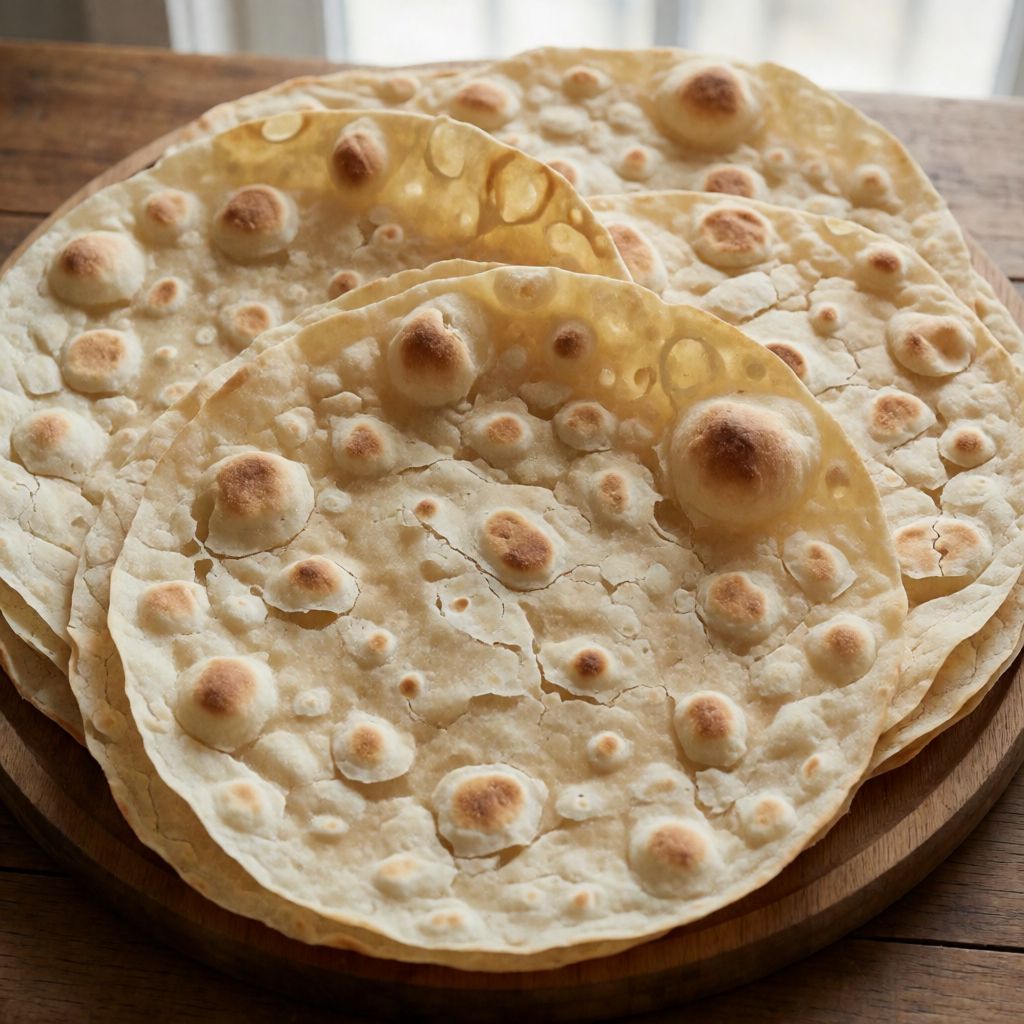
 AI photo
Carasau Bread
A traditional Sardinian flatbread, rolled thin and baked twice into crisp sheets known as carta da musica.
Labels are worked out automatically from the ingredients and can be wrong. Check the packaging if it matters to you.
Ingredients
- 250 g Water
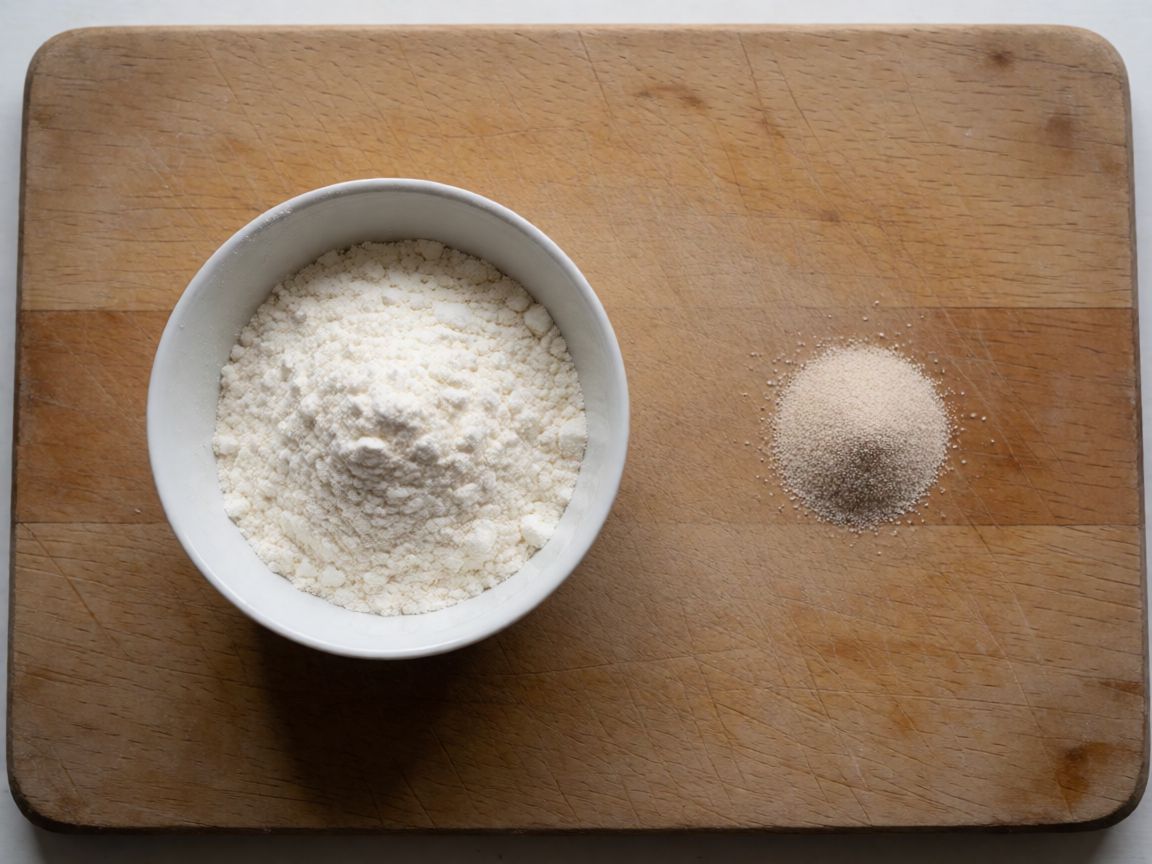
- 500 g Durum flour
- 5 g Yeast
- 10 g Salt


Steps
Pour the water into the bowl of a stand mixer, add the yeast and durum flour, and knead energetically. After a few minutes add the salt and keep kneading until the dough is smooth and elastic.
Transfer the dough to a container and leave it to rest.
38 minTurn the dough out onto a work surface, divide it into three pieces of 250g each, shape into balls, cover with a tea towel and leave to rest.
30 minRoll out each ball of dough into a 40cm circle, transfer onto a cotton cloth and leave to rise.
40 minPreheat the oven and place a baking stone inside, heating it at its highest setting.
Bake the first disc of dough, wait until it puffs up and blisters, then remove it from the oven.
1 minVery carefully split the disc into two with a knife to get two thin sheets, pressing gently around the edges.
Put the sheets back in the oven to dry until crisp.
2 minRepeat with the remaining discs of dough, stacking the finished sheets on top of each other.
Carasau is not bread you eat fresh and move on from. It is bread you make once and then forget about for weeks — a dry, brittle sheet, almost a cracker, that softens again the moment it meets water or steam. Armenian shepherds carried it up into the mountains for exactly that reason: no mould, no staleness, because there is almost no moisture left in it to spoil. You are not baking a loaf here, you are baking out the water.
What decides whether it works is a sequence, not a list of steps. First the dough has to puff — properly, like a pita — because that puff is what gives you two thin sheets instead of one thick one. Then you have to catch the disc at the exact moment it is cooked enough to hold its shape but still soft enough to pull apart without tearing. Miss that window and you either rip the dough or you are left splitting a cracker that's already set, which doesn't split, it shatters. Then, and only then, comes the second bake, whose whole job is to finish drying the sheets to a hard, honest crispness — that's the stage people skip when they're impatient, and that's the stage that actually makes this carasau rather than just flatbread.
So three things carry the whole recipe: a hot enough surface to force a fast puff, a dough strong enough to hold that puff without bursting, and the nerve to split it while it's still warm and giving. Everything else — the three rests, the rolling to 40cm — exists to get the dough to that point in good condition.
Durum flour isn't a style choice here, it's load-bearing. Durum has a tighter, tougher gluten than ordinary wheat — it's the same reason pasta holds its shape in boiling water instead of turning to mush. You need that toughness because the dough has to form a thin skin that traps steam without splitting open on the stone. Some say any strong flour will do for a flatbread — no, because a softer gluten tears at the thin point before the steam has a chance to lift it, and you get a flat disc with a few sad bubbles instead of a proper pita-like balloon you can slice into two sheets. If you genuinely can't get durum, a strong bread flour is the fallback, but expect a paler, softer bread with less of that nutty bite — not a failure, just a different bread wearing the same name.
Yeast and water are unremarkable here — 5g of yeast against 500g of flour is a slow, modest rise, not a race. That slowness matters: fermentation over the first long rest (nearly 40 minutes) is where the flavour actually comes from, not from the baking. Rush this stage and you get a crisp bread that tastes mostly of flour and nothing else.
The salt going in a few minutes after the flour, not with it, isn't fussiness. Salt tightens gluten on contact — add it too early and you fight the dough while it's still trying to hydrate and build structure, and you end up overworking it to compensate. Let the water and durum flour start forming gluten first, then add salt to firm up what's already there. That order is what gives you dough that's strong but not rubbery.
The three rests are three different jobs, not one long wait repeated. The first builds flavour and gas. The second — after dividing into balls — lets the gluten you just tightened by shaping relax again, so the dough will actually stretch to 40cm instead of springing back at you like a trampoline. The third, on the cloth, is proofing, but because the dough is now rolled paper-thin it's also quietly drying a skin on the surface, which helps it slide into the oven rather than stick and tear.
On the baking itself — be honest with your oven. A tonir or a clay oven throws radiant heat far beyond what a UK domestic oven on its highest setting can manage, even with a stone in it. You'll still get the puff, because the mechanism is the same — a flash of fierce heat flash-steams the surface moisture before the crumb has set, and the two skins of the disc separate as a pocket of steam between them. But don't expect tonir drama. Watch for the blister and the lift, not a clock; a minute is the lower bound, the puff itself is the real signal. If you don't own a baking stone — not everyone does, and buying one for a bread you'll make occasionally is a big ask — a thick, heavy tray or a cast-iron griddle, left in the oven from the start to heat through, does the same job: something that holds heat and delivers it to the base of the dough in one hard hit rather than slowly.
Splitting the disc wants confidence more than skill. The knife is just there to start the seam; you're easing two layers apart that steam has already half-separated for you, pressing gently round the edges so they don't tear where they're still joined. If it resists everywhere, it's not ready — leave it a few seconds more, don't force it.
The second, short bake that dries the sheets to a crack is the one people are tempted to shorten, because by then the kitchen's warm and you're hungry. Don't. That's the step doing the actual preserving — the reason this bread, unlike almost anything else that comes out of your oven, is still good to eat in three weeks, dipped in water to soften and wrapped round whatever you've got. From 500g of flour you'll get six thin sheets, which is a generous stack for four people and then some left over — which, with a bread built to keep, is rather the point.