
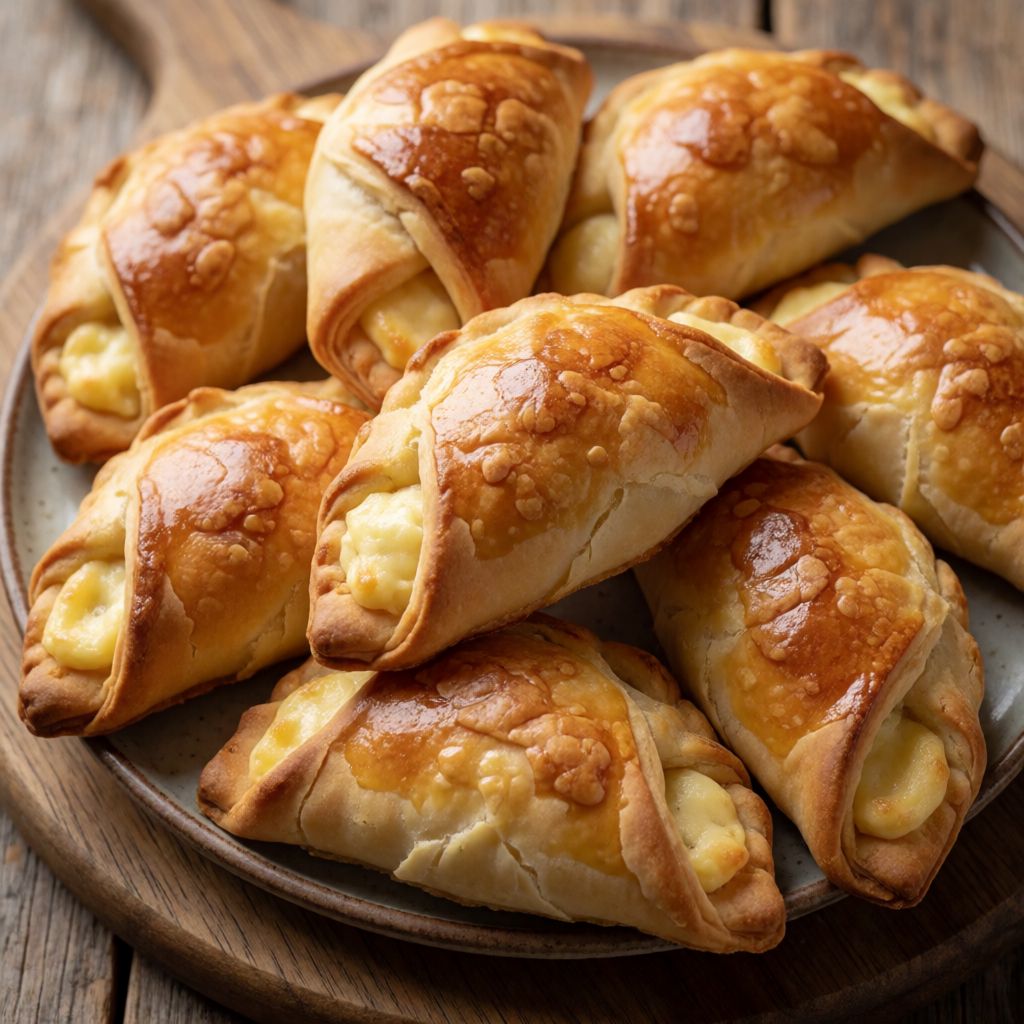
 AI photo
Fiadoni (Savoury Cheese Pastries)
Savoury half-moon pastries filled with a mix of cheeses, sealed with a fork and baked until golden.
Labels are worked out automatically from the ingredients and can be wrong. Check the packaging if it matters to you.
Ingredients
- 500 g Plain flour
- 100 ml White wine
- 100 ml Olive oil
- 2 pcs Eggs for the dough
- 1 pinch Salt
- 1 pcs Eggs for brushing
- 400 g Mature cheddar or another well-aged hard cow's milk cheese
- 100 g Pecorino Romano
- 100 g Parmesan
- 100 g Ricotta well drained
- 4 pcs Eggs for the filling







Steps
Beat 2 eggs, add the olive oil and white wine, mix in the flour and salt, and knead into a smooth dough.
Wrap the dough in cling film and leave it to rest.
30 minCombine the ricotta with the pecorino and parmesan, add the 4 beaten eggs and mix until smooth.
Roll the dough out into a thin sheet and cut into rectangles.
Place small balls of filling onto the dough, leaving space between them.
Cover the filling with dough, seal the edges and cut into half-moon shapes.
Press the tines of a fork around the edge of each piece to seal.
Lay the pastries on baking parchment, leaving space between them, and make a small cut in the centre of each.
Brush with beaten egg and bake in a fan oven preheated to 200°C.
18 min
What was changed
Mature cheddar replaces the smoked meat listed in error, since the filling needs an aged hard cow's-milk cheese.
Fiadoni are Corsican cheese pastries — a wine-and-oil dough wrapped round a filling that's basically a savoury cheesecake. Think of them as the Mediterranean cousin of your Sunday sausage roll: pastry case, rich filling, eaten warm from the tin. What decides whether they work isn't the dough, which is forgiving, but the filling — get the moisture wrong there and you get a soggy, split pastry rather than a set, sliceable one.
The dough here is unusual because it has no butter and no water. Wine and olive oil do the fat-and-liquid job together: the alcohol in the wine evaporates in the oven and leaves the gluten structure looser than a water dough would, so you get something closer to a short, biscuity case than bread. Some say wine in pastry is just for flavour — no, it's there because it behaves differently from water during baking, taking moisture out of the equation earlier, which matters when your filling is wet cheese and egg.
The filling is where the real engineering is. Ricotta is soft and carries water; cheddar, pecorino and parmesan are the structure — salty, aged, low in free moisture, and strong enough in flavour that a little goes a long way. The four eggs aren't padding, they're the setting agent: without enough egg relative to cheese, the filling stays a paste and leaks when you cut the half-moon seal; with it, the filling bakes into something you can hold in your hand.
On the flour: 500 g plain flour is right here — you're not after bread's chew, so don't reach for strong flour out of habit. Plain gives you a dough that rolls thin without fighting you, which matters because the pastries are meant to be a one-bite-and-a-half parcel, not a doorstop.
The white wine should be dry, not sweet — a sweet wine will fight the salt in the cheese. If you don't drink wine or don't have an open bottle, the honest substitute isn't water; it's a dry cider or even a splash of wine vinegar cut with water, something with acidity, because the acid is doing part of the dough's tenderising work, not just the alcohol. Don't skip it for plain water and expect the same texture — you'll get a tougher case.
Olive oil here wants to taste like olive oil — this is one of the few times "any oil with no smell of its own" is the wrong instruction, because the oil is a flavour ingredient as much as a fat. Use a decent, fruity extra virgin, not your cheapest bottle. If olive oil genuinely isn't to hand, a neutral vegetable oil will hold the dough together but you lose a layer of flavour you can't get back later.
On the cheese: mature cheddar standing in for Corsican sheep's cheese is a sound swap — what you need is age and dryness, not nationality. A young, mild cheddar will bleed water into the filling and you'll end up compensating by overbaking the pastries to dry it out, which toughens the dough. Pecorino and parmesan are there for salt and savoury depth in small quantity — these are seasoning cheeses, not bulk, so don't be tempted to increase them past the ratio given or the filling turns sharp rather than rounded. Ricotta must be well drained, as the recipe insists — tip it into a sieve for ten minutes if your tub looks wet, because any extra water here either steams the filling into a loose curd or escapes through your fork-crimped seal and burns onto the tray.
The four filling eggs plus two for the dough plus one for brushing is seven eggs for six people — that's not excess, it's structural, each batch doing a different job: binding the dough, setting the filling, glazing for colour. Don't use one egg to cover two jobs to save washing up; the dough egg and the filling egg are beaten and used at different stages and temperatures, and conflating them is how you end up short.
On the oven: 200°C fan is hot enough to set the egg in the filling and colour the pastry before the cheese underneath has time to leak out through the seams — a cooler oven gives the filling longer to soften and escape before the crust firms up around it. Eighteen minutes is a floor, not a clock to live by: look for the dough going from pale and raw-looking to an even gold, and a glossy egg wash gone matte and set. If your oven runs hot or cold against its dial — and most domestic ovens do, by a surprising margin — trust the colour over the timer.
A word on patience, because this dish asks for it twice. Thirty minutes' rest for the dough isn't a formality — it lets the gluten you just worked relax, so when you roll it out thin it doesn't spring back and shrink on you mid-cut. And the filling benefits from being made ahead and left to cool, even briefly, because cold filling holds its shape as a ball far better than warm, loose filling, which collapses sideways the moment you try to wrap dough around it.