
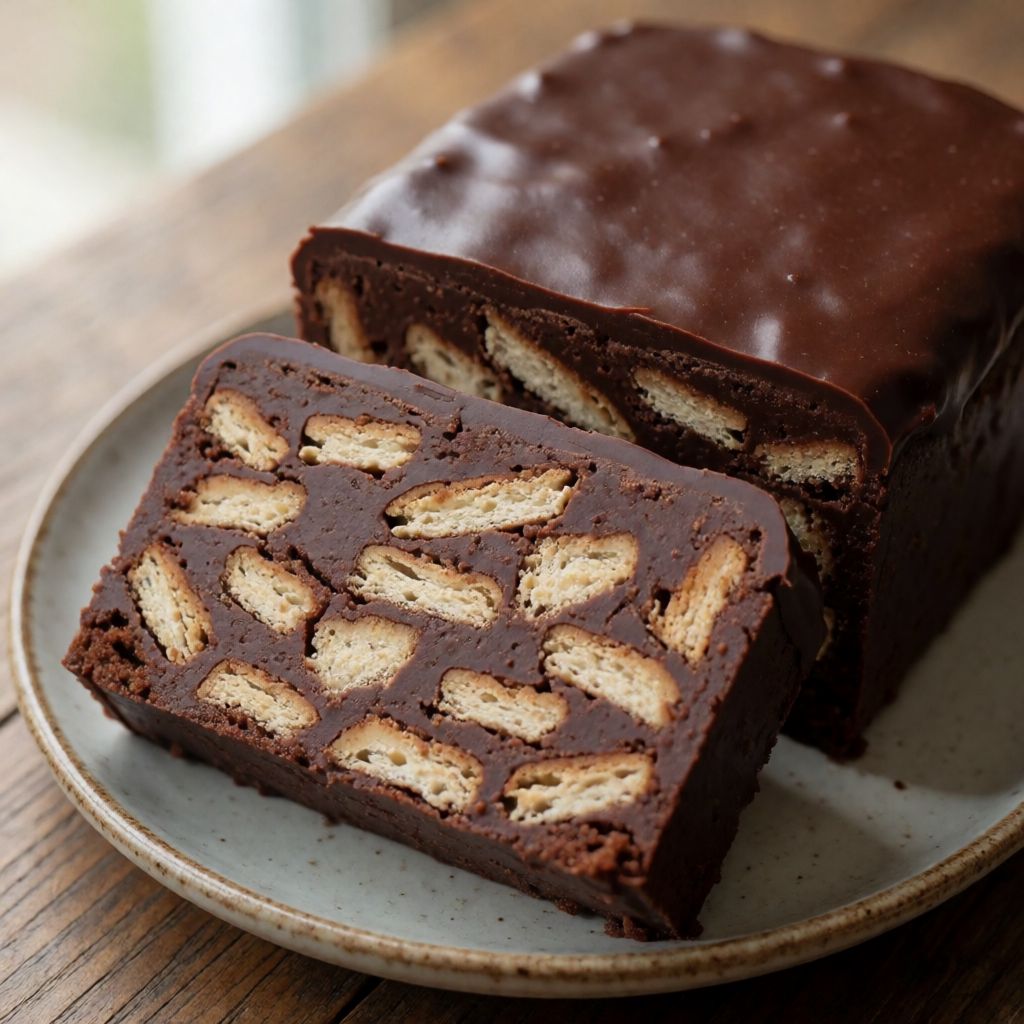
 AI photo
No-Bake Chocolate and Hazelnut Fridge Cake
A cold, no-bake chocolate and hazelnut cake made with crushed biscuits, mascarpone and melted chocolate.
Labels are worked out automatically from the ingredients and can be wrong. Check the packaging if it matters to you.
Ingredients
- 300 g Dark Chocolate
- 200 g Milk Chocolate
- 2 tbsp Sugar
- 120 g Mascarpone
- 1 tsp Instant Coffee
- 300 g Cocoa Biscuits
- 5-6 pcs Amaretti Biscuits
- 40 g Hazelnuts chopped






Steps
Crush the cocoa biscuits in a food processor into fine crumbs, adding the amaretti biscuits.
Melt the dark chocolate in a bain-marie, stirring, and leave to cool.
In a large bowl, mix the mascarpone with the sugar and beat with a spoon until smooth.
Add the crushed biscuits, the cooled chocolate, the coffee and half of the hazelnuts, and mix well.
Spread the mixture into a tin greased with butter or lined with baking paper, and press down lightly.
Build up the edges so they stand higher than the centre.
Melt the milk chocolate in a bain-marie and pour it into the centre of the cake.
Sprinkle the remaining crushed hazelnuts over the cake.
Chill the cake in the refrigerator for 30-40 minutes.
35 min
This is not a cake in the oven sense — it's a fridge cake, which is really a cold press job. You're building a biscuit skeleton, gluing it together with melted chocolate and softened cream cheese, and letting the fridge do the only "cooking" there is: crystallising fat back into something firm enough to slice. Nothing here browns, rises, or sets by heat. It sets by cold. That changes what actually matters: not minutes in the fridge, but the state of the chocolate when it goes into the bowl, and how hard you pack the crumb.
Some people still think anything that doesn't see an oven "isn't really baking." No — because this dish exists for the opposite reason: it's what you make when the oven is busy. In a British kitchen that's usually Sunday, with the joint taking up the only heat source in the house for three hours. Fridge cakes like this one are old kitchen economics — a way to use broken biscuits, the last of a chocolate bar, and a free bit of fridge space, without competing with the roast for the one thing you can't double: oven room.
The trick that decides whether it looks like a proper cake or a chocolate puddle is the rim. You build the edges of the base higher than the centre on purpose, so when you pour the melted milk chocolate on top it pools instead of running off — a shallow dish made of biscuit, not pastry. That's the whole visual payoff: a dark, dense base with a pale, glossy lake sitting in it, not a cake with icing dribbled over the side.
The two chocolates aren't interchangeable, and that's not snobbery — it's structural. Dark chocolate (around 70%) has more cocoa solids and less sugar fat, so it sets harder; it's what gives the base its backbone, the bit that holds its shape when you cut a slice and it doesn't collapse. Milk chocolate has more sugar and milk fat, so it stays softer and glossier — perfect for the top pool, where you want a contrast you can see and a texture that gives under the teeth rather than snapping. Swap them the wrong way round and you get a soft base that won't hold a slice, with a brittle cap that cracks instead of yields.
The bain-marie step isn't fussiness either. Melt chocolate directly over a flame and the cocoa solids scorch before the fat has fully let go — you get a grainy, bitter mess instead of a smooth pour. The water bath keeps the heat gentle and even, which is also why you must keep every drop of actual water away from the chocolate itself: one splash and the sugar in it seizes into a stiff, unworkable paste. That's not an old wives' tale — it's simple chemistry of sugar meeting water in the wrong ratio, and it's why you dry the bowl and the spoon before they go anywhere near melted chocolate.
Letting the dark chocolate cool before it meets the mascarpone matters for the same family of reasons. Mascarpone is cold and full of moisture; hot chocolate poured straight onto it will seize at the point of contact and leave you picking grainy lumps out of a mix that should be silky. Give the chocolate a few minutes to come down near room temperature first, and it folds into the cheese instead of fighting it. Mascarpone itself is there to keep the crumb from turning into dry sand once it's chilled — if you haven't got any, full-fat cream cheese will do the same binding job, just with a sharper, less sweet-cream flavour.
The biscuit crumb is the scaffolding, so crush it fine and even — big chunks leave weak points that crumble when you slice, the same way a wall built of mismatched bricks fails at its joins. Cocoa biscuits give you the colour and chocolate note without adding more sweetness than the cake needs; amaretti bring a bitter-almond edge and a touch more crunch into the mix. No amaretti to hand? Use more of the cocoa biscuit, or any plain digestive-type biscuit — the amaretti is there for contrast, not for structure, so its absence won't collapse anything.
Instant coffee in a chocolate dessert isn't about caffeine — it's an old trick for making chocolate taste more like chocolate, cutting through the sweetness rather than adding a coffee flavour you'd notice on its own. Dissolve it in the smallest amount of hot water before it goes in, or you'll get grit instead of depth. The hazelnuts want the same light touch: toast them yourself in a dry pan until they smell different, not just warm, and they'll do more work than the raw, pre-chopped kind. Any nut with a clean, un-competing flavour works in their place — almonds, walnuts — the point is crunch and roast, not a specific nut.
Line the tin with baking paper rather than just butter if you want clean edges on the finished slice — paper lets you lift the whole thing out and peel it back without tearing the built-up rim you worked to create. And press the mixture down lightly, not hard — enough to remove air pockets so it doesn't crumble on the knife, not so much that it turns dense and chewy. That's patience doing its quiet work twice in this recipe: once in your hand while you press, and once in the fridge while the chocolate finishes what the heat started.