
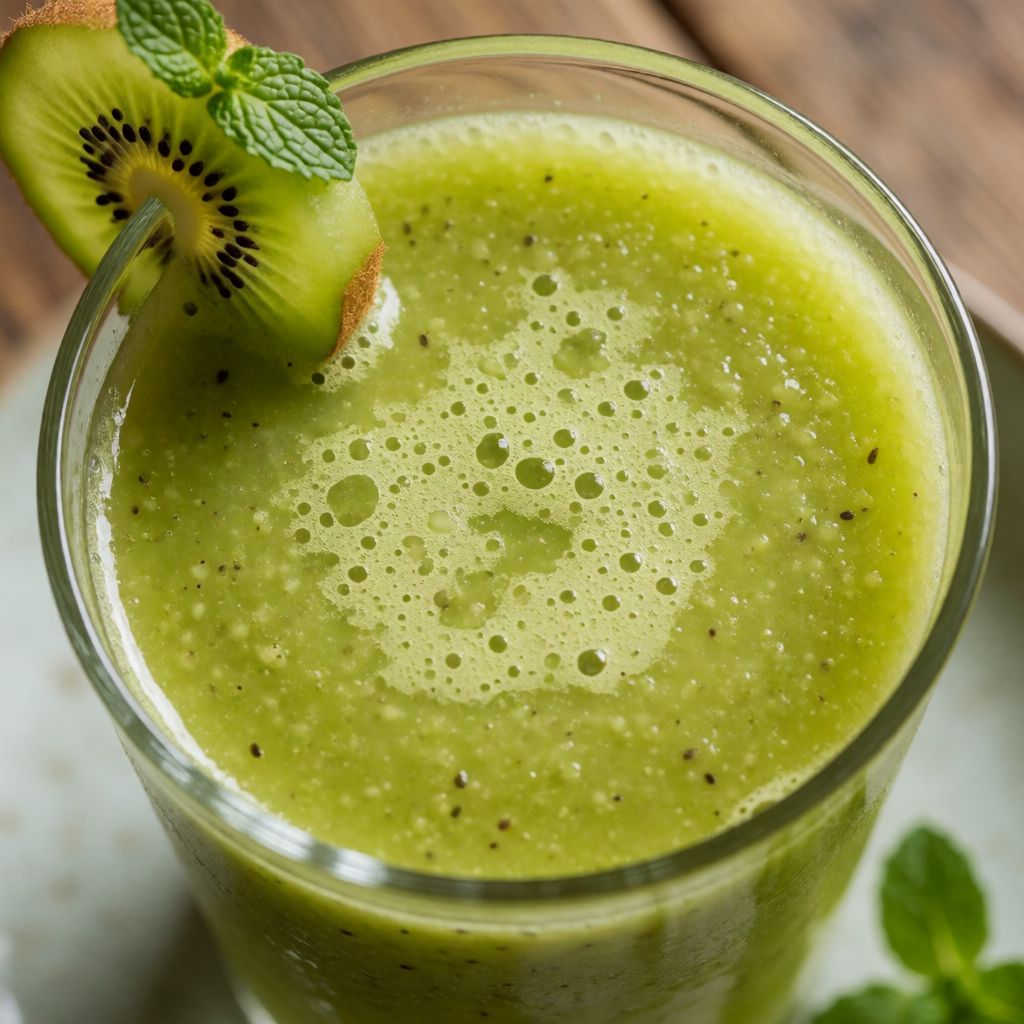
 AI photo
Green Kiwi Juice
A refreshing green juice made with kiwi, broccoli, apple, pear and ginger.
Labels are worked out automatically from the ingredients and can be wrong. Check the packaging if it matters to you.
Ingredients




Steps
Put everything into a juicer and enjoy with ice cubes.
5 minYou can also blend it in a blender — the drink will become richer in fibre and thicker; in that case I recommend adding a small ripe banana to make it creamy and taste like a smoothie.
2 min
This isn't really a recipe, it's an assembly line — fruit and one vegetable through a machine, cold to the glass. What decides whether it works is not technique, it's timing of a different kind: how ripe the fruit was before you touched it. A juicer doesn't cook, doesn't soften, doesn't correct anything. Whatever sweetness or bitterness is in the apple and pear going in is exactly what's in the glass coming out.
Some say green juice is a health food because it's green. No — it's a sweet drink with a vegetable hidden in it. The broccoli is there for colour and for the halo it gives you to feel virtuous at breakfast; the actual flavour is carried entirely by the apple, pear and kiwi. Put in too much broccoli stem and you get something grassy and bitter that no amount of ginger will rescue — the fix isn't more ginger, it's less broccoli, or riper fruit to cover it.
The juicer spins the fibre out and leaves it in a separate container — what you drink is the liquid, clear-ish, thin. The blender keeps everything in, fibre and pulp together, so the same ingredients come out thick, almost a purée. That's not a flaw in the blender method, it's a different drink, and if you go that way you need something to bind the fibre so it doesn't feel like drinking wet sawdust — a ripe banana does that job, and also quietly fixes any sourness from an apple that wasn't quite ready.
Ice cubes at the end aren't decoration. A juicer, by friction, warms what passes through it slightly — not much, but enough that a drink meant to be refreshing tastes flat without the ice bringing it back down.
Kiwi, two of them, peeled: this is sweetness with a sharp acidic edge and it's what gives the drink its green colour as much as the broccoli does — if you've only got the fuzzy kind, fine, same fruit, more work with the knife. Choose kiwi that gives slightly under the thumb. Rock-hard kiwi is mostly starch still, not sugar yet, and it will make the whole glass taste thin.
Broccoli, a small amount, is doing a job of restraint, not flavour. 100 g in a glass that also holds three pieces of fruit is a minority vote — enough to say "vegetable" without the drink saying "salad." Any mild raw green works on the same logic: courgette, cucumber, the tender part of celery. Kale and spinach are bitterer, so if you swap in either, you'll need to lean harder on the pear to keep the balance, or you'll taste nothing but green.
Apple and pear are the actual engine of the drink — they supply the sugar that makes everything else drinkable. This is where the patience is, and it's patience spent before you ever start the recipe: buy the fruit a few days ahead and let it ripen on the counter. A pear that's still hard as a cricket ball gives almost no juice and what it gives is sour water. Press your thumb gently near the stem end — give, not mush, is what you want. If your fruit is underripe on the day, don't force it through — use less of it and make up the sweetness with an extra kiwi or a spoon of honey, because the machine will not ripen fruit for you.
Ginger, "or to taste," is the one ingredient where quantity is a genuine question rather than a cop-out. Young ginger — smooth, pale skin, almost see-through when sliced thin — is juicy and mild, you can be generous. Old ginger, the knobbly, dry-skinned kind that's been sitting in a shop since autumn, is more fibrous and far more pungent gram for gram — half of what you think you need. Start with a piece the size of your thumb's top joint and taste before adding more; you can't take it back out once it's in.
If you go the blender route for the fibre and thickness, the banana isn't a nutritional add-on, it's doing mechanical work — its starch and texture give the suspended fibre something to hang onto, so the drink coats the glass and your spoon-or-straw rather than separating into pulp and water the moment it sits for a minute. Use it ripe, with brown freckles starting on the skin — that's when its own starch has turned to sugar and it'll disappear into the mix rather than announce itself.
On a British kitchen counter none of this needs special kit beyond whichever machine you already own — juicer or blender, both are standard here. The only real decision the recipe is asking you to make, every time, is: ripe enough, or not yet? Everything else is five minutes and a sink to wash afterward.