
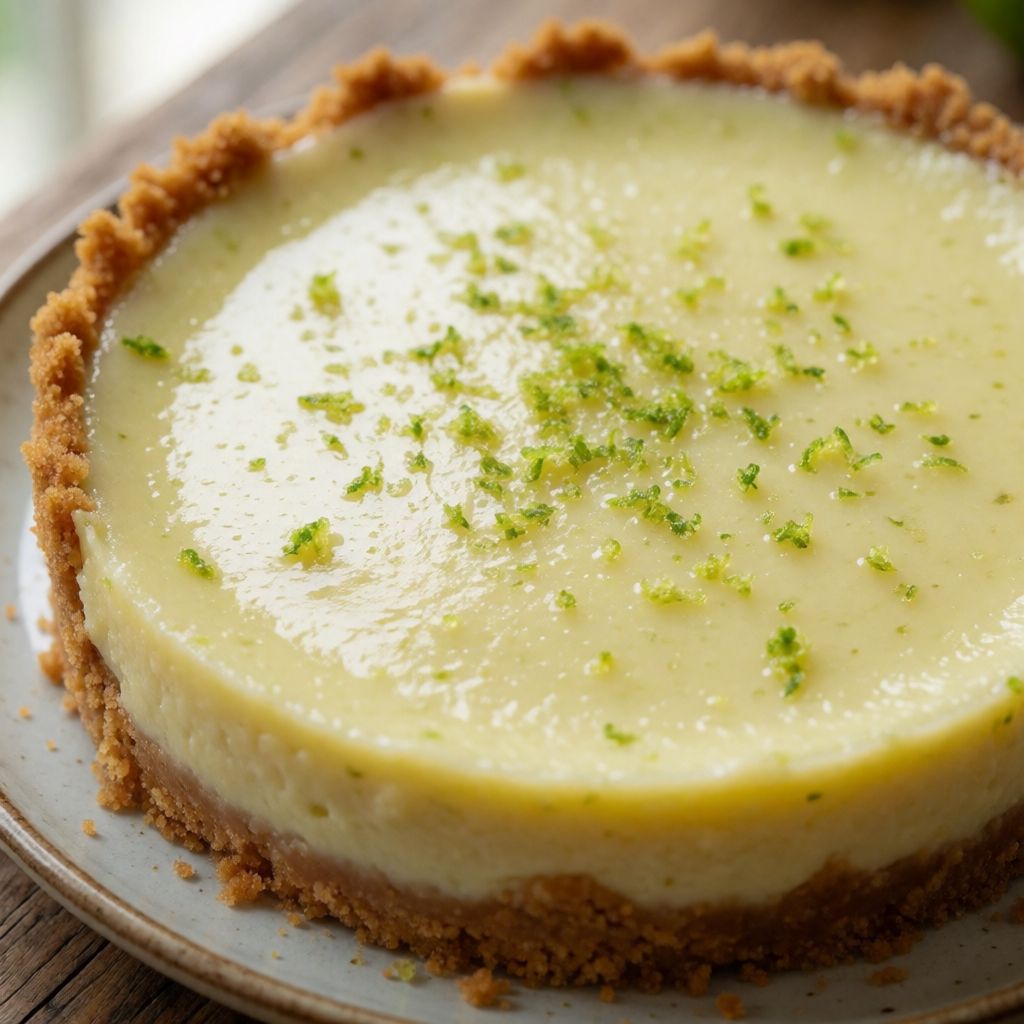
 AI photo
Lime Pie
A creamy lime pie with a biscuit base, finished with whipped cream, lime slices and little chocolate balls.
Labels are worked out automatically from the ingredients and can be wrong. Check the packaging if it matters to you.
Ingredients
- 250 g Digestive biscuits
- 125 g Butter
- 1 pinch Salt
- 600 g Condensed milk
- 6 pcs Egg yolks
- 5 pcs Lime for juice and zest
- 250 ml Whipping cream whipped to soft peaks
- 1 pcs Lime cut into thin slices
- 1 tsp Dark chocolate balls
- 1 pinch Edible gold dust
- 2 pcs Mint sprigs, for decoration









Steps
For the base, blitz the biscuits in a food processor to fine crumbs.
Add the butter and salt and mix quickly until combined.
Spread the base into a greased 24 cm loose-bottomed pie tin.
Press the base firmly by hand over the bottom and sides of the tin so it is evenly spread.
Bake the base in an oven preheated to 170°C (fan) for about 10 minutes.
10 minLet the base cool on the kitchen counter.
For the lime filling, whisk together the condensed milk and egg yolks.
Add the lime juice to the mixture along with freshly grated zest from one lime and mix well.
Taste and add more lime juice and zest if needed.
Spread the lime filling over the pre-baked base and bake the pie in an oven preheated to 160°C (fan) for 20–25 minutes. The filling should be set and soft, not liquid in the centre.
25 minLet the pie cool on the kitchen counter, then chill in the fridge for at least 3 hours or overnight.
Decorate the pie with whipped cream, lime slices and little chocolate balls rolled in edible gold dust, plus a little mint.
What was changed
The decorative herb Mint was swapped for mint, as lemon balm is not available in the ingredient catalogue.
This is a Key Lime Pie by another name — a biscuit shell, a filling that sets without gelatine, and cold as the real seasoning. What decides whether it works isn't the baking, it's the chemistry you're relying on instead of heat: the acid in lime juice meets the proteins in condensed milk and egg yolk and curdles them, gently, into something that slices clean. The oven just helps that reaction finish evenly and kills any raw-egg worry. If you've only ever made custard by cooking it on the hob, this feels backwards — you're not cooking a sauce, you're setting a reaction.
Some say lime pie needs a water bath like a cheesecake, to stop it cracking. No — because this filling has no flour and almost no air in it; it's dense and wet from the condensed milk, so it doesn't rise and fall and tear the way a cheesecake does. The real risk here isn't cracking, it's overbaking — push past "soft wobble in the middle" and the egg proteins tighten too far, the filling turns grainy and weeps liquid later in the fridge. Twenty to twenty-five minutes is your lower bound, not your target; the target is a centre that moves like set jelly, not like soup, when you nudge the tin.
Digestive biscuits are doing a job, not supplying flavour — they're starch and a bit of malt sweetness, mainly a crumb that holds fat. Any plain, not-too-sweet biscuit that turns to dry sand in a processor works the same way: a British digestive, a ginger nut if you want a bit of heat under the lime, even plain shortbread trimmed of sugar in the filling to compensate. What you want to avoid is anything already soft or oily — it won't bind with the butter, it'll go greasy instead of crisp.
Butter is the glue, and it's doing exactly what it does in pastry: melting fat coats the crumbs and sets hard again in the fridge, locking the shape. 125 g to 250 g of biscuit is a ratio you can trust by feel more than by scale — squeeze a pinch of the mixed crumb in your fist; if it holds together like wet sand, it's right. Too little butter and the base crumbles when you slice; too much and it turns from a base into a toffee underneath because the butter never fully resolidifies.
Condensed milk is the one ingredient here doing the work of three — sugar, dairy, and thickener all at once, which is exactly why this pie exists as a no-cream-sauce, no-roux shortcut. It's sweetened and reduced already, so there's no raw milk water content to boil off; that's what lets the filling set in under half an hour at a gentle oven temperature instead of needing a stovetop custard. There is no real substitute that behaves the same — evaporated milk plus sugar gets you close in sweetness but you lose some of the body, so if you use it, cut back slightly on the lime juice or the filling won't firm up properly.
The egg yolks are there for structure, not richness — heat sets their proteins and that's what turns a sweet liquid into a sliceable filling. This is also why you don't need gelatine or cornflour: the acid from the lime juice has already started denaturing those proteins the moment you mixed it in, well before the oven touches it. That's the one detail worth noticing while you work — don't let the mixed filling sit too long on the counter before it goes in, because it's already thickening slightly from the lime, and you want the oven finishing a reaction already underway, not restarting a cold one.
Lime itself is acid and aromatic oil, two different jobs split between juice and zest. Juice sours the filling and drives the set; zest carries the smell, which lives mostly in the oil of the peel, not the pulp. Grate zest before you juice the fruit — obvious once you've cut a juiced lime in half and tried to zest a flattened, dry rind. Five limes sounds like a lot until you remember UK limes are often small and dry compared to the fruit this dish started life with in Florida with its thin-skinned local limes — taste as you go, because "5 limes" is a target, not a guarantee, and dry fruit may need an extra one.
The whipped cream on top is contrast, not decoration for its own sake — cold, unsweetened-ish softness against a filling that's dense, sweet, and acid-sharp. Whip it only to soft peaks; stiff peaks on a pie topping weep and go grainy sitting in a fridge overnight, because you've pushed the fat globules past the point they hold water happily. The gold dust and chocolate balls are theatre, and there's nothing wrong with theatre — just know they're doing zero work for the pie's structure, so if you've got none, a few extra lime zest curls do the same visual job of saying "there's citrus in here" before anyone's taken a bite.