
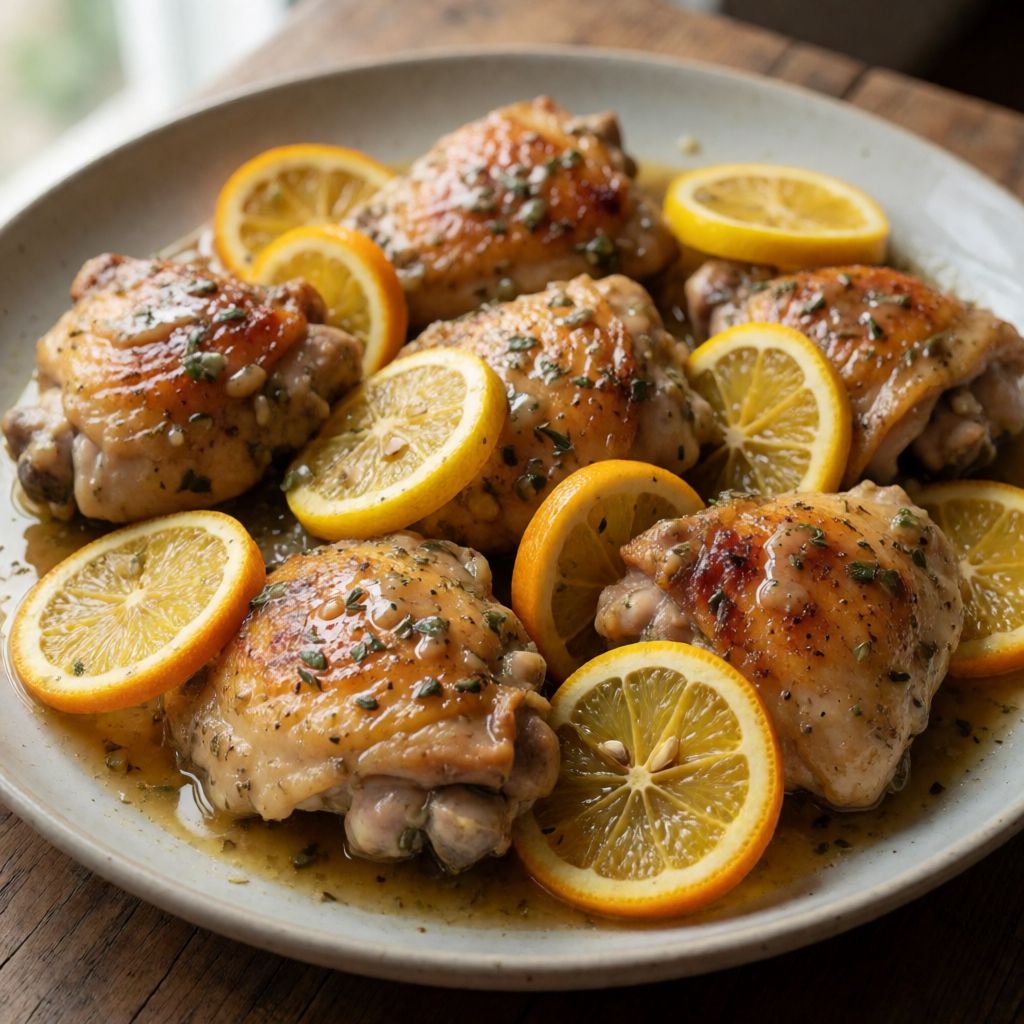
 AI photo
Livorno-style Chicken with Citrus
A Tuscan dish of chicken braised with white wine, orange and lemon for a bright citrus sauce.
Labels are worked out automatically from the ingredients and can be wrong. Check the packaging if it matters to you.
Ingredients
- 1 pcs Whole chicken cut into pieces
- 3 tbsp Olive oil
- 20 g Butter
- 250 ml White wine
- 1 pcs Orange
- 1 pcs Lemon
- Dried herbs marjoram, thyme, bay leaf, rosemary, to taste
- Salt to taste
- White pepper to taste
- Plain flour to taste










Steps
Pat the chicken pieces dry, dust them in flour, and fry in a pan with olive oil and butter.
Pour in the white wine, let it evaporate, sprinkle with the chopped herbs and add salt.
Cook over low heat, adding the orange and lemon juice.
40 minGrate the zest of both citrus fruits and add it to the pot for aroma.
Turn the chicken pieces often, adding water as needed so they don't dry out. Doneness: 74°C inside.
Just before the end of cooking, sprinkle with black pepper.
Serve with mashed potatoes or basmati rice, drizzled with the citrus sauce.
This isn't a roast, even though it starts with a Sunday-roast bird in a Sunday-roast kitchen. The chicken goes into the pan to brown, not to cook through — that's the job of the forty minutes that follow, where citrus acid does to the meat what long oven time does to a joint: breaks down the tough fibres until they give. So the dish lives or dies on two separate moments, not one: the crust you build in the first five minutes, and the patience you show for the next forty.
Browning first means flour first. Some cooks skip the dusting, thinking it's only for crunch — no, it isn't, because the crunch won't survive the braise anyway. The flour is glue. It catches on the hot oil and butter, forms a thin skin that seals the surface so the juices inside don't boil straight out into the pan, and it leaves behind the fond — those stuck brown flecks — that the wine will lift and turn into the backbone of your sauce. Skip the flour and the chicken weeps into the pan instead of browning in it.
Once the wine's gone — not disappeared, just stopped smelling sharp and started smelling like wine that's cooked — the real work begins. Low heat here doesn't mean a number on a dial; it means a surface that bubbles lazily at the edges, never a hard rolling boil. A hard boil toughens the chicken exactly where the citrus is trying to soften it, so you'd be fighting yourself. Citrus juice goes in with the herbs, zest a little later — juice feeds the acid that tenderises, zest feeds the oils that give aroma without the bitterness the white pith underneath would bring if you grated too deep.
The chicken itself carries the oldest piece of logic in this recipe. Before broiler farms gave us tender six-week birds by the million, a Sunday chicken was often an old laying hen gone past her usefulness — cheap, plentiful, and tough as an old boot straight off the bone. Long, acidic, slow cooking was how you made her edible. That's the real reason this dish simmers rather than roasts: not tradition for tradition's sake, but a practical answer to a tough bird. Buy a decent free-range chicken today and you've got less work to do than the original cook did, which only means you can relax a little on the clock, never that you should rush the acid's job.
Olive oil and butter together aren't fashion, they're division of labour. Oil carries the heat without burning as fast, butter brings flavour and helps the browning along because its milk solids caramelise. If your kitchen has neither — say you're out of olive oil — any oil with no smell of its own will do the carrying job; sunflower, rapeseed, whatever's in the cupboard. Butter you can skip, but you'll lose a little of the rounding-out at the finish.
The wine's job is acid and aromatics, not alcohol — that cooks off in minutes once it hits a hot pan. Use a dry white you'd actually drink a glass of; a sweet one will fight the citrus instead of backing it up. No wine in the house? A splash of dry vermouth does something similar, or failing that, a bit more lemon juice and a spoon of water, though you'll lose some of the depth wine's fermentation gives.
Orange and lemon aren't interchangeable with each other, which is why the recipe wants both. Lemon brings sharp acid, the kind that does the tenderising. Orange brings sweetness alongside its own acid, softening the sharpness so the dish doesn't read as simply sour. This pairing — meat, citrus, a touch of sweet-sour balance — has deep roots in Livorno specifically, a free port since the sixteenth century that pulled in Sephardic Jewish traders and their Mediterranean citrus routes; the sweet-sour thread in this chicken owes more to that trading history than to any single kitchen's invention.
White pepper goes in during the long simmer because it's milder and won't turn bitter under heat the way black pepper's volatile oils can if cooked too long. Black pepper comes in at the very end, freshly here, because its aroma is the first thing to burn off — add it early and by the time you serve, you'd be tasting the memory of pepper rather than pepper itself.
As for your pan: you don't have a kazan, and that's fine — a wide domestic pan with a lid, or a plate pressed over it if the lid's missing, does the job, but know its limits. A wider surface loses water to evaporation faster than a tall curved pot would, which is exactly why the recipe tells you to top up with water as the pieces cook and to turn them often — not for show, but because a thin domestic pan has hot spots a kazan doesn't, and the meat nearest the heat will dry out first if you leave it be.