
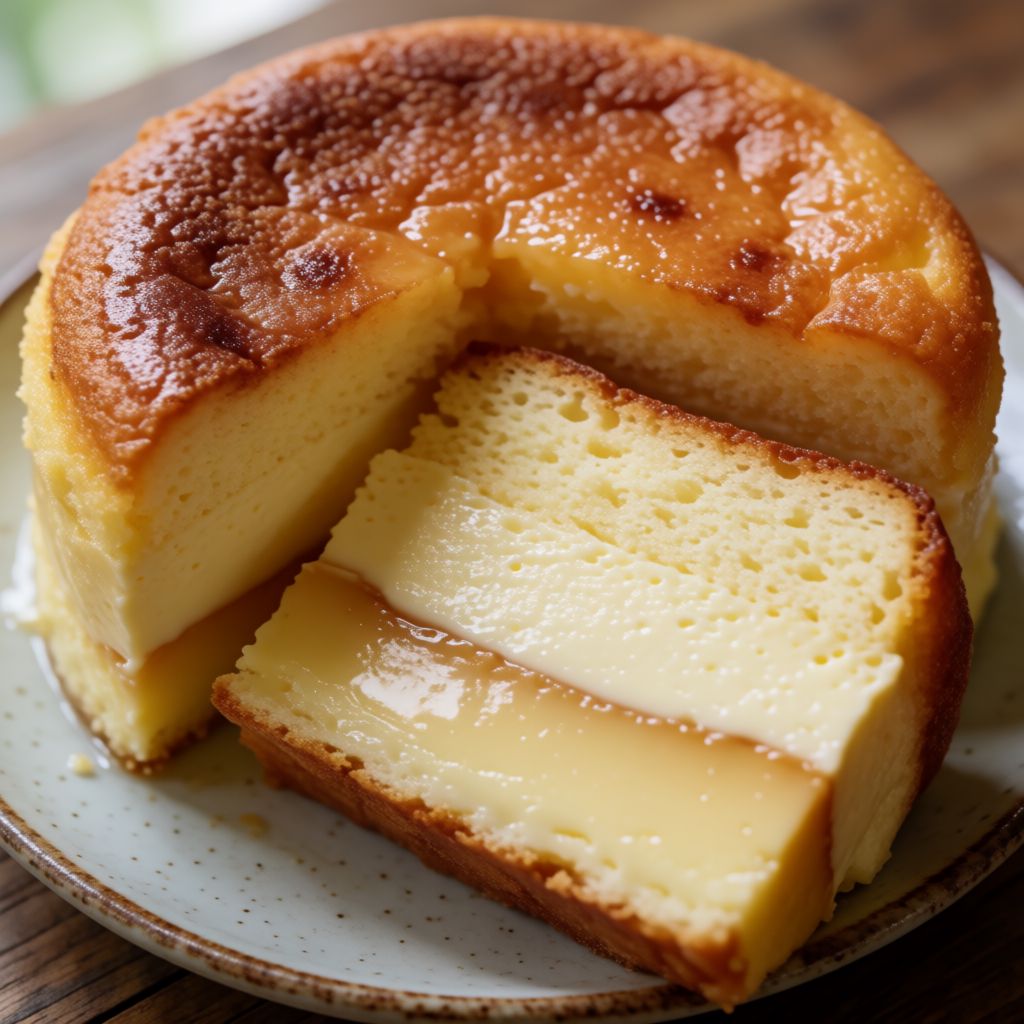
 AI photo
Magic Three-Texture Cake
A magical cake that separates into three layers – dense, creamy and light – as it bakes.
Labels are worked out automatically from the ingredients and can be wrong. Check the packaging if it matters to you.
Ingredients
- 4 pcs Eggs
- 150 g Caster sugar
- 125 g Butter
- 1 pinch Salt
- 1 tbsp Vanilla extract
- 1 tbsp Water
- 115 g Plain flour sifted
- 1 tsp Lemon juice
- 500 ml Milk
- Icing sugar to taste







Steps
Separate the egg whites from the yolks into two separate bowls. Melt the butter and let it cool completely.
Beat the egg whites to soft peaks, adding the lemon juice as soon as they turn white.
Beat the yolks with the sugar for about 10 minutes until light and fluffy. Add the water, vanilla extract and salt.
10 minWarm the milk in a small saucepan.
Add the cooled butter to the yolk mixture and continue beating with a mixer.
Gradually add the sifted flour, beating continuously.
Add the warm milk, continuing to stir.
Gently fold in the egg whites, stirring from the bottom up with a wooden spoon.
Line a 20x20 cm square tin with baking parchment and pour in the batter.
Bake the cake at 150°C in a preheated oven for about 1 hour 20 minutes.
80 minLet the cake cool completely at room temperature.
Cover with cling film and leave in the fridge for 2 hours.
120 minRemove the cake from the tin and cut into squares with a smooth knife and a damp blade.
Dust with icing sugar and serve.
This cake doesn't bake, really — it separates. One batter, one tin, one bake, and it comes out of the oven as three distinct layers: a dense, almost custardy base, a pale creamy middle, and a light, sponge-ish top. People call it "magic cake" because it looks like a trick. It isn't. It's physics doing exactly what you told it to do, if you did it right.
What decides whether it works is how thin your batter is and how patiently you treat the egg whites. This batter is deliberately runny — it's closer to a thick soup than cake mix, because 500ml of milk against 115g of flour is nowhere near a normal sponge ratio. That thinness is the whole trick: a loose batter separates by density during a long, gentle bake. The heavier egg-and-flour mixture sinks, the milk sits in the middle and sets into something custard-like, and the whipped egg white — the lightest thing in the bowl — floats and holds air, becoming the top layer. If you make the batter too thick, or beat everything together into one uniform mix, you get an ordinary cake. No magic, no layers, just cake.
Some say this only works in a proper oven with fan assist, evenly heated from all sides — no. It works because the bake is long and the heat is low. 150°C for well over an hour gives the layers time to set in sequence, slowest part last, rather than the whole thing seizing up together the way a hot oven forces a normal sponge to. A domestic oven with hot spots is fine here; you've got time on your side, not precision.
Eggs are doing two separate jobs here, which is why you split them before anything else. The yolks, beaten hard with sugar for a full ten minutes, aren't just for colour — that long beating dissolves the sugar and traps air, giving the base its structure and some lift of its own. The whites are beaten separately to soft peaks because they need to stay a distinct, airy mass that you fold in at the very end, not disappear into the batter. Fold too hard and you knock the air back out — then there's no third layer, just two.
The lemon juice in the whites is an acid trick, not a flavour one — a few drops stabilise the egg-white foam, making it hold its structure a little longer while you finish the rest of the batter and get it into the oven. If you haven't got lemon, any mild acid works on the same principle — a pinch of cream of tartar, a few drops of white vinegar. The point is stability, not taste, so don't reach for something sharp enough to notice.
Butter goes in melted and fully cooled — not warm, not soft, cooled. Warm butter would start cooking the egg yolks on contact and you'd lose the smooth emulsion you're building. Any neutral butter works; if you're using a cheap "spreadable" butter with added water or oil, expect a slightly looser set, because you've already got water doing a job here and don't need more of it from an unstable fat.
Milk is the ingredient doing the heavy lifting of the "magic," and it needs to go in warm, not cold, not boiling — warm enough that it doesn't shock the batter and firm anything up prematurely, but still hot enough to loosen the mixture into that near-pourable consistency the whole separation trick depends on. Whole milk gives you the fat content that makes the middle layer custardy rather than watery; skimmed milk will work but the middle layer thins out and loses some of its character. Don't be tempted to use less milk thinking it'll make a "sturdier" cake — less milk means less separation, meaning less magic, meaning you've just made a dense sponge for no reason.
Flour is sifted and added gradually for one reason: lumps. A runny batter like this has nowhere to hide a flour knot — it'll sit there raw in the middle layer, and nobody's fishing it out with a spoon later. Plain flour, not self-raising — you don't want baking powder fighting the natural layering with its own bubbles.
The tin is lined, not just greased, because this batter is thin enough to find every gap in a seasoned tin and weld itself to the metal while it sits for ninety minutes. Parchment paper is cheap insurance against ruining the thing at the last step.
Cutting matters more than people expect from something that looks like a traybake. A smooth-bladed knife, wiped damp between cuts, slides through the custard layer instead of dragging it — a serrated blade tears the soft middle and smears the three layers into each other, and then you've got a lovely-tasting mess with none of the visual trick left. Icing sugar at the end is decoration only — don't skip the fridge rest thinking a dusting of sugar will distract from an undercut, soft cake. It won't.