
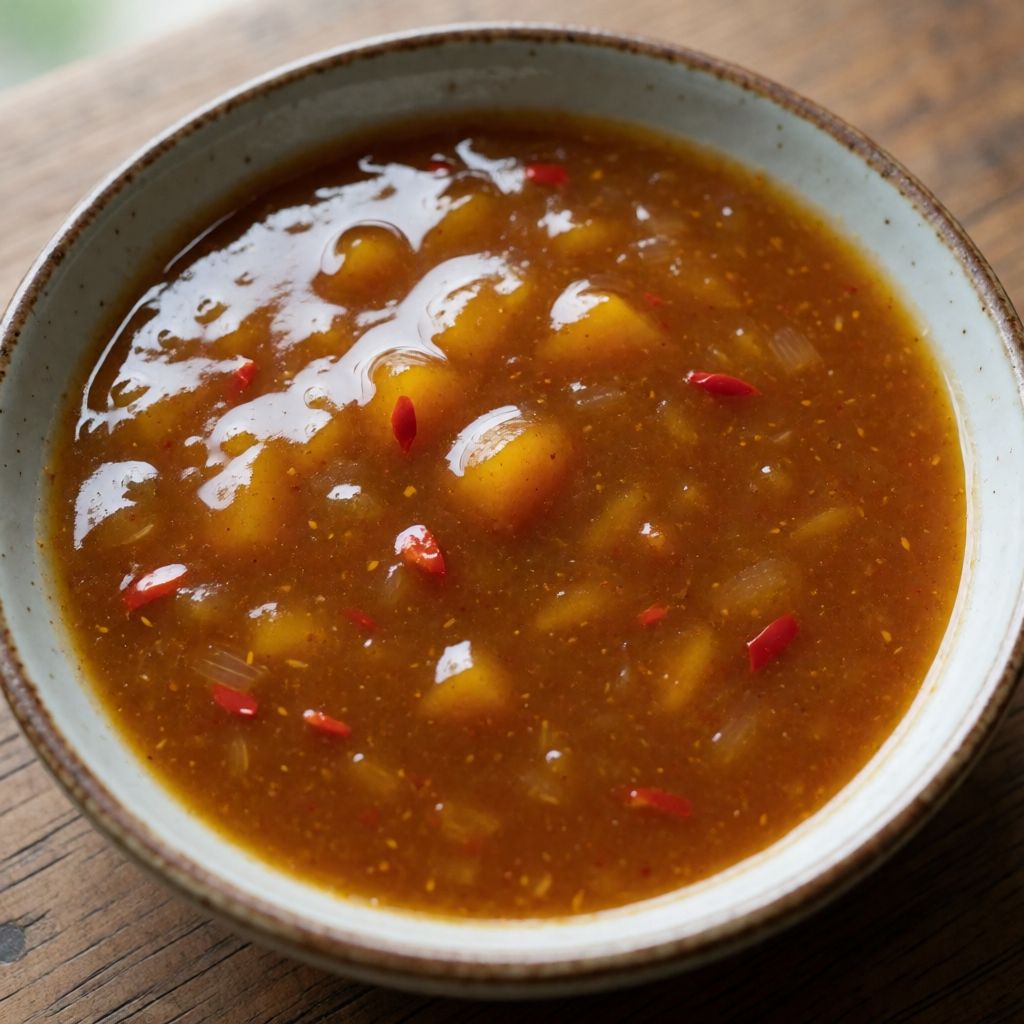
 AI photo
Sweet and Spicy Mango Sauce
A tangy mango chutney with chilli, garlic and warming spices.
Labels are worked out automatically from the ingredients and can be wrong. Check the packaging if it matters to you.
Ingredients
- 1 pcs Onion finely chopped
- 2 clove Garlic finely chopped
- 1 pcs Mango diced
- 0.5 pcs Chilli finely chopped
- 50 ml Sugar
- 1 pinch Vanilla powder
- 0.5 tsp Cardamom ground
- 3 tbsp Apple cider vinegar
- 100 ml Water
- 1 tbsp Olive oil










Steps
Heat the oil in a saucepan, add the onion and garlic, and sauté gently until the onion is soft.
3 minAdd the rest of the ingredients and let simmer until the chutney turns soft and reaches the desired consistency.
7 minServe, for example, alongside Indian dishes.
This is mango chutney's quicker, saucier cousin — same sweet-hot family, but cooked down fast in one pan rather than simmered for an afternoon the way a proper preserve would be. You get something closer to a sauce than a jam: looser, glossier, meant to be spooned over rather than kept in a jar for months.
Two things decide whether it comes together or falls apart. First, what state the onion and garlic are in before the acid hits the pan — get that wrong and you'll be chewing raw onion in a sweet sauce for the rest of the meal. Second, how ripe your mango actually is, because that decides the whole cooking time, not the clock.
Some say you need a green, unripe mango for a proper chutney — no, because that's a different dish with a different texture, firm chunks holding their shape in syrup. Here you want a ripe mango, one that gives slightly under your thumb and smells sweet at the stalk end. It breaks down into the sauce instead of sitting in it, which is exactly the point when the dish is called a sauce and not a relish.
On a British hob this is easy territory — no kazan needed, no heroic heat. A wide saucepan, lid off, gentle bubble. The only real enemy is rushing the reduction with high heat, which catches the sugar on the bottom before the mango's had time to go soft. And do the arithmetic properly: despite what the card says about one serving, this quantity makes you a small jam-jar's worth — enough to sit beside a curry for four to six people, not a solo portion.
Start with the onion and garlic in oil, and understand why that order matters. Heat converts the sharp, sulfur-heavy compounds in raw allium into something sweeter and rounder — that's the whole job of this step, nothing more. You're not after colour. Stop at soft and translucent, almost see-through at the edges; if it starts browning you're building a roasted, savoury note that will fight the mango instead of carrying it. This is also why the onion goes in before the vinegar and not after: acid locks the cell walls, keeps them rigid, and an onion that hits vinegar while still raw will stay crunchy no matter how long you simmer it afterwards. Soften first, acidify second — that's the rule hiding inside step one.
The mango is doing the real work, and its ripeness sets your timer, not the card. A ripe one collapses into syrup on contact with heat and sugar; an underripe one will sit there stubbornly, firm, and you'll either need to give it far longer than ten minutes or add more sugar to force the issue by osmosis — drawing water out of the fruit faster than it wants to give it up. If your mango's unripe and you're short on time, dice it smaller; surface area does some of the work heat alone can't.
Sugar and vinegar aren't separate jobs, they're one mechanism: sugar pulls moisture out of the mango, vinegar supplies the sharp edge that stops the whole thing tasting like dessert, and together with the water they reduce down into a glaze. Judge doneness the way you'd judge jam, not a stew — pull the spoon through and the gap should hold for a beat before the sauce flows back in. That's nappe, and it's a thing you see, not a number of minutes.
Cardamom and vanilla are both aromatic, both volatile, both best treated gently. Ground cardamom loses its punch within weeks of grinding, so if yours has been sitting in the cupboard since last Diwali, it'll barely register — crack a few pods and grind them fresh if you want the full effect. Vanilla powder holds its aroma through heat better than liquid extract does; if you're substituting extract, add it off the heat at the end, because alcohol and heat together just boil the scent away before it reaches the plate. The chilli is your dial, not a fixed ingredient — half a chilli is a guess at someone else's chilli, so taste the raw heat first and adjust, remembering seeds are where most of the fire lives.
For the oil, the criterion is simple: anything with no smell of its own, so it carries heat and nothing else. Groundnut, sunflower, a mild rapeseed oil — anything that won't compete with mango and cardamom. Olive oil works here too, but reach for a plain one, not your good peppery extra virgin; that flavour has no business in a sweet sauce.
And give it the time it actually needs. Ten minutes on the card is a floor, not a ceiling — patience here is what turns raw chopped fruit into something that coats a spoon. Rush it and you get a soup with lumps in it; let it sit at a proper simmer and it turns into something you'd actually want next to a curry, or cold on Boxing Day with the leftover roast, which is honestly where half of Britain's chutney jars end up anyway.