
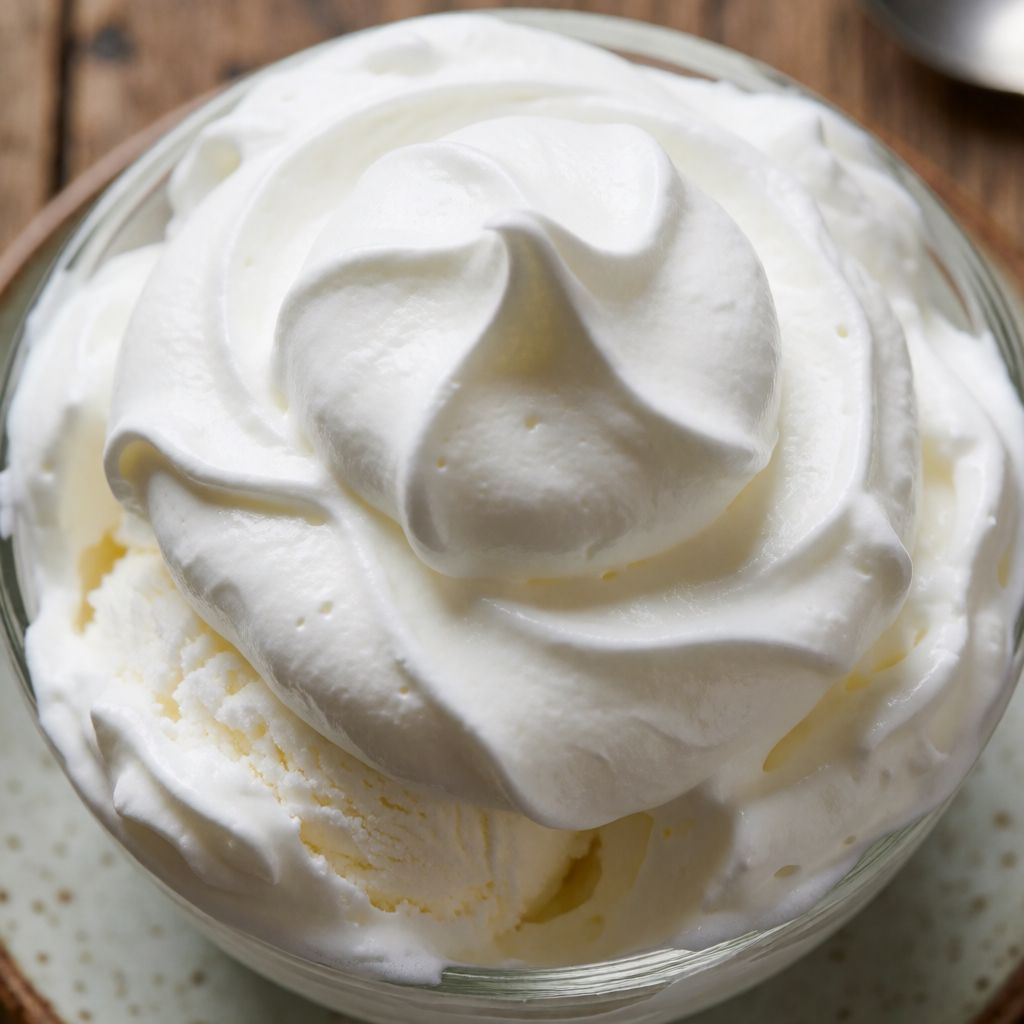
 AI photo
Homemade Marshmallow Cream for Ice Cream
A fluffy homemade marshmallow cream swirl, made in two flavours — classic and strawberry — for topping ice cream.
Labels are worked out automatically from the ingredients and can be wrong. Check the packaging if it matters to you.
Ingredients
- 50 ml Water
- 50 g Glucose syrup
- 200 g Caster sugar
- 1 tsp Vanilla sugar
- 100 g Egg whites
- 200 g Caster sugar
- 50 g Glucose syrup
- 50 ml Strawberry juice
- 100 g Egg whites
- 3 tbsp Strawberry jam





Steps
Classic swirl – 8 servings. Bring the water, glucose syrup, caster sugar and vanilla sugar to the boil in a saucepan, stirring until the sugar dissolves.
5 minPut the syrup in the fridge for 15 minutes, stirring a few times, until it cools slightly.
15 minWhisk the egg whites to stiff peaks.
3 minPour in 1 tbsp of the syrup, then add the rest of the syrup in a thin stream, little by little.
Keep whisking for a further 5-10 minutes, until the mixture is glossy and airy.
7 minStrawberry swirl – 8 servings. Bring the caster sugar, glucose syrup and strawberry juice to the boil in a saucepan, stirring until the sugar dissolves.
5 minPut the syrup in the fridge for 15 minutes, stirring a few times, until it cools slightly.
15 minWhisk the egg whites to stiff peaks.
3 minPour in 1 tbsp of the syrup, then add the rest of the syrup in a thin stream, whisking thoroughly.
Add a little strawberry jam to taste and keep whisking for a further 5-10 minutes, until the mixture is glossy and airy.
7 min
This is a meringue, not a magic trick — you're making Italian meringue twice, once plain and once pink with strawberry, so you end up with two bowls you can swirl into soft-serve or fold into whipped cream for a ripple ice cream. The whole thing hinges on one mechanism: egg white protein, denatured and set by hot sugar syrup instead of by oven heat. That's why it stays soft and stable instead of drying into pavlova shell.
What decides whether it works is the syrup, not the whisking. Glucose syrup is there to stop sugar crystallising — plain sucrose on its own wants to snap back into gritty crystals the moment it cools, and once that starts, no amount of whisking saves it. Glucose molecules get in between the sucrose molecules and physically block them from lining up. Skip it and you risk a grainy meringue that never goes glossy.
Some say you can just dissolve sugar in water and skip the syrup stage entirely — no, because unboiled sugar water doesn't cook the egg white. It's the heat carried into the syrup that pasteurises the whites and sets their structure when you pour it in. A cold sugar solution whipped with raw whites gives you sweet foam, not meringue — it won't hold, and it won't be safe to eat raw.
Pour the syrup in correctly and you'll see why the method insists on a thin stream against the whisk, never a dump. Whisk eggs are already full of air bubbles holding a fragile structure. A sudden slug of hot syrup collapses that structure with its weight and heat before it can lock in — thin stream means every drop meets whisked whites it can bond with immediately, not a pool it has to fight through.
On an ordinary UK hob, without a thermometer, go by what you see: the syrup should run like thin honey off a spoon, not sheet off it in strings, and should move freely when you tilt the pan, no skin forming at the edge. If it's gone cloudy or started to seize at the rim, it's cooled too far and started recrystallising — reheat it gently rather than force it in.
Caster sugar earns its place because it dissolves faster than granulated — smaller crystals, more surface area touching the water. Granulated will work, it just asks for longer stirring and a sharper eye for undissolved grit at the bottom of the pan before you let it boil, because any sugar crystal left whole at that point becomes the seed that turns your whole syrup gritty later.
Glucose syrup itself isn't exotic — it's the same stuff bakers use for royal icing shine, sold in small tubs near the baking sugar. If you genuinely can't find it, golden syrup or liquid glucose substitute does the same anti-crystallising job, though golden syrup brings its own caramel note, which is no bad thing in the plain batch and oddly good against strawberry too.
Egg whites: use them at room temperature, not fridge-cold straight from the carton, because cold whites take longer to whip to stiff peaks and you want that structure ready and waiting the moment the syrup is poured — not whisking two things to readiness at once on a domestic hob with one pair of hands.
The strawberry batch swaps water for strawberry juice and finishes with jam — juice gives colour and a clean fruit note without diluting the sugar's job, jam adds concentrated flavour and a little pectin body. No strawberry juice on a British Sunday? Any pureed, strained soft berry — raspberry, blackcurrant — does the same job; thin bottled juice without real fruit behind it will taste of pink, not of fruit, and the jam won't fully rescue it.
This isn't a five-minute pudding, whatever the ingredient list suggests — the resting, the two rounds of whisking, the patience to let glossy actually mean glossy rather than "nearly there" — all of it is the price of a cream that holds its shape in the freezer instead of turning icy and flat. Rush the syrup stream and you'll taste the difference in texture before you taste anything else.