
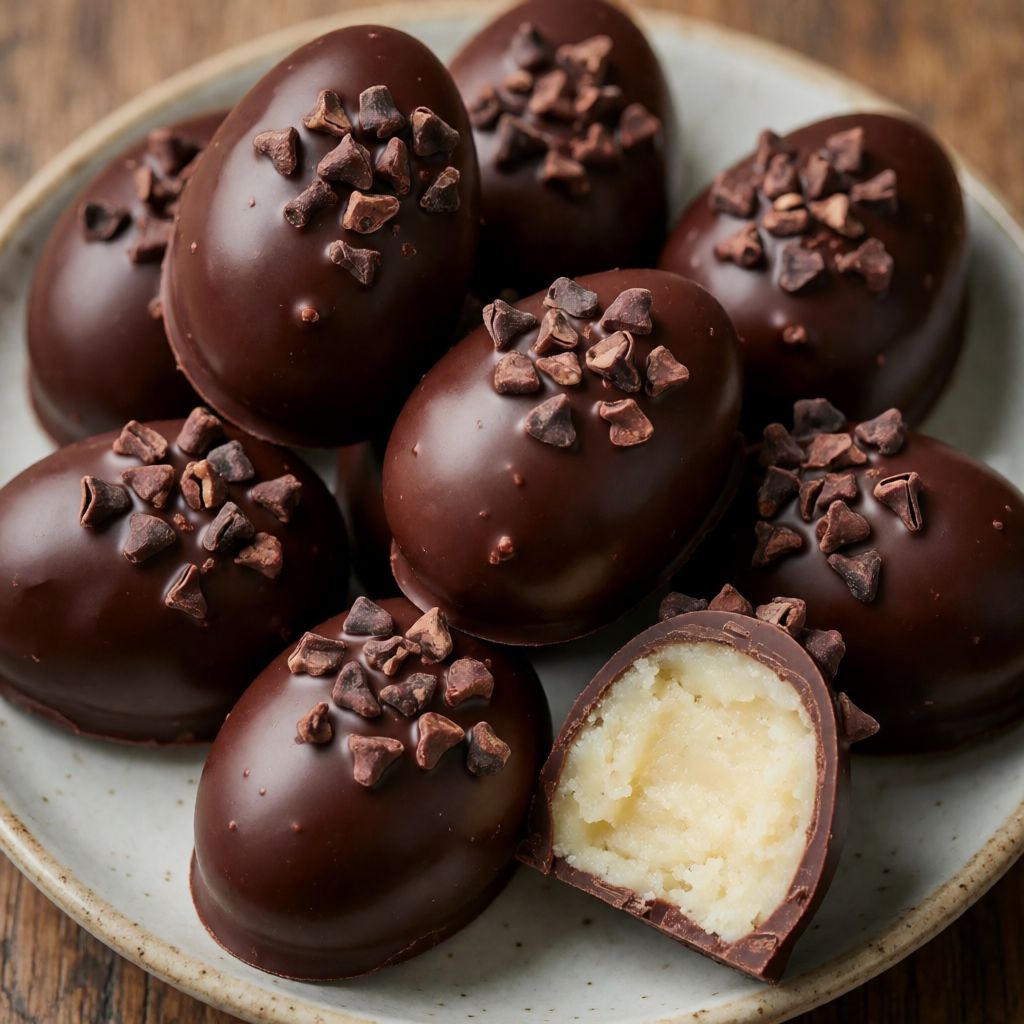
 AI photo
Easter Marzipan Eggs
Sweet marzipan and nougat eggs coated in dark chocolate, a traditional Easter treat.
Labels are worked out automatically from the ingredients and can be wrong. Check the packaging if it matters to you.
Ingredients
- 250 g Marzipan
- 80 g Nougat
- 50 g Hazelnuts
- 40 g Sugar
- 200 g Dark chocolate finely chopped
- 1 tbsp Crushed cacao nibs optional
- 1 tsp Gold sprinkles optional, for decoration




Steps
Toast the hazelnuts in a frying pan until the skins begin to loosen. Wrap in a clean cloth and rub to remove the skins.
Roughly chop the nuts. Return them to the pan with the sugar over medium heat, stirring until it melts, then remove from the heat.
Stir in the nougat, spread onto baking paper, let cool and divide into 8 portions.
Divide the marzipan into 8 pieces and roll into round discs. Wrap each one around a portion of nougat and nut mixture. Shape into Easter eggs.
Let the eggs dry on baking paper on the kitchen counter for 1 hour before coating with chocolate.
60 minMelt half the chocolate in a bain-marie, stirring and checking with a thermometer, until it reaches 55°C. Remove from the heat, stir in the remaining chocolate, and cool to 31°C.
Dip the eggs in the chocolate, then let them dry on baking paper until set. If you like, finish with edible gold dust or a sprinkle of cacao nibs.
These are little eggs built like a sandwich in reverse — a crunchy nut-and-sugar core, wrapped in almond paste, then sealed in a shell of real tempered chocolate. Nothing goes in the oven. Everything here depends on what happens to sugar and fat when you control their temperature, not their time in the pan.
The nut-and-sugar part is simple mechanics. Toasting the hazelnuts loosens the skin by driving off moisture underneath it, so it slips away with a rub in a cloth instead of a scrape with a knife — colour is a side effect, not the point. Melting sugar over the chopped nuts until it turns from grainy to wet and shiny glues them into a mass you can actually divide into eight pieces, rather than a loose pile that won't hold a shape. It's a crude praline, standing in for the egg whites and syrup that proper nougat usually needs — the cheap, honest version.
The real hinge of the whole thing is step 6, the chocolate. Some say melting chocolate is just melting — get it liquid, job done. No, because cocoa butter sets into several different crystal structures, and only one of them gives you a shell that snaps, shines, and doesn't go pale and streaky after a day in the tin. Taking it to 55°C wipes out all the existing crystal order; cooling it to 31°C while stirring in fresh unmelted chocolate reseeds it with the right kind. Skip that discipline and the eggs will still taste the same — they'll just look like they spent Easter in someone's coat pocket.
Marzipan is almond paste with sugar worked into it until it's pliable, not crumbly. Look at the almond percentage if the pack tells you — something near 50% almonds is a reasonable baseline; the cheaper end, heavy on sugar and light on almond, will crack rather than fold when you try to wrap it round the filling. No marzipan in the cupboard? Almond paste with a touch of sugar worked through by hand does the same job — just roll it between two sheets of baking paper so it sticks to itself and not to your palms or the counter.
Nougat here means the soft, chewy confectionery sort, not the hard brittle some shops also call nougat. You want enough give in it to fold through the toasted nuts without it shattering into shards. If you can't find it, a soft paste-type sweet with similar chew — even a halva-style paste — will stand in; its job is just to bind the nuts and give the inside some bite against the crisp shell outside.
Hazelnuts need to be fresh, not just toasted. Rancid nut oil is the one fault no amount of chocolate will hide, so smell them before you start. If yours are already blanched and skinned, you can skip the rubbing step, but still toast them — the heat wakes the oil's smell back up after it's been dulled by packaging and time on a shelf.
The sugar melted into the nuts isn't there for sweetness on its own. It's setting glue, holding the chopped nuts together into eight even portions. Any sugar that melts clear without catching will do — caster dissolves fastest on an ordinary hob and gives you less of a window to scorch it while you're still deciding whether it's ready.
For the chocolate, choose one you'd happily eat plain, at least 50% cocoa solids. A flavourless "cooking" chocolate low in real cocoa butter won't temper properly no matter how carefully you watch the thermometer, because it simply doesn't have enough of the fat that does the crystallising. Chop it finely so it melts evenly, without a dense lump turning grainy and seizing at the bottom of the bowl while the rest is liquid. You don't need a proper bain-marie — a heatproof bowl sitting over, not touching, a pan of gently steaming water does exactly the same work in a UK kitchen, and a cheap digital thermometer is worth the few pounds; without one you're guessing at crystal structure by eye, and eye alone isn't reliable enough here.
Cacao nibs and gold sprinkles are decoration, nothing more — they break up a plain shiny shell with texture or shine on the table. Leave them off and the eggs lose nothing structural, they just sit a little more modestly next to the teapot on the day.