
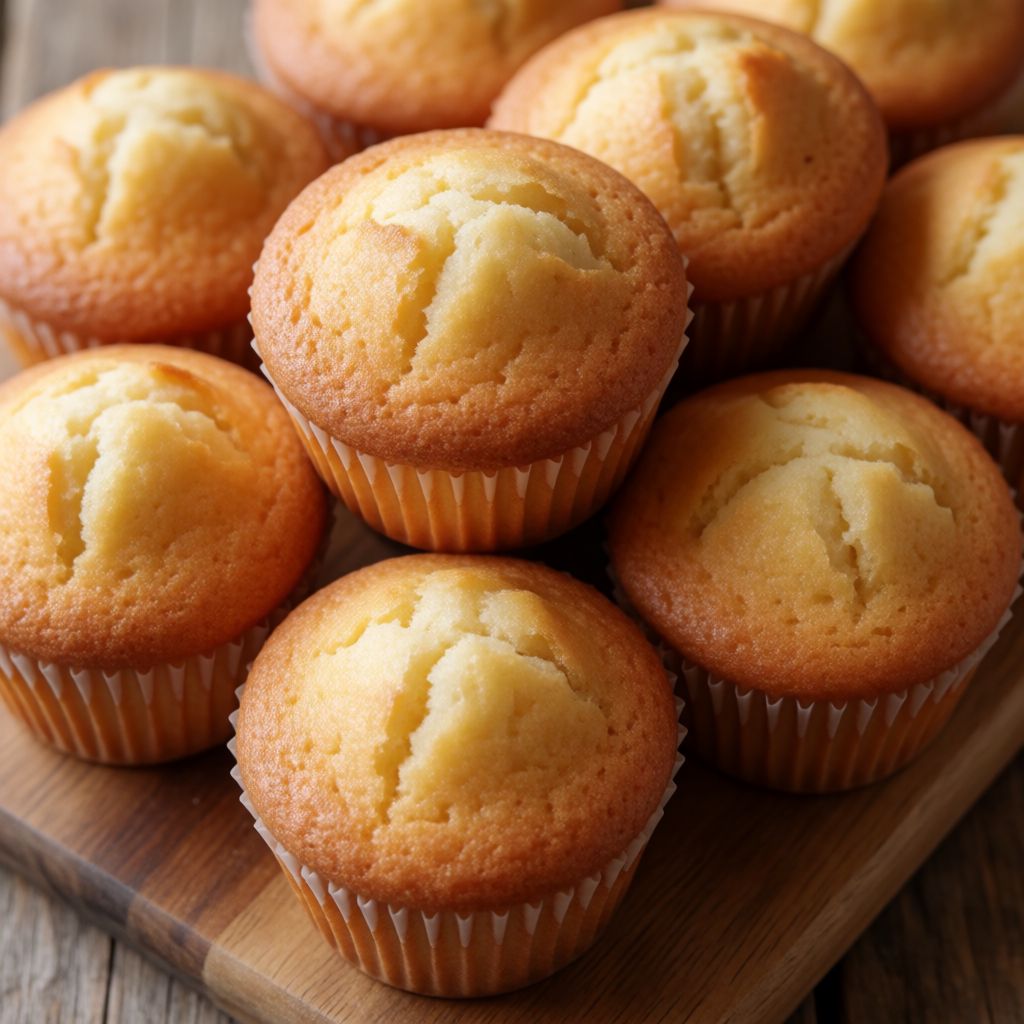
 AI photo
Marzipan Muffins
Soft muffins made with grated marzipan, finished with a creamy frosting and a sprinkle of streusel.
Labels are worked out automatically from the ingredients and can be wrong. Check the packaging if it matters to you.
Ingredients
- 150 g Marzipan grated
- 125 g Butter room temperature
- 175 g Caster sugar
- 1 tsp Vanilla sugar
- 3 pcs Eggs
- 200 g Plain flour
- 1 tsp Baking powder
- 1 pinch Salt
- 1 tbsp Streusel topping









For the frosting
- 200 g Butter room temperature
- 200 g Icing sugar
- 200 g Cream cheese


Steps
Beat the marzipan, butter, sugar and vanilla sugar together until smooth and fluffy. Add the eggs one at a time, beating until the batter is even.
3 minMix the flour, baking powder and salt, sift into the batter and stir well.
1 minDivide the batter into muffin tins and bake in a preheated fan oven at 175°C for 17-19 minutes, until cooked through.
18 minLet the muffins cool completely on a wire rack before decorating with the frosting.
30 minFrosting: beat the butter with the icing sugar until pale and fluffy. Then quickly mix in the cream cheese and fill a piping bag fitted with a star nozzle.
1 minDecorate the muffins with the frosting and sprinkle with streusel topping.
Marzipan muffins are a cupcake wearing a disguise. Grating marzipan into the batter instead of melting it does one thing: it keeps tiny beads of almond paste intact through mixing, so they soften and spread into the crumb as they bake rather than dissolve into sweetness you can't locate. That's the whole trick. Lose that texture — say, by creaming the marzipan into a paste first — and you've made an almond-flavoured sponge, which is a different, lesser thing.
What decides whether this works is the butter stage, not the oven. Butter and sugar beaten properly trap air in thousands of tiny pockets; that air is your rise, because this is a muffin leavened mostly by creaming plus a modest teaspoon of baking powder, not a towering soufflé reaction. Room-temperature butter isn't a fussy instruction — it's the only state in which butter holds air instead of just getting pushed around by the beater. Cold butter shears instead of fluffing. Melted butter won't hold anything at all.
Some say you can skip bringing the eggs to room temperature too, "it's only a muffin." No — because cold eggs tighten the butter back up mid-beat, and the fat seizes into little curds you then have to fight to loosen. Let everything sit out before you start; that's patience spent early so you don't pay for it later with a dense muffin.
Marzipan itself is almond paste bulked with sugar, built that way centuries back because ground almonds alone were expensive and unstable in baking — the sugar both stretches the almonds further and binds the oil so it doesn't separate out in the oven. Buy the block kind sold for cake covering, at least 50% almond content if the label gives you a number; the cheaper end is mostly sugar syrup and will melt into the batter rather than hold its grated shape. There's no real substitute — ground almonds plus extra sugar gets you the flavour but not that half-melted chew, so don't bother hunting for one unless marzipan itself isn't available to you.
Caster sugar does a job vanilla sugar can't: its fine grain dissolves fast enough into the butter during creaming to actually help cut air into the fat, where coarser sugar would just sit there being sweet. The vanilla sugar is there for flavour alone, a teaspoon's worth, so if you haven't got any, a few drops of vanilla extract added with the eggs covers it — just don't use it to replace the caster sugar's job, only its flavour.
Plain flour with a teaspoon of baking powder stirred in — not self-raising on its own — because you want to control exactly how much lift you're adding on top of what the creamed butter already gives you. Self-raising flour here would make the crumb coarser and less predictable, since you'd be stacking an unknown amount of raising agent on top of what you've already built in by hand.
For the frosting, cream cheese means the actual block or tub kind meant for cheesecake, full-fat — the low-fat spreadable sort carries too much water and will thin your frosting out no matter how careful your beating. Icing sugar, not caster, because its fine starch-dusted grain dissolves without grit in a fat-based frosting; caster sugar would leave your piping gritty and liable to catch a star nozzle's fine grooves.
In an ordinary UK kitchen there's no kazan logic here, no live-fire judgement to make — a fan oven at 175°C is a stated, trustworthy number, so trust your oven thermometer over the dial if you have one, since domestic ovens drift by 10–15 degrees more often than people admit. What you watch for instead of trusting the clock: a skewer coming out clean, the top springing back rather than leaving a dent. That's 17–19 minutes as a floor, not a fact.
Let the muffins go properly cold — room temperature cold, not just cool to the touch — before piping. Warm muffins have warm surface fat; frosting meets that and starts sliding, and you'll watch your careful star nozzle work collapse into a puddle. Half an hour isn't decoration, it's the difference between a piped rosette and a smear.