
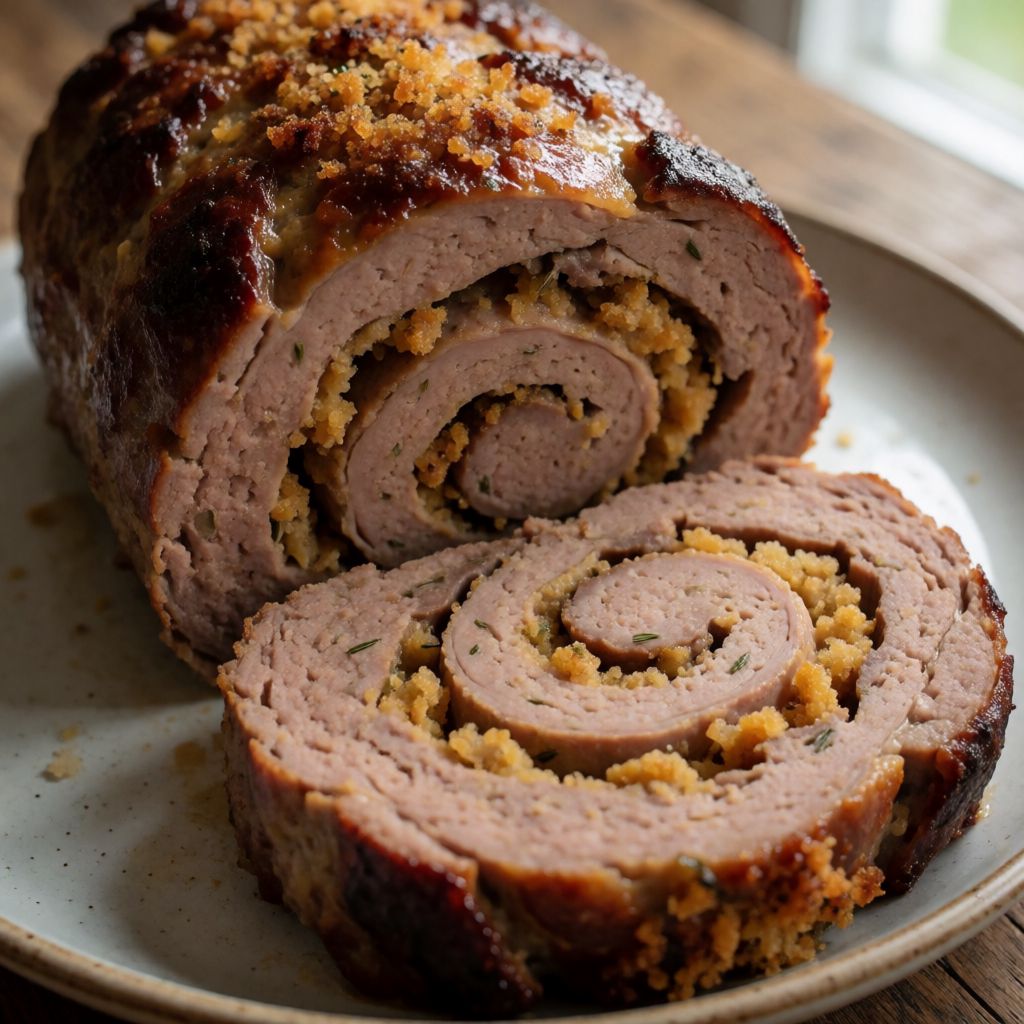
 AI photo
Italian Meat Roulade
A savoury rolled meatloaf filled with sun-dried tomatoes, Parmesan and mozzarella, baked until golden.
Labels are worked out automatically from the ingredients and can be wrong. Check the packaging if it matters to you.
Ingredients
- 400 g minced veal and pork
- 100 ml milk
- 75 g panko breadcrumbs
- 1 pcs egg
- 2 clove garlic crushed
- 1 tsp dried thyme
- salt
- black pepper freshly ground
- 1 pcs onion finely chopped
- 4 clove garlic finely chopped
- 50 g sun-dried tomatoes finely chopped
- 75 g Parmesan freshly grated
- 1 tsp dried thyme
- 1 tsp oregano dried
- 0.5 tsp dried rosemary
- 1 pcs lemon zest, grated
- 125 g mozzarella
- 1 pcs egg
- 50 g panko breadcrumbs













Steps
Put the mince, milk, half the panko, egg, garlic, thyme, salt and pepper into a bowl and mix well for a few minutes.
3 minSpread the mixture out flat on baking paper dusted with the remaining panko. In a separate bowl, mix the onion, garlic, sun-dried tomatoes, Parmesan, thyme, oregano, rosemary and grated lemon zest, and mash it all together well.
5 minSpread this mixture over the mince, leaving 5 cm free along one edge. Lay the mozzarella on top and roll the mince into a roulade. Finish the roll on the edge of the mince with no filling. Brush with beaten egg, sprinkle with panko and press it in lightly so the roulade holds its shape.
7 minBake in a preheated fan oven at 180°C for about 1 hour.
60 min
A roulade is a meatloaf that's been taught some manners. Instead of mince going into a tin and baking into a dense brick, you roll it flat, pack the filling in a spiral, and the whole thing gets more surface — more crust, more places for fat to render out and flavour to concentrate. That's the entire trick. Nobody is doing anything clever with technique here; they're doing something clever with geometry.
What decides whether this works is the soak and the panko crust. Milk goes into the mince and sits there with breadcrumbs doing the job a kazan does for pilaf — holding moisture inside the meat so it doesn't seize up and go dry under an hour of oven heat. Skip the milk-soak and you get a loaf that tastes of cardboard with regret. Some say mince just needs "binding" with egg and that's the whole story — no, egg glues, milk hydrates, and you need both jobs done, not one.
The second panko — the one on the outside, pressed on after the egg wash — isn't decoration. It's there so the roulade keeps its rolled shape in the oven rather than slumping back into a flat slab, and it gives you something to bite that isn't just soft meat and melted cheese all the way through. Texture needs a boundary. This is the boundary.
Four people, one roll, about an hour of oven time you mostly ignore. The filling — sun-dried tomato, Parmesan, lemon zest, mozzarella — is doing the work that stock and long braising would do in a dish built around a tougher cut. Here the meat is already tender mince; the filling's job is just flavour and a pocket of melt in the middle. That's the whole architecture.
The mince itself — veal and pork together — is a fat-and-lean balance, not a flavour choice. Veal mince alone is lean and goes dry under an hour's bake; pork brings back the fat that keeps things moist and gives body to the texture. If you can't get veal, use all pork, or beef with a slightly higher fat content — 15–20%, not the lean stuff sold for burgers. What you're protecting against is the same dryness the milk-soak protects against, so if your mince is fattier, you can afford to be less fussy about the soak; if it's leaner, don't skip either safeguard.
Panko versus ordinary breadcrumbs: panko is drier and coarser, made from crustless bread baked without steam, so it stays crisper on the outside and absorbs liquid more slowly in the mix — which is exactly what you want in both places it's used here, inside for structure and outside for crust. Ordinary dried breadcrumbs will do the job, just expect a softer bite on the crust and slightly denser mince, because they take up moisture faster and compact more.
The sun-dried tomato and Parmesan filling is concentrated flavour, not bulk — this is the part doing the work a long braise would do for a tougher cut of meat, except here it's achieved by packing acidity, salt and umami into one tight seam instead of hours of slow cooking. Parmesan: buy a block and grate it yourself if you can — the ready-grated bags are cut with anti-caking starch and bring less savour for the same weight. Any hard, aged, salty cheese works on the same logic — pecorino, aged Gouda, even a strong cheddar in a pinch, though cheddar will push it toward a different, heavier flavour entirely.
Mozzarella in the centre is your pocket of melt — the ball sitting mid-roll means by the time it reaches temperature, it's a seam of stretch rather than a puddle, because it's insulated by meat on all sides and doesn't touch the hot pan directly. Use the firmer block mozzarella sold for cooking, not the fresh ball in brine meant for salads — the fresh kind carries too much water and will leak into the mince as it melts, making the inside soggy rather than giving you that clean pull. If you've only got the fresh kind, pat it dry hard with a cloth first and accept the pocket will be looser.
Lemon zest earns its place against all that salt and fat — it's not for scent, it's acid-adjacent brightness that stops the dish tasting flat after an hour in the oven concentrates everything else. Don't swap it out for juice; juice adds moisture you don't want in the filling, zest adds lift without wetting anything down.
On the oven: 180°C fan for an hour is a slow, steady heat that lets the roulade cook through to the centre without the crust burning before the inside catches up — this is not a dish you rush at high heat, because mince this size needs the full hour just to get warm in the middle; patience here isn't optional, it's an ingredient the same as the milk or the cheese. A Sunday roast habit suits this well — it wants the same unhurried, put-it-in-and-walk-away rhythm, and it rests happily on the side of a roasting tray the way a joint of beef would, so there's no reason not to treat it as the centrepiece of exactly that kind of afternoon.