
 AI photo
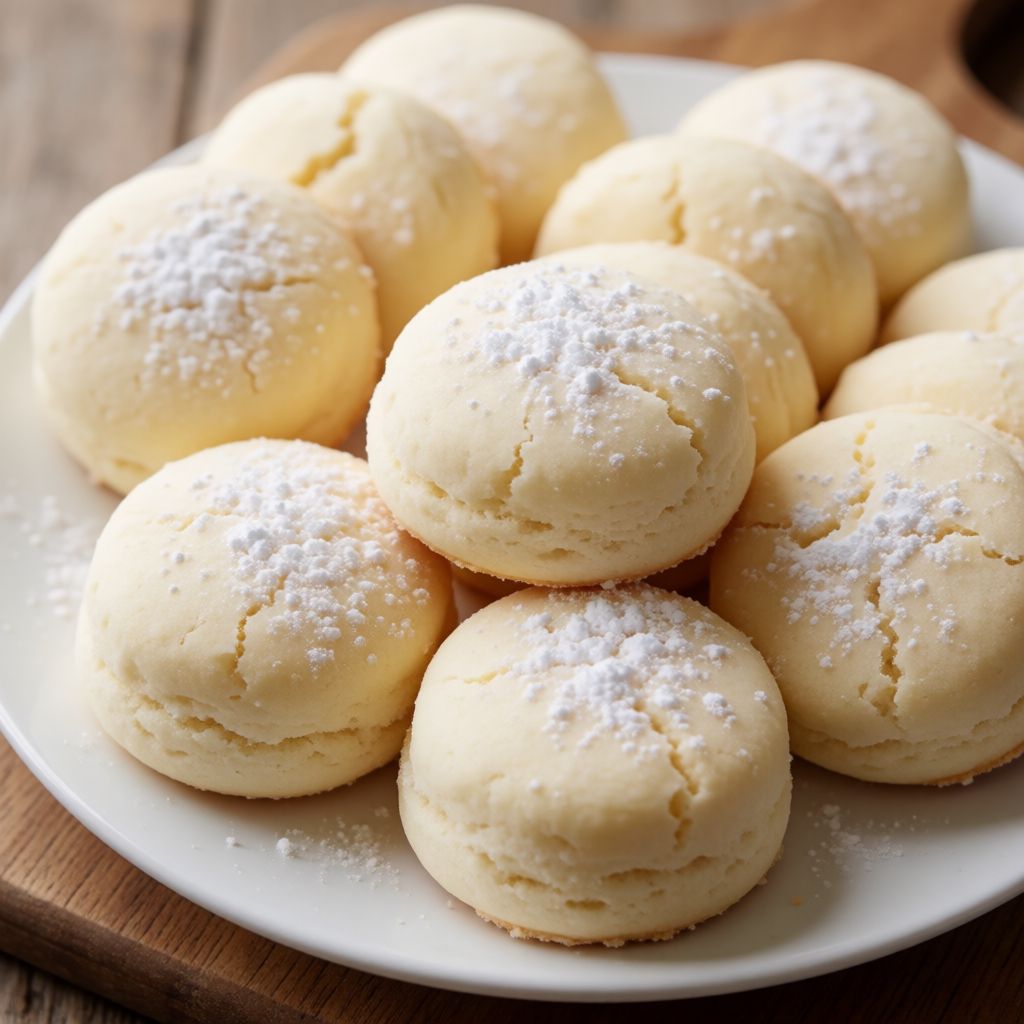
Milk Biscuits
Soft milk biscuits with a hint of vanilla, baked until lightly golden.
Labels are worked out automatically from the ingredients and can be wrong. Check the packaging if it matters to you.
Ingredients
- 350 g Plain flour
- 240 g Icing sugar
- 100 g Potato starch
- 1 tsp Vanilla extract
- 5 g Bicarbonate of soda
- 1 pcs Egg
- 120 ml Milk
- 100 g Butter melted








Steps
In a bowl, mix all the dry ingredients: flour, icing sugar, potato starch, vanilla extract and bicarbonate of soda.
Add the egg and milk, mix by hand, then work in the melted butter until the dough is smooth.
Cover the dough with cling film and leave it to rest in the fridge.
30 minShape the biscuits: pinch off walnut-sized pieces, roll into balls and place on a baking tray lined with parchment.
Using the handle of a wooden spoon, make a hole in the centre of each ball of dough.
Bake the biscuits in an oven preheated to 190°C with the fan function.
13 minLet the biscuits cool completely before serving.
What was changed
Vanilla extract was swapped in because British shoppers usually buy liquid vanilla extract rather than vanillin sachets.
This is a soft, pale biscuit, not a crisp one — closer in spirit to a small, dense little cake than to shortbread. You can tell by the method alone: nobody creams butter and sugar here. Instead you melt the butter and let milk and egg carry it through the dough. That's the whole character of a "milk biscuit" — it's built to be tender and a bit crumbly on the tongue, not to shatter.
What decides whether it works is temperature, but not the oven's — the dough's. You mix it warm and loose, because melted butter makes everything fall together fast. Then you chill it, because cold is what turns that loose dough back into something you can roll between your palms without it sticking to everything in the kitchen, including you. Skip the fridge and the biscuits will spread into thin, greasy discs the moment the butter re-melts in the oven. The rest in the fridge isn't a ritual — it's damage control for using melted fat in the first place.
Some say bicarbonate of soda does nothing without an acid to wake it up — vinegar, buttermilk, something sour. No. Heat alone breaks it down; above roughly 80°C sodium bicarbonate falls apart into carbon dioxide, water and sodium carbonate, acid or not. That's exactly what a 190°C fan oven gives you — enough heat, fast enough, that the gas escapes while the dough is still soft enough to trap some of it as lift. What an acid actually buys you is a cleaner taste, because without one, any soda left unreacted sits there tasting faintly of soap. The amount here is modest enough that heat does the job and you don't notice it.
Flour and potato starch do opposite jobs and need each other. Flour brings gluten, which holds a biscuit together; starch has none, and its only purpose here is to interrupt that gluten so the crumb stays short instead of chewy. Any pure starch does the same work — cornflour (cornstarch, if that's the word on your packet) is the obvious substitute, gram for gram. What you can't substitute with is more flour; that just gives you a drier, tougher biscuit than the recipe intends.
Icing sugar instead of granulated is a texture decision, not a sweetness one. Fine sugar dissolves into the wet ingredients without needing to be beaten against butter first, which matters because this dough skips the creaming stage entirely. Granulated sugar stirred by hand into egg and milk will mostly stay granulated — you'll taste grit at the edges where it never fully dissolved. If icing sugar isn't in the cupboard, blitz caster sugar in a blender for a few seconds; you're not after the cornflour some commercial icing sugar carries, just the fineness.
The egg and the milk together are doing the butter's old job of binding and moistening, cheaply. This is worth saying plainly rather than romantically: biscuits like this come from kitchens where butter was the expensive ingredient and milk, eggs and starch were not, so the recipe stretches a little fat a long way using dairy and starch instead of more fat. There's nothing mystical in that — it's a ledger, not a legend. If you want a richer biscuit you could use more butter and less milk, but then you're no longer making this biscuit; you're making shortbread's cousin instead.
Melted butter, specifically, is what makes the whole dough come together in one bowl without a mixer — which matters in an ordinary flat kitchen where you likely don't own a stand mixer and don't want to dig one out for a batch this small. The trade-off, as said, is that the dough is soft and needs the fridge to firm back up before shaping. Don't try to speed this by using the freezer instead — you want the butter to re-solidify evenly through the dough, not refreeze unevenly at the edges while the middle stays soft.
Vanilla extract here is background, not a flavour you're meant to taste directly — it rounds off the plainness of flour and starch. If you only have vanilla paste or a vanilla pod's scraped seeds, either works; just don't reach for synthetic vanilla essence with a strong alcohol bite, because there's no caramelisation or long baking time in this recipe to cook that sharpness off.
At six servings this makes a modest plateful — enough for tea with milk, not enough to survive a full Sunday roast's worth of family dropping by for pudding later. If you want more, scale the whole list evenly; don't just add more soda thinking you'll get extra lift, because past a certain point you get that soapy edge back, and no amount of oven heat burns it off.