
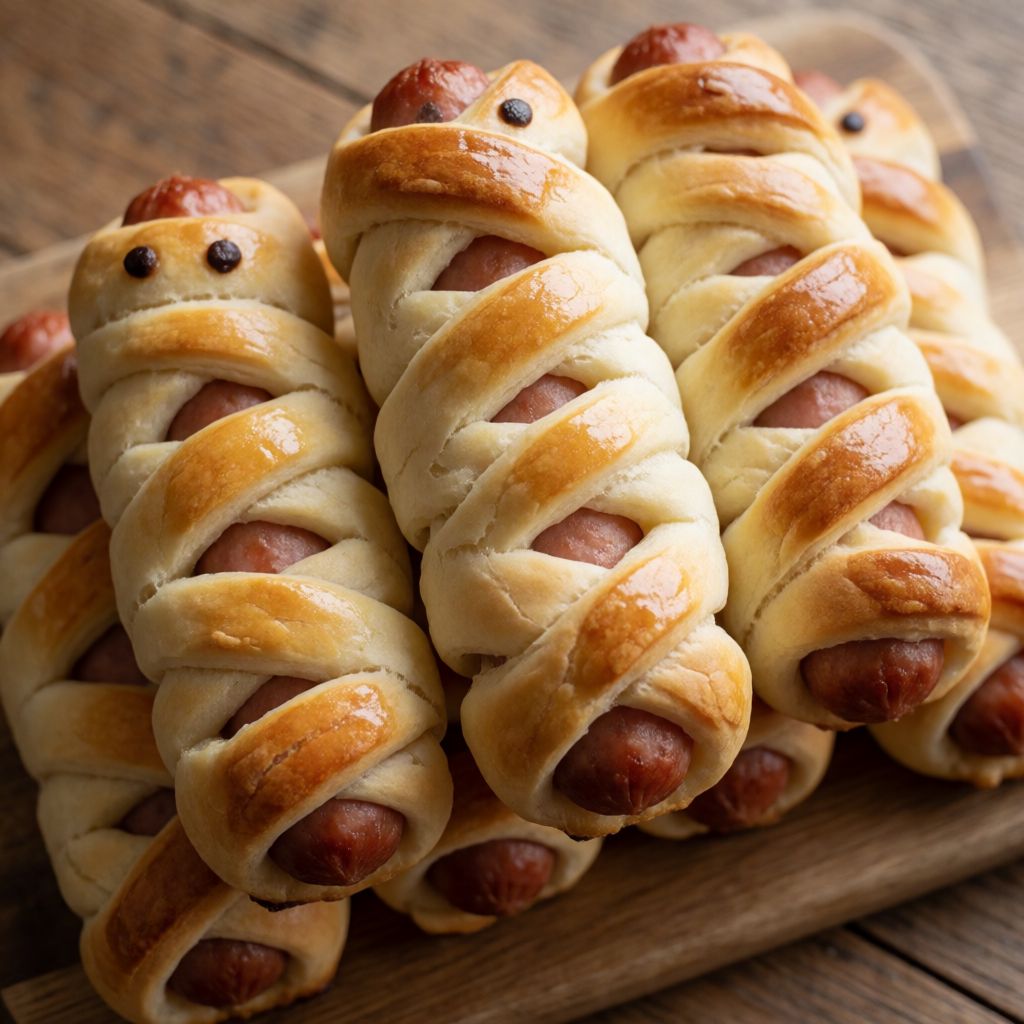
 AI photo
Halloween Mummy Sausage Rolls
Fun Halloween treat: frankfurter sausages wrapped in soft yeasted dough to look like little mummies.
Labels are worked out automatically from the ingredients and can be wrong. Check the packaging if it matters to you.
Ingredients









Steps
Dissolve the yeast in a bowl with the room-temperature milk and oil, sugar and egg. Mix well, then gradually add the salt and flour.
5 minKnead the dough for 10 minutes, preferably with a mixer on low speed, until it is elastic and easy to work with.
10 minLeave the dough to rise in a bowl covered with a clean tea towel for 1 hour at room temperature.
60 minRoll out the dough into a rectangle and cut into long thin strips.
5 minWrap the strips around the sausages, forming mummies (leaving the top end free), and place on a baking tray lined with baking paper.
Leave the sausage mummies to rise for a further 1 hour at room temperature, covered with a clean tea towel.
60 minBrush with the beaten egg and bake in a preheated oven at 175°C (fan) for about 15 minutes.
15 minLet cool and decorate with sugar eyes made from small dots of white fondant icing with a black fondant dot.
This is yeasted bread dough wound round a frankfurter and baked until the dough is a roll, not a wrapper. The whole trick is treating it as a bread recipe that happens to carry a sausage, not a pastry recipe. Get the dough right and the "mummy" effect is just scissors and patience with a knife.
What decides whether it works is the double rise. Skip either proof and you get a dense, chewy bandage stuck to cold sausage — not bread. The first rise builds the gluten structure and gas that make the dough light; the second, after you've handled and stretched the strips around the sausages, lets that structure recover from being manhandled. Dough that's just been rolled, cut and wound tight is bruised — the gluten's been stressed and the gas knocked out. Give it that second hour and it puffs back up around the sausage instead of baking into a hard, thin skin.
Some say you can skip the second rise because "it's basically done" — no, because the dough hasn't recovered from being stretched, and it bakes thin and tough where it was pulled. The 15 minutes in the oven is not long enough to fix a short proof; it's barely long enough to bake the strips through and set the egg wash to a shine. That's the one number in this recipe that's really a lower bound: bread stays pale and slightly damp-looking under the glaze if it's not actually cooked, so look for even golden colour on the strips, not just the clock.
Sixteen servings assumes a child's portion is one sausage, cut in half — small hands, small bites, and these are built for a Halloween table, not a Sunday roast plate.
Yeast first, and it needs milk that's genuinely at room temperature, not fridge-cold and not warmed to "help it along." Yeast that's cold works slowly and you won't know if it's dead until an hour's gone and nothing's happened; yeast hit with milk that's too warm just dies quietly and you get the same flat dough with no clue why. Room temperature is the safe middle because it asks nothing of your judgement about degrees.
The egg and sugar in the dough aren't there to sweeten a savoury bread — they're enrichment. Egg adds fat and protein that soften the crumb so it doesn't bake into something closer to a baguette; sugar feeds the yeast fast and helps the crust colour under the egg wash later. Olive oil does similar work to butter here — any oil with no smell of its own will do, so a plain vegetable or sunflower oil substitutes without changing the result; a strongly flavoured extra virgin olive oil will fight with the egg glaze and taste out of place in a bread meant to taste mostly of itself.
Ten minutes of kneading, by machine on low or by hand, is what turns flour and liquid into something elastic enough to stretch into strips without tearing or springing back into blobs. Under-knead it and your strips won't hold their wind around the sausage — they'll shrink back and leave gaps, which is also where sausages end up with bare patches instead of bandages. This is a fussier ask on a domestic worktop than in a bakery, so don't rush it chasing the clock; elastic and smooth is the test, not a stopwatch.
The frankfurters are a British-kitchen convenience, not an invention of the original dish — any thin precooked sausage that fits a bread strip will do, including a halved cocktail sausage if you want smaller mummies for a party plate. Fresh raw sausage won't work the same way: it needs real cooking time the bread can't give it in fifteen minutes in the oven, so stick to something already cooked through.
The fondant eyes are decoration with a job: they need to go on after baking and cooling, because fondant softens and slides on anything warm. White dot first, then the smaller black dot on top is the order that keeps the black from bleeding or smearing into the white — do it the other way and you get grey eyes, not mummies. If you have none, a dot of icing sugar paste or even a tiny piece of white chocolate with a sesame seed or poppy seed for the pupil does the same visual job: two dots, contrast, done.