
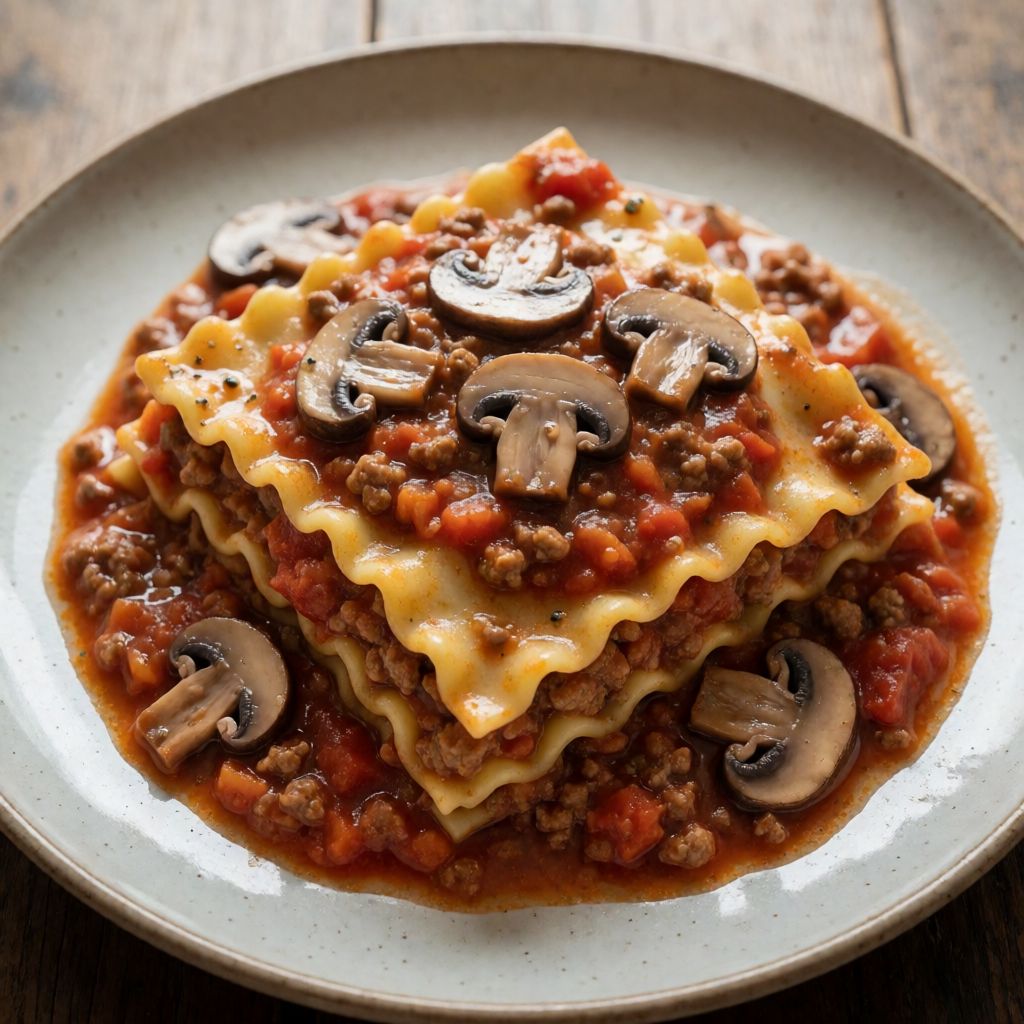
 AI photo
Lasagne with Mushroom Ragù
A rich lasagne layered with a savoury veal and mushroom ragù, béchamel and parmesan.
Labels are worked out automatically from the ingredients and can be wrong. Check the packaging if it matters to you.
Ingredients
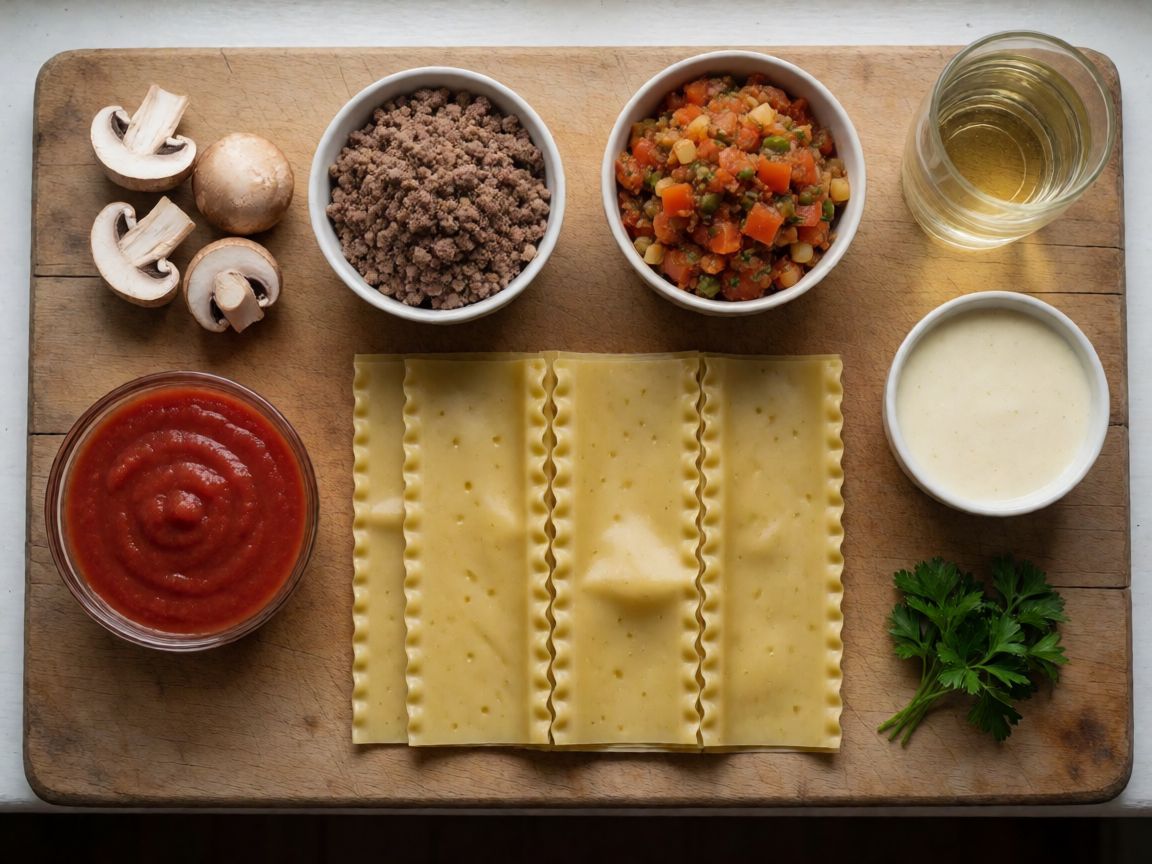
- 300 g Mushrooms
- 250 g Minced veal and pork
- 400 g Tomato passata
- Soffritto mix as needed
- Lasagne sheets as needed
- 400 ml Béchamel sauce
- 2 tbsp Vegetable oil
- Salt as needed
- Black pepper as needed, ground
- 120 ml White wine
- Parsley as needed
- Parmesan as needed
- Butter as needed













Steps
In a pan, fry the soffritto mix in the oil, add the minced veal and pork and brown it.
Pour in the white wine and let it evaporate completely.
Simmer gently.
15 minAdd the cleaned, diced mushrooms and continue cooking.
Pour in the tomato passata, season with salt, add black pepper and parsley.
In a baking dish, layer the lasagne sheets, ragù, béchamel and parmesan.
Finish with a layer of ragù, béchamel, parmesan and butter.
Bake at 200°C.
Done when the centre reaches 71°C.
This is not a quick supper, it's a Sunday-roast-length project: sheets, a meat-and-mushroom ragù, béchamel, stacked and baked until separate wet layers stop being separate and become one dish. Four people, one dish, maybe fifty minutes of your own attention before the oven takes over the rest.
What decides whether it works is dryness, not time. The ragù has to be thick enough to sit on a spoon without running before it ever goes in the dish — a wet ragù means wet pasta, and wet pasta means a lasagne that slides apart on the plate instead of cutting into a square. The oven then has one job: press those layers into a firm block and brown the top into something worth fighting for.
Mushrooms are here for the meat's sake, not their own. They bulk the ragù and add savoury depth without more mince — the same instinct that had people stretching a little meat with whatever the garden or the market gave them, long before anyone called it cooking with mushrooms on purpose.
And don't trust the clock for the oven stage. Ground meat isn't a steak — searing a steak's surface is enough, because any bacteria sit on the outside, but mincing folds surface bacteria right through the meat. That's why this recipe gives you a core temperature instead of minutes: 71°C at the centre is the only honest sign of doneness here, and a cheap probe thermometer earns its keep on this one dish alone.
Start with the mince browning, because this is where it quietly goes wrong for most people. Cold mince into a hot pan, and for the first couple of minutes nothing browns — it just turns grey and sits in its own liquid. That's not a failed sear, that's physics: mince is full of water, and the water has to cook off before the pan's hot enough again to brown anything. Give it that time rather than cranking the heat to compensate, and don't crowd the pan — too much mince at once steams instead of frying, and steamed mince stays grey forever.
The wine does two separate jobs. It lifts the browned bits stuck to the pan bottom — real flavour, not scraps — and then it needs to cook off completely, because raw alcohol tastes sharp and faintly bitter, not of wine at all, it tastes of wine that hasn't finished cooking. "Let it evaporate completely" isn't fussiness, it's the gap between a sauce that tastes of itself and one that tastes faintly of a wine bar.
Mushrooms go in after the meat's browned and the wine's gone, and the order matters: mushrooms are mostly water, and tipped in alongside raw mince they'd flood the pan before anything had a chance to brown. Dice rather than slice — more cut surface lets the water out faster, and you want it out, concentrating what's left into flavour instead of simmering it in a puddle. Pick firm, dry caps; a mushroom that feels slightly slippery before it's even been near the heat is already breaking down and gives you less flavour for more liquid. Chestnut or button mushrooms are fine; a handful of dried porcini, soaked and chopped in alongside, pushes the depth further if you want it — just strain the soaking water through a cloth and add it with the passata instead of pouring it away.
The soffritto — onion, carrot, celery, finely diced — is the base under half of European home cooking, and the reason is economic, not mystical: three vegetables that kept all winter in a cold store, always cheap, always in the house, cooked slowly in fat until they collapse rather than fried hard until they catch. Dice it fine and it melts into the sauce; dice it rough and you'll bite into it at the table, which isn't a disaster, just a different dish.
Béchamel is butter and flour cooked together first, then loosened with milk — the roux is cooked a minute or two on its own before any milk goes in, to cook out the raw-flour taste, and the flour's starch is what swells and thickens the milk once it's added. In this dish it does a second job: it's the moisture that lets dried lasagne sheets soften in the oven without ever being boiled first. Some say you must always pre-cook lasagne sheets or they'll stay hard — no, because a wet enough sauce plus béchamel between the layers gives a dried sheet all the steam it needs inside a covered dish; that's exactly why some packets of dried sheets say no pre-cook required. If your ragù looks dry going in, the sheets will stay dry coming out, so be generous with both the ragù's moisture and the béchamel rather than mean with either.
Parmesan on top, finished with butter, is what gives you the crust: a hard aged cheese melts and browns, where a soft cheese like mozzarella would just stretch into strings and never set a crust at all. The butter on that final layer isn't decoration — it stops the top drying and cracking in the oven's dry heat before the inside's caught up. For frying the soffritto and the mince, use any oil with no smell of its own — plain vegetable or sunflower oil — because this is the wrong place for extra-virgin olive oil's flavour and low smoke point; keep that bottle for drizzling at the table, not for the pan.