
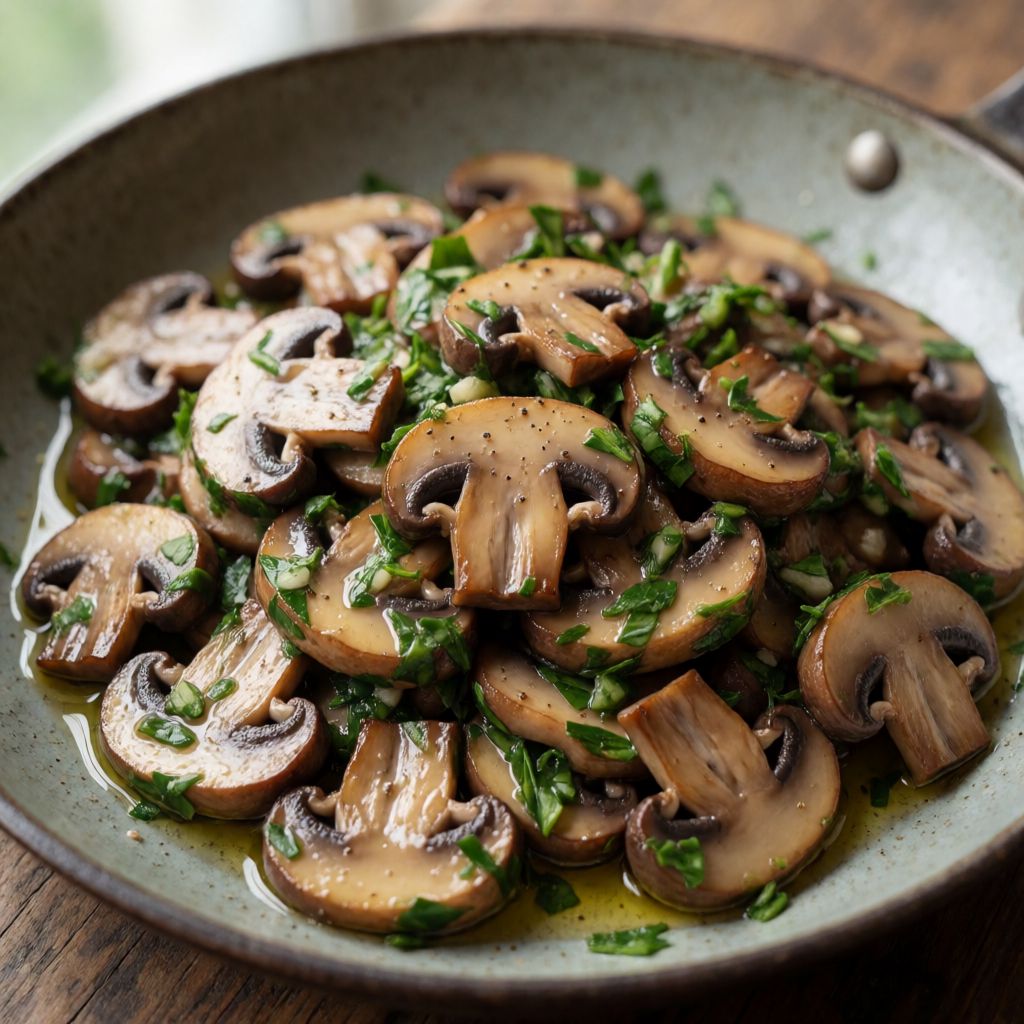
 AI photo
Trifolati Mushrooms with Garlic and Parsley
Mushrooms gently braised with garlic and parsley, a simple Italian-style side dish.
Labels are worked out automatically from the ingredients and can be wrong. Check the packaging if it matters to you.
Ingredients





Steps
Carefully clean the mushrooms with the blade of a knife, removing any residual soil. Cut larger mushrooms in half, then rinse thoroughly under cold water.
Put the mushrooms in a pot of water, bring to the boil and cook for 10 minutes, skimming off any foam.
10 minDrain the mushrooms and pat them dry carefully with a paper towel.
Heat the olive oil in a large frying pan and sauté the minced garlic until golden, then remove it from the pan.
Add the mushrooms, cover the pan and cook on high heat until the liquid has evaporated.
10 minAdd the salt and a pinch of black pepper, and continue cooking, stirring frequently.
5 minTransfer the mushrooms to a serving plate and sprinkle generously with parsley.
Trifolati isn’t a shape or a cut — it’s a method borrowed from how Italians used to treat actual truffles: thin slices, hot oil, garlic, parsley, done fast. Truffle was never an everyday thing for most people — too rare, too dear — so the garlic-and-parsley treatment got transplanted onto something an ordinary household could afford every week: button mushrooms. You're not making a lesser truffle dish. You're making the dish the truffle treatment was always meant to dress up a cheap vegetable with, and the mushroom just happens to be the vegetable most people had on hand.
What decides whether this works is not seasoning, it's water. A mushroom is mostly water held inside a cell structure that collapses the second you apply real heat. Drop raw mushrooms straight into a hot pan and you get two things happening badly at once: the outside tries to fry while the inside is still dumping liquid, so you end up with rubbery, squeaking lumps sitting in their own broth, never browning, never concentrating flavour. The boil at the start solves this cleanly — it's a controlled way to pull the bulk of that water out before frying even starts, in water that's already boiling, so nothing steams or stews. By the time the mushrooms hit the oil, they've already given up most of what would have fought the heat.
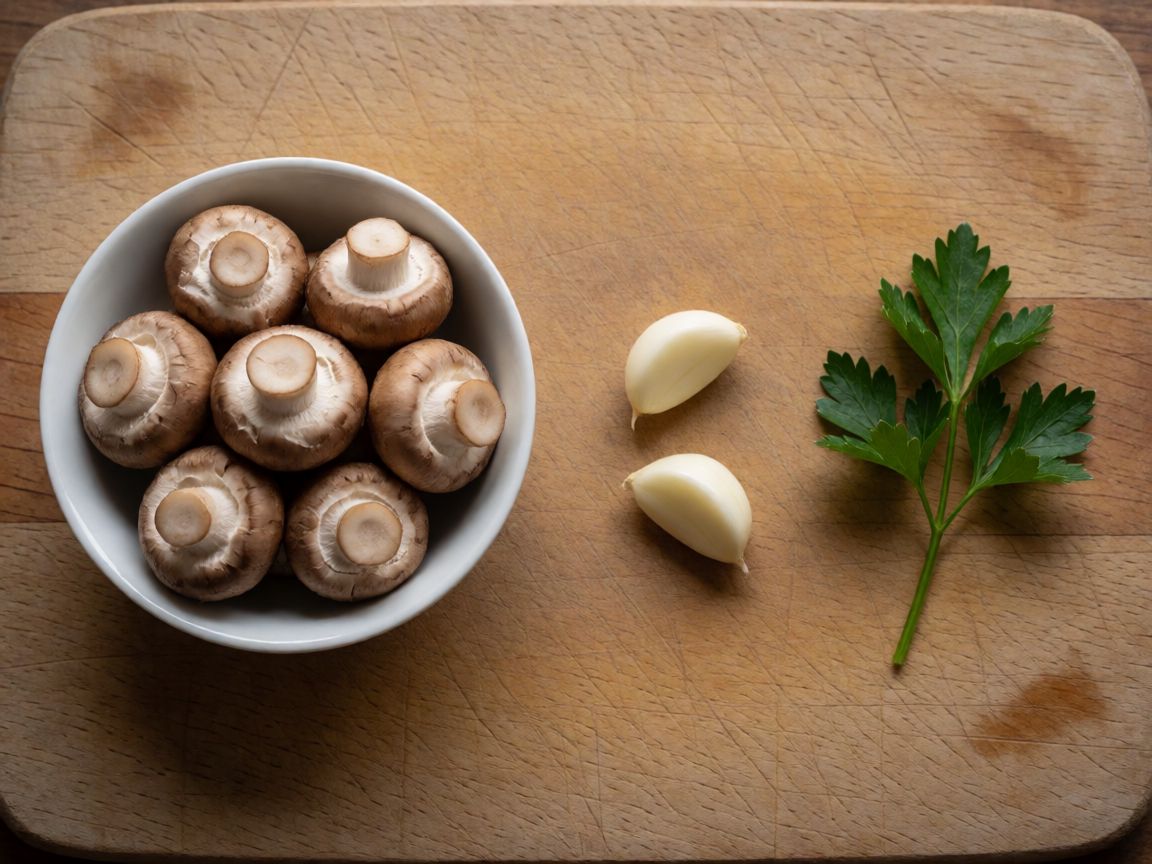
Mushrooms, 800 g for four as a side — a decent handful each, because they shrink hard once the water leaves them; what looks like plenty raw will look modest on the plate. Button mushrooms are standard and cheapest, but anything firmer and closed-capped — chestnut mushrooms, which most UK supermarkets sell right next to the button ones — gives you more flavour for the same treatment, because they started with a slightly lower water content and a deeper taste to begin with. Choose by feel: firm, dry-skinned, gills tucked in tight. Avoid anything slick or sweating in its plastic punnet — that's not dirt, that's a mushroom that's already begun breaking down, and it'll give you more liquid to boil off and less flavour once it's gone.
On washing: there's an old insistence that mushrooms must never see water, only a brush, because "they soak it up like a sponge." They don't, not in the time it takes to rinse them. A mushroom's resistance to water is mostly in its skin; the sponge problem only shows up if you leave them sitting in a bowl of water for a long soak. A quick rinse under the tap, after cutting the larger ones, costs you nothing and gets the grit the knife missed.
Olive oil, six tablespoons for 800 g — that's a generous amount on purpose, because mushrooms have a lot of surface area once halved and need enough oil around them to fry rather than catch and burn in patches. Olive oil earns its place here because this is fundamentally an Italian dish and the oil's own flavour is meant to be part of the result, not hidden. If you only have a neutral oil — sunflower, a mild rapeseed, anything with no smell of its own — it'll do the frying job fine, you just lose some of the character that's the actual point of using olive oil in the first place. Butter is the wrong substitution here, not because of some rule, but because it browns and burns well before the garlic's had its moment, and you'd be fishing out black specks instead of golden ones.
Garlic, two cloves, minced and fried in the oil until golden, then taken straight back out before the mushrooms go in. This isn't caution for its own sake — garlic is thin and burns in a fraction of the time it takes mushrooms to release their water and start frying properly. Leave it in the pan the whole way through and by the time the mushrooms are actually done, the garlic's turned bitter and acrid, and that bitterness doesn't cook back out. Frying it briefly and removing it means the oil carries its flavour without carrying its ash.
Salt and a pinch of black pepper go in once the liquid's gone, not before. Salt pulls water out of anything it touches; add it while the mushrooms are still wet and you're fighting your own boiling step, drawing out more liquid right when you're trying to dry the pan out and start frying. Add it after, and it just seasons what's already concentrated.
Parsley, to taste, goes on raw at the very end, off the heat. Its smell is carried by oils that cook off fast — put it in the pan and you'll get green colour and none of the lift. Scatter it on at the table, not in the pan, and that's the whole trick of it. None of this is quick, and that's not a flaw to rush past — the boiling, the draining, the drying, the waiting for the sound in the pan to change, all of it takes patience you can't shortcut with higher heat. Higher heat just burns the outside while the inside stays wet. The method is slow because the water has nowhere else to go but out, in its own time.