
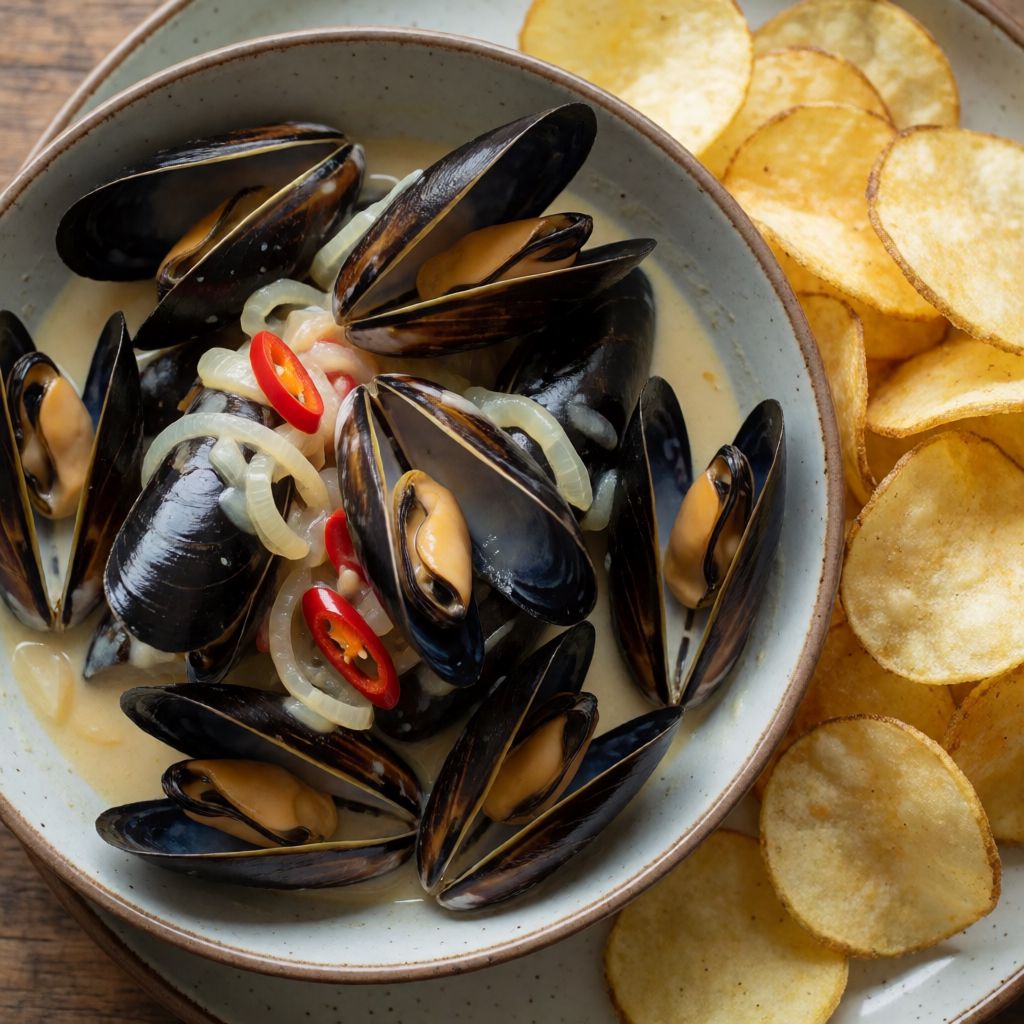
 AI photo
Mussels in Creamy Wine Sauce with Chips
Steamed mussels in a creamy white wine sauce, served with crispy oven-baked chips.
Labels are worked out automatically from the ingredients and can be wrong. Check the packaging if it matters to you.
Ingredients
- 1 kg Potato cut into chips
- 3 tbsp Olive oil
- Salt
- 2 kg Mussels
- 2 pcs Onion finely chopped
- 0.5 pcs Red chilli finely chopped
- 2 clove Garlic finely chopped
- 300 ml White wine
- 200 ml Double cream
- 1 bunch Parsley finely chopped
- 1 tbsp Olive oil for frying
- Black pepper freshly ground










Steps
Wash the potatoes thoroughly and cut them into chips.
Toss the chips with the oil and salt and roast in the oven at 175°C (fan) for 35–40 minutes, until crisp.
Turn the chips a few times while roasting.
Scrub the mussels thoroughly under running water, without soaking them. Discard any with cracked shells, and any open ones that do not close when tapped sharply on the worktop.
In a large pot, fry the onion, chilli and garlic in olive oil until soft.
Add the mussels and white wine, and cover with a lid.
Cook over medium heat for 5–10 minutes, until the mussels have opened.
Strain the liquid from the mussels through a sieve into a bowl to collect the wine sauce. Cover the mussels to keep them warm.
Pour the wine sauce back into the pot and keep the mussels covered to stay warm while the sauce reduces.
Reduce the wine sauce to about 100 ml.
Increase the heat and watch closely so the sauce doesn't boil away completely, as this happens quite quickly.
Lower the heat once about 100 ml of wine sauce remains, add the cream and season with salt and pepper.
Return the mussels to the pot, cover and bring back to the boil, cooking for 1–2 minutes.
Serve in a large bowl or divide among deep plates.
Sprinkle with finely chopped flat-leaf parsley and serve with the oven-baked chips.
Discard any mussels that have not opened during cooking.
This is a pot of shellfish doing two jobs at once: feeding you and making its own sauce. The mussels open, dump brine and juice into the wine, and that liquid becomes the base for the cream. You're not cooking a sauce and mussels separately — you're cooking one thing that produces the other. Get that relationship right and everything else is housekeeping.
What decides whether it works isn't the cream or the wine, it's the mussels themselves, before any of them touch heat. A mussel that's already dead — cracked, gaping, unresponsive to a sharp tap — won't open cleanly when cooked; it just sits there looking cooked while something's gone off inside. Sort them at the sink, not at the table. That's the one step with no second chance.
Heat here is really just "enough to make steam, in a sealed pot." You're not frying the mussels, you're flash-steaming them in their own liquid plus wine, and the lid matters more than the dial number — it's what traps the steam that forces the shells open. Five to ten minutes isn't a target, it's a ceiling: the moment the shells have gaped, they're done, and anything closed after that stays closed for a reason, not out of stubbornness.
The chips are the other half of the plate and they want almost no attention from you once they're in the oven — that's the point of oven chips next to a dish that needs your full focus on the hob for twenty minutes. Two things cooking in parallel, one needing eyes, one not.
Potatoes: any floury variety that roasts rather than waterlogs — the kind sold loose for baking, not the waxy salad ones that stay bullet-hard and refuse to crisp. Cut them to chip size, toss in oil thinly enough that it coats rather than pools, because a chip sitting in its own puddle of oil in a tray steams instead of browning, and a steamed chip is a sad, pale chip. Turning them partway through is what stops the underside going soft while the top crisps — contact with hot metal is what browns, so every side needs its turn down.
Mussels: 2kg sounds like a lot until you remember maybe a fifth of the weight is shell and water you'll throw away, and that a mussel that doesn't open is a mussel you never ate anyway, so buy generously. Farmed rope-grown mussels, which is most of what you'll find in a UK supermarket, are already fairly clean — the old instruction to soak them for hours in water with oatmeal or flour, to get them to "spit out grit," is largely a leftover from wild-harvested mussels dragged off a rocky shore. Scrub, don't soak — soaking in fresh water stresses them and can kill a few before they even reach the pot, which just adds to your discard pile for no gain.
Onion, chilli, garlic: this trio isn't flavour decoration, it's the base the wine reduces onto. Softening them in oil first — not colouring them — means they melt into the sauce rather than crunching through it; a browned onion here would taste of caramel and fight the delicate mussel liquor instead of supporting it. Any onion variety works; the chilli's job is a background warmth, not heat you're meant to notice, so use less if your chilli runs hot and more if it's mild — taste is the only honest guide, the "half a chilli" on the list is somebody else's chilli, not yours.
Wine: a dry white, something you'd be happy drinking, because the alcohol cooks off but the flavour doesn't — a wine that tastes thin or sour on its own will taste thin or sour concentrated into 100ml of sauce. This is also the whole reason the dish exists in this form: mussels and white wine is a coastal, French-leaning pairing because wine was the acid and the flavour people on those coasts already had in the house, cheaper and more available than lemons ever were. Moules marinière is this recipe's parent; the cream and the chips are what turn a bistro starter into a full plate.
Straining the mussels out before reducing is the step people skip, and it's the step that saves the dish. Leave the mussels in the pot while the sauce boils down and they go from tender to rubbery — all that extra heat has nowhere useful to go once the meat's already cooked, it just toughens it. Pulling them out, covering them with a plate or a tent of foil to hold their heat, lets the sauce reduce hard and fast without cooking the shellfish a second time. Reducing to roughly 100ml isn't an arbitrary number — it's the point where the liquid's gone from thin wine-and-juice to something with enough body to actually coat, concentrated salt and all, which is also why you season after reducing, not before, or you'll oversalt it.
Cream: double cream, because it has enough fat to sit in a hot, slightly acidic, slightly salty liquid without splitting into watery curds — a single or half-fat cream is more likely to break the moment it hits that reduced wine. If you're avoiding dairy, crème fraîche behaves similarly for the same fat-content reason, though it'll bring its own tang; a dairy-free cream alternative with enough fat content can work but check it's one meant for cooking, not for tea. Lower the heat before it goes in — this isn't about tenderness, it's that a vigorous boil can still split even a good cream once the acid and salt are both already in there.
Parsley at the end is cheap, obvious, and still worth saying: it's raw, bright, slightly bitter against all that richness, and it only works added at the very last second, off the heat — cooked parsley just goes dark and loses the thing it was there for.