
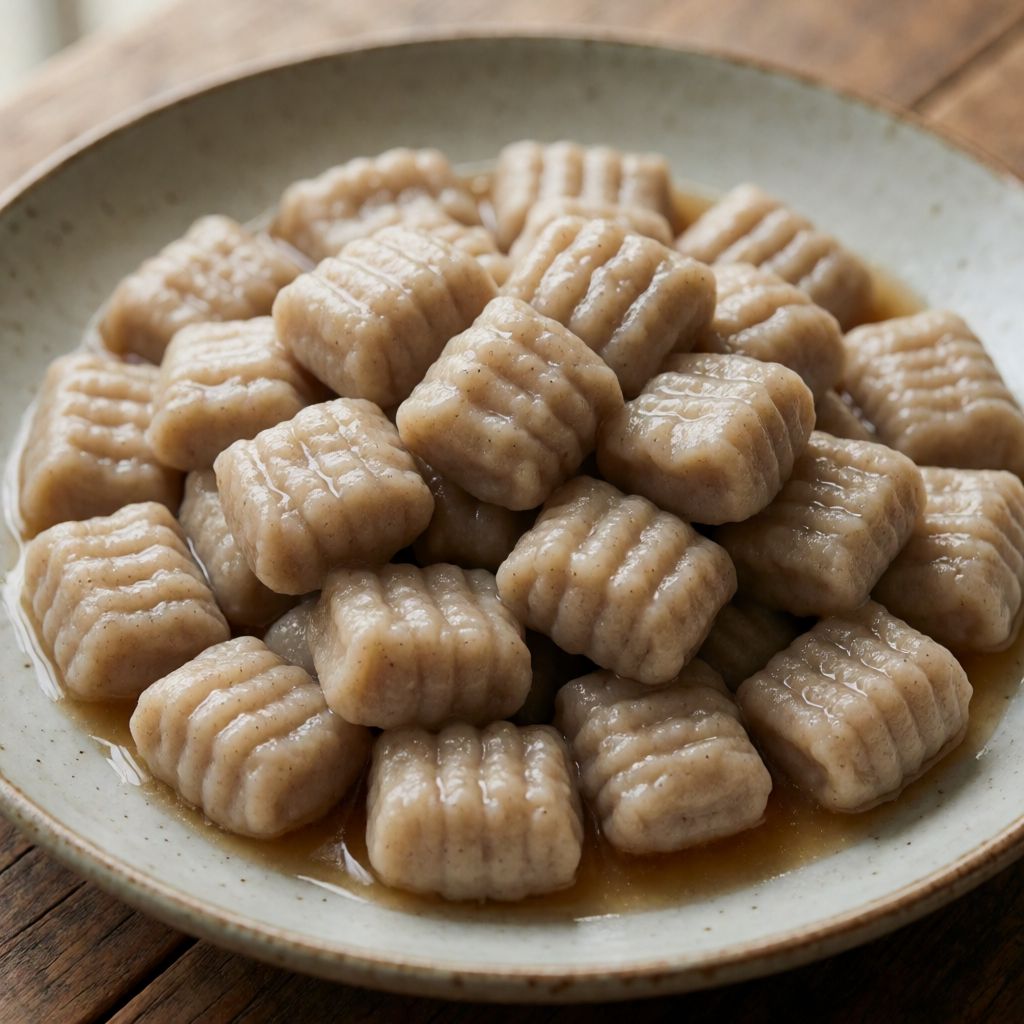
 AI photo
Chestnut Flour Gnocchi
Soft gnocchi made from chestnut flour, simmered in chicken stock and finished with butter and a mature hard cheese.
Labels are worked out automatically from the ingredients and can be wrong. Check the packaging if it matters to you.
Ingredients
- 450 g Chestnut flour
- 50 g Plain flour
- 2 pcs Eggs
- Salt to taste
- 1.5 l Chicken stock
- 100 g Butter
- 250 g Mature hard cheese





Steps
Mix the sifted chestnut flour with the plain flour, pile it into a mound and make a well in the centre.
Break the eggs into the well, add a pinch of salt and gradually pour in cold water, mixing with your fingertips.
Knead the dough well by hand so the flour absorbs the water, until you have a soft, dry ball of dough.
Cover the dough with a clean cloth and let it rest for at least 30 minutes.
30 minPlace the dough on a floured surface and shape it into long ropes, then cut into small gnocchi pieces.
Bring the chicken stock to the boil in a large pot.
Drop the gnocchi into the hot stock and cook for about 20 minutes.
20 minLift out the gnocchi with a slotted spoon and arrange on a serving plate.
Melt the butter in a small saucepan and slice the mature hard cheese thinly.
Combine the melted butter and cheese with the gnocchi and mix well.
Serve the chestnut flour gnocchi hot.
What was changed
Mature hard cheese was chosen as a mature hard cheese that shoppers can easily find.
Chestnut flour gnocchi is not a pasta dish pretending to be rustic — it's what mountain villages ate when wheat was a luxury and the chestnut tree was the thing that actually fed them. Tuscany, Corsica, parts of the Apennines: no grain grows well on those slopes, but chestnuts do, and dried, ground chestnuts became "the flour of the poor" long before anyone called it artisanal. That history explains the texture you're aiming for: this dough is never going to behave like durum pasta, and trying to force it to is where most people go wrong.
What decides whether this works is the ratio of chestnut flour to plain flour and how much water your hands let in. Chestnut flour has no gluten — none. The 50g of plain flour you're adding isn't there for flavour, it's there to give the dough just enough structure to hold together in boiling stock instead of dissolving into a chestnut-flavoured soup. Too little plain flour and your gnocchi disintegrate the moment they hit a simmer. Too much water in the well and you get the same disaster, because there's no gluten network to trap it.
The other thing that decides it: patience with the dough, twice. Once while it rests under the cloth — that's not decoration, that's the small amount of gluten you do have relaxing and the chestnut flour finishing its hydration, which stops the gnocchi cracking apart when cooked. And once while they poach, because 20 minutes in gently bubbling stock is a floor, not a countdown — you're watching for them to firm up and hold shape when lifted, not watching a clock.
Some say gnocchi has to be shaped into those ridged little ovals with a fork. No — because that ridging exists to catch sauce, and you're not serving a clinging sauce here, you're serving melted butter and sliced cheese that simply coats. Cut your ropes into short pieces and leave it there; the fork work is wasted effort on a dish that doesn't need grip.
The chestnut flour is the whole point, so don't substitute it unless you genuinely can't get it — but know what you're trading if you do. It's naturally sweet-ish, slightly dense, and gluten-free, which is why the dough needs the plain flour as scaffolding. If you're using British supermarket chestnut flour, check it's actually 100% chestnut and not a blend — some continental brands cut it, and that changes how much water the dough wants. Sift it properly: chestnut flour clumps more than wheat flour because it's oilier, and unsifted lumps become hard nuggets in the finished gnocchi.
The plain flour is just ordinary wheat flour for gluten — plain, not strong bread flour, because you don't want a chewy, bready gnocchi fighting the chestnut's softness. If you're out of plain flour, any wheat flour works at a pinch; what matters is that it contributes gluten, not flavour.
The eggs bind the dough and add a little richness and colour. Two eggs for 500g of combined flour is light — this isn't an egg-rich pasta dough — so don't be tempted to add a third "for luck." More egg means more structure, which sounds helpful until you realise it also means tougher gnocchi.
The stock is doing double duty: it's the cooking liquid and it's seasoning the gnocchi from the outside in, since chestnut flour dough itself carries almost no salt until you add it at the well stage. Use a proper chicken stock, homemade if you've got it from Sunday's roast carcass — this is exactly the kind of dish that justifies keeping that stock instead of binning the bones. A stock cube version will work but will taste thinner; if that's all you have, go a little heavier on the final butter and cheese to compensate.
For the finish, "mature hard cheese" is a criterion, not a brand — you want something with enough character and salt to stand up to the chestnut's sweetness, and firm enough to slice thinly rather than grate. In Italy that's often pecorino or a hard aged cheese from the same region; in a British kitchen, a mature Cheddar or a hard sheep's cheese does the same job. Don't reach for something mild — mild cheese disappears against chestnut flour and you're left tasting plain butter.
On equipment: you don't need a kazan or anything specialist here, just a wide pot big enough that 1.5 litres of stock isn't crowded, and a slotted spoon to lift the gnocchi out gently — they're more fragile than wheat gnocchi, and tipping the whole pot through a colander is how you lose half of them to the sink.