
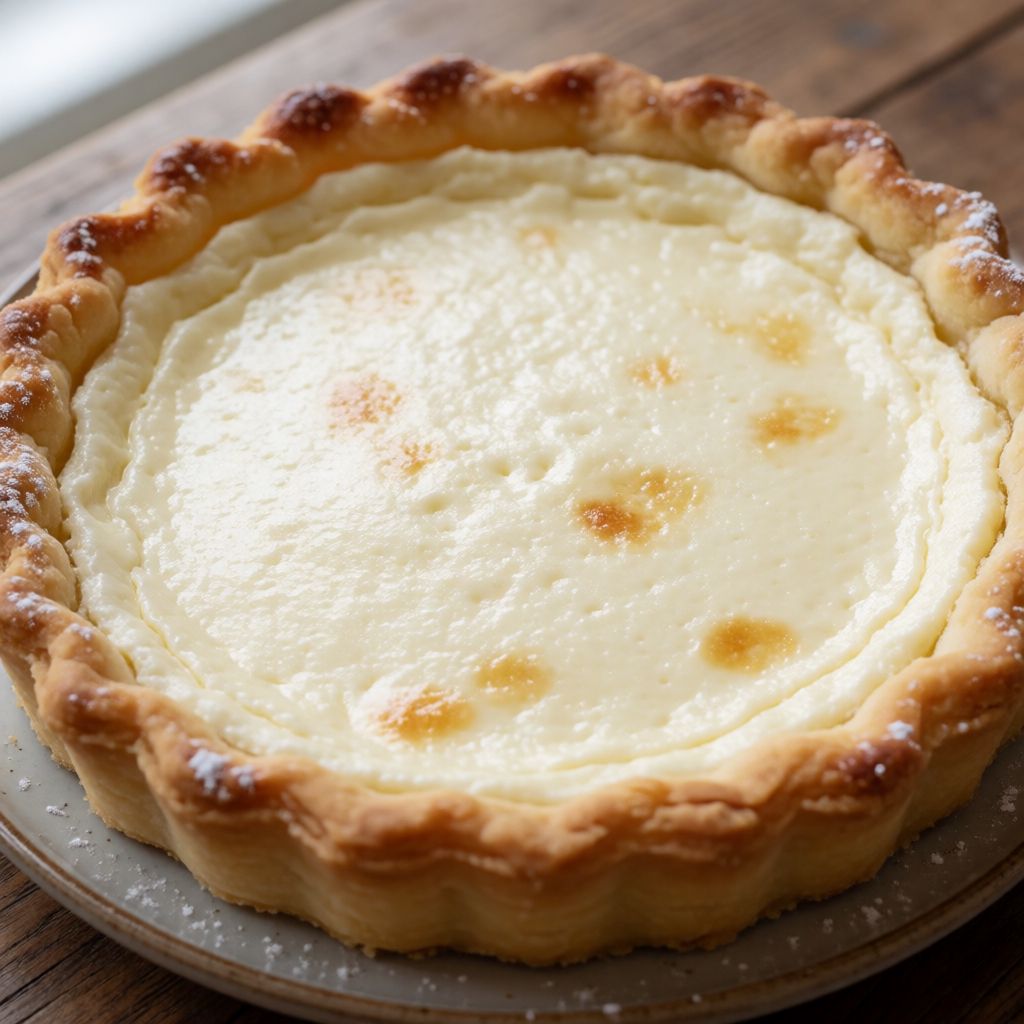
 AI photo
Crostata with a Buttery Base
A classic Italian-style crostata with a buttery shortcrust base, ricotta filling and strawberry jam.
Labels are worked out automatically from the ingredients and can be wrong. Check the packaging if it matters to you.
Ingredients
- 150 g Butter softened at room temperature
- 1 pcs Egg
- 80 g Icing Sugar
- 240 g Plain Flour
- 1 tsp Vanilla Extract
- 250 g Ricotta
- 300 g Strawberry Jam







Steps
In a bowl, place the softened butter and beat with an electric mixer until soft, then add the egg and the icing sugar.
Gradually sift in the flour, mixing first with the mixer and then with a spatula, until you get a soft, smooth dough.
Transfer the dough to a piping bag and shape the base in a springform tin using concentric rings, then form the edge.
Spread the mixed ricotta in an even layer and cover with the strawberry jam.
Smooth the surface and, if you like, decorate the edge with the tines of a fork.
Bake in a preheated fan oven at 160°C for 40–45 minutes (or at 170°C without fan for 45–50 minutes).
45 min
This is a crostata that skips the rolling pin. The base here is a soft, creamed butter dough — butter beaten to something like whipped cream, not cut cold into flour the way classic pasta frolla is made. That's the whole trick, and it's what decides whether this works: the dough has to be soft enough to go through a piping bag and hold its shape as rings on the tin, not stiff, not greasy, not collapsing.
What you're actually building is three layers that each do a job: a short, buttery base that supports everything; a layer of ricotta that sits between the pastry and the jam like a raincoat; and jam on top, which is there for sweetness and colour, not for cooking. Nothing in this bakes raw fruit into jam — the jam is already finished, you're just setting it in the heat along with everything underneath.
Success shows itself by sight, not by the clock. The base goes from pale and raw-looking to a gold that's edging toward amber at the rim — that's the butter finally browning a little, the sugars catching. The ricotta stops looking wet and glossy and sets into something you could cut cleanly. If the middle still wobbles like a loose custard, it isn't done, whatever the timer says.
Some say a tart base always needs to rest in the fridge before baking. No — because that rule is for rolled pastry, where chilling stops the gluten springing back and the butter staying workable under a pin. Here you've gone the opposite direction on purpose: you want the dough soft and warm enough to pipe. Chilling it would be fighting your own technique.
Butter first, because it carries the whole method. It has to be genuinely soft — press a finger in and it should give without resistance, not greasy-shiny, which means it's started to melt and will never hold air properly when beaten. Cold butter here is a defect waiting to happen: beat cold butter and you just bruise it, no air goes in, and the base comes out dense instead of short. Any butter will do as long as it's unsalted, so you control the salt yourself; margarine will take the shape but won't give you the same clean, short bite when you chew it.
The egg goes in once the butter's already soft and aerated, because its job is to emulsify — bind the fat and the eventual flour into one smooth paste rather than a split, curdled-looking mess. Icing sugar instead of ordinary caster sugar is not a style choice, it's about grain size: those fine crystals dissolve into the butter during beating, so you get smoothness instead of a slightly grainy bite. If you've only got caster sugar, blitz it a few seconds in a blender or food processor first — that's the substitution criterion, not the brand.
Flour goes in sifted, and gradually, for one reason: you want it mixed in with the least working possible. Flour develops gluten the more you handle it wet, and gluten is exactly what turns a tender base into a tough, biscuit-hard one. Mixing briefly with the machine, then finishing by hand with a spatula, is how you stop short of that point — the spatula lets you feel when the dough has just come together and tells your hand to stop, where a mixer on full speed won't.
Vanilla extract is there for the real thing — actual vanilla flavour, not the synthetic sweetness of an essence. If you only have vanilla essence, use it, the dish survives; paste or scraped seeds from a pod are the better substitute if you have them. Ricotta is doing structural work, not just flavour: its job is to sit between the wet jam and the baked base so the jam doesn't soak straight down and leave you with a soggy bottom — which is the real cause of a crostata that disappoints, not bad luck with the oven. Choose a firm, well-drained ricotta rather than a wet, runny one; if you've no ricotta, a thick quark or mascarpone will stand in, as long as it isn't loose with whey.
The jam should be stiff — set properly, not a runny compote — because a thin jam will bleed through the ricotta during baking and undo the barrier you've just built. Strawberry is traditional partly because it's cheap and available everywhere, not because the dish demands it; any thick, well-set fruit preserve will do the same job.
One more thing worth saying honestly: a springform tin matters here because this soft dough needs somewhere it can be released from cleanly once baked, and the piped rings give you a base and edge without the shrinkage problems rolled pastry has in a domestic oven. On temperature — fan ovens move hot air around the food, so they cook evenly at a lower setting; without a fan the air near the tin insulates a little, so the recipe asks for a few more degrees to get the same result. Either way, don't rush the beating of the butter at the start — patience there is what gives you a light base instead of a dense one, and no amount of oven time fixes that afterwards.