
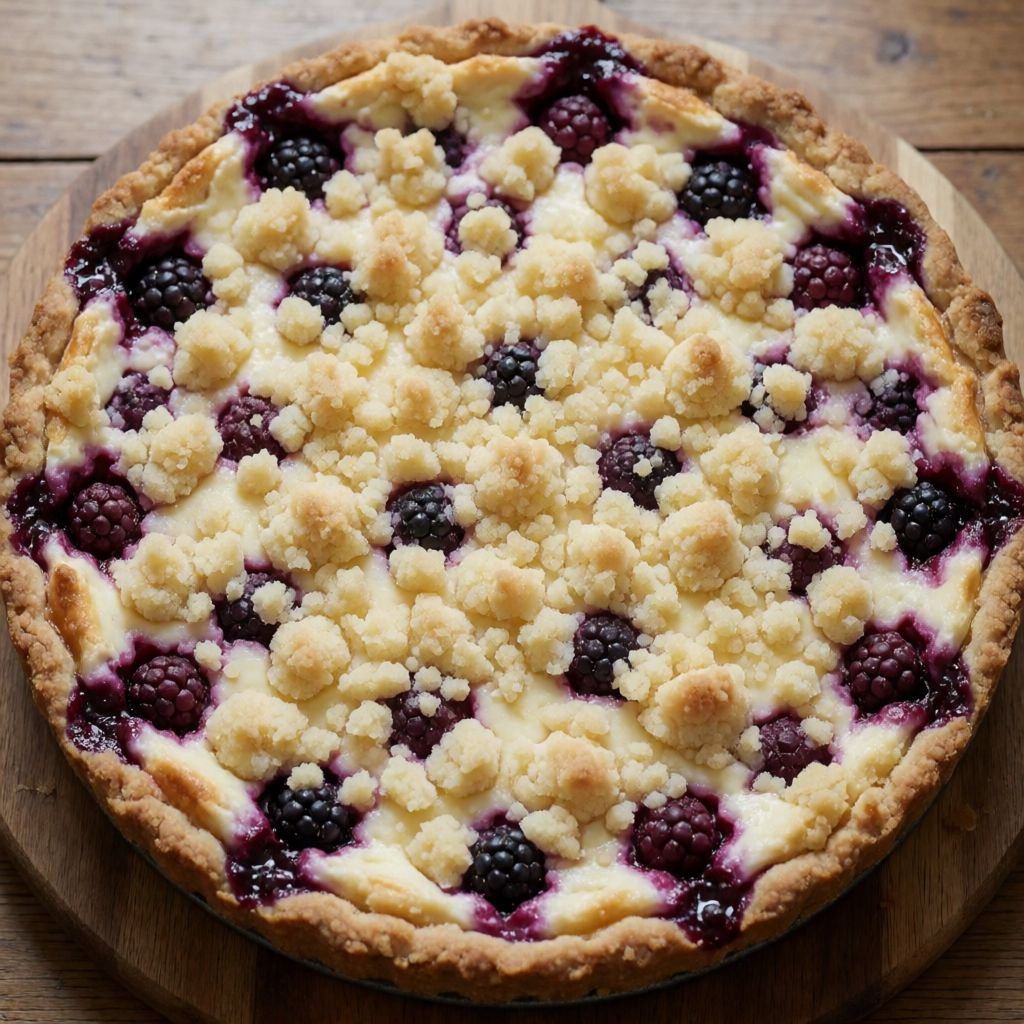
 AI photo
Ricotta and Blackberry Crumble Pie
A crumbly pastry pie filled with sweet ricotta and juicy blackberries.
Labels are worked out automatically from the ingredients and can be wrong. Check the packaging if it matters to you.
Ingredients
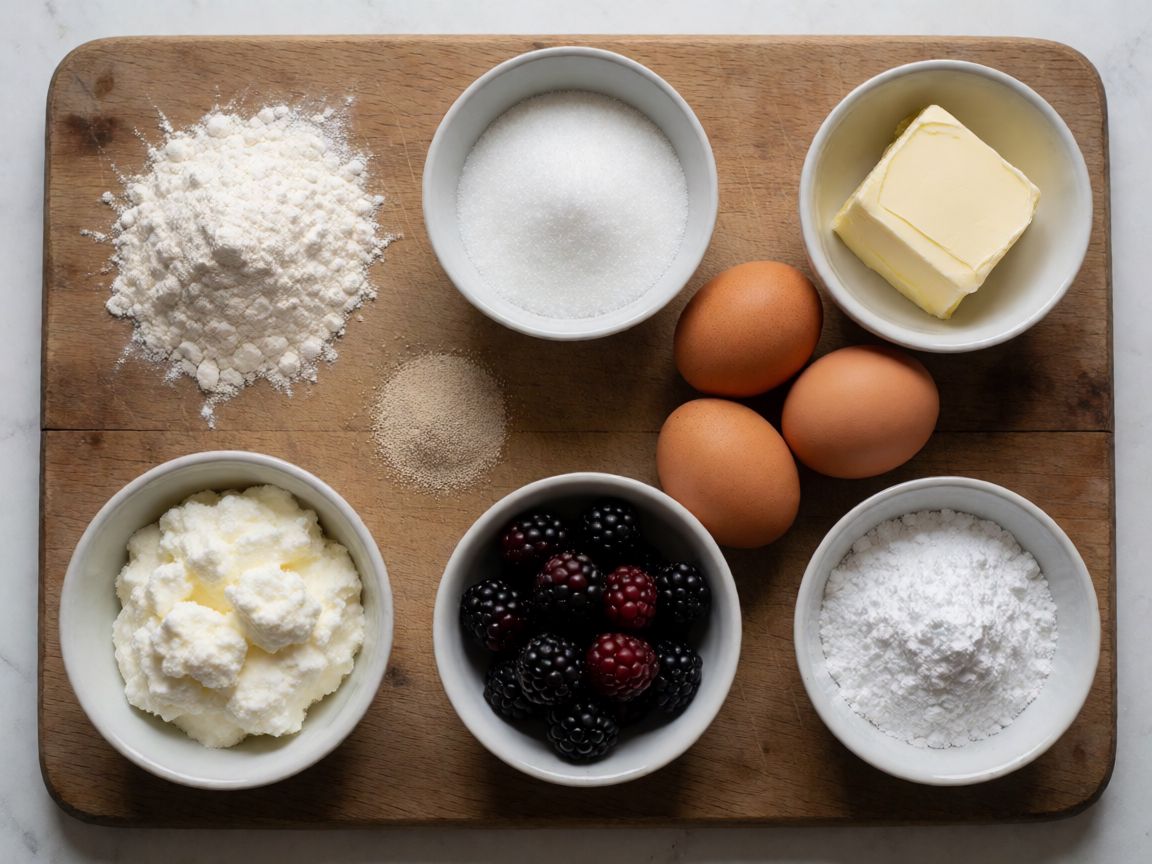
- 500 g Plain flour
- 200 g Caster sugar
- 200 g Butter
- 3 pcs Eggs
- 10 g Yeast
- Salt to taste
- 500 g Ricotta
- 500 g Blackberries
- 200 g Icing sugar









Steps
In a food processor bowl, combine the flour, yeast and sugar and start mixing.
Warm the butter in a saucepan for a few seconds until soft, then add it to the dry ingredients.
Make sure the dough stays crumbly, like breadcrumbs.
Take the dough out of the processor, add the eggs and knead by hand, adding a little flour as needed.
Put the dough in a bowl, cover tightly with cling film and leave in the fridge.
30 minIn another bowl, mix the ricotta with the icing sugar until smooth.
Rinse the blackberries and set aside.
Take the dough out of the fridge, press about two-thirds of it into a baking tin and smooth it out.
Spread the ricotta mixture evenly on top, leaving a border at the edge of the tin.
Add the blackberries, then crumble the remaining dough over the top.
Bake in a preheated oven at 200°C, checking occasionally.
45 minLet the pie cool before serving.
This is a sbrisolona dressed up as a cheesecake — a crumbly, half-biscuit shell that holds a ricotta filling and a scatter of blackberries, then gets covered back over with its own rubble. The whole trick of the pastry — called pasta frolla in Italy, though nobody here needs the Italian to make it — is that it is never kneaded into a smooth dough until the very end, and even then only just enough. Butter coats flour before any liquid arrives, so the gluten strands that would otherwise link up and go tough never get the chance. That's why step three insists on breadcrumbs, not dough: it's the structural decision the whole pie depends on, made early, before you've even seen an egg.
What decides whether this works is temperature discipline with the butter and fat, and restraint with your hands. Warm the butter only until it yields like putty — if it pools into liquid, it will seep straight through the flour instead of coating each grain separately, and you lose the crumb forever; you get instead a dense, biscuity slab. Some say pastry must be worked hard to "come together" — no, the opposite: every extra minute of kneading after the egg goes in builds gluten you don't want, and a pastry crust that fights back with a bite is a pastry handled with anxious, over-eager hands.
Flour: plain is correct here, not strong bread flour — you don't want the extra protein that makes dough elastic and chewy, because elastic is the enemy of a crumb that's meant to shatter a little under a fork, not stretch. Caster sugar dissolves into the dry mix rather than sitting as gritty specks, which matters more in a pastry that's never fully smoothed by kneading — any undissolved sugar stays undissolved.
Butter should be cold going in, then warmed only to softness, not melted — a few seconds in the pan is about judgement, not a timer: press it with a finger, it should dent rather than squish. If you're using salted butter because that's what's in the fridge, go easy on or skip the added salt; English butter tends saltier than you'd think.
Yeast in a pastry recipe like this is unusual — you're not after a rise, you're after a faint lift and tenderness, almost incidental. If you only have active dried yeast rather than fresh, use roughly a third of the 10g and don't bother activating it in water first; there's no proving stage here for it to bloom in anyway.
Ricotta: buy it fresh and drain it if it looks watery — supermarket tubs in the UK often sit in a fair amount of whey, and a wet filling will seep into your base and turn the bottom pastry soggy instead of short. If ricotta isn't available, a well-drained cottage cheese blitzed smooth, or mascarpone cut with a little quark, gets you the same loose, mild creaminess — the criterion is a cheese with soft curd and little tang, not a specific brand.
Blackberries don't need to be fresh off a bramble — frozen work, but thaw and drain them first, or you're baking off a puddle of purple juice that the crumble topping can't absorb fast enough. Any berry that holds its shape under heat without collapsing to mush — raspberries, blueberries — substitutes fine; the criterion is firmness, not flavour-matching.
On the oven: 200°C is where the crumbled top dries and colours rather than steams — a domestic fan oven runs hotter at the back than the front, so turn the tin halfway if you've no way of knowing otherwise, and go by colour, not the clock. You're watching for pale gold crumbs turning sandy-brown, the filling just set and no longer wobbling like liquid when the tin is nudged — forty-five minutes is where to start checking, not where to stop. Some say a pie is done once the top browns — no, because ricotta underneath can still be loose even when the crust above looks finished; give it the nudge test, not just a glance.
Letting it cool fully before cutting isn't politeness, it's physics: the ricotta filling firms as it cools, the way a baked custard does, and a slice cut hot will slump rather than hold its edge on the plate.