
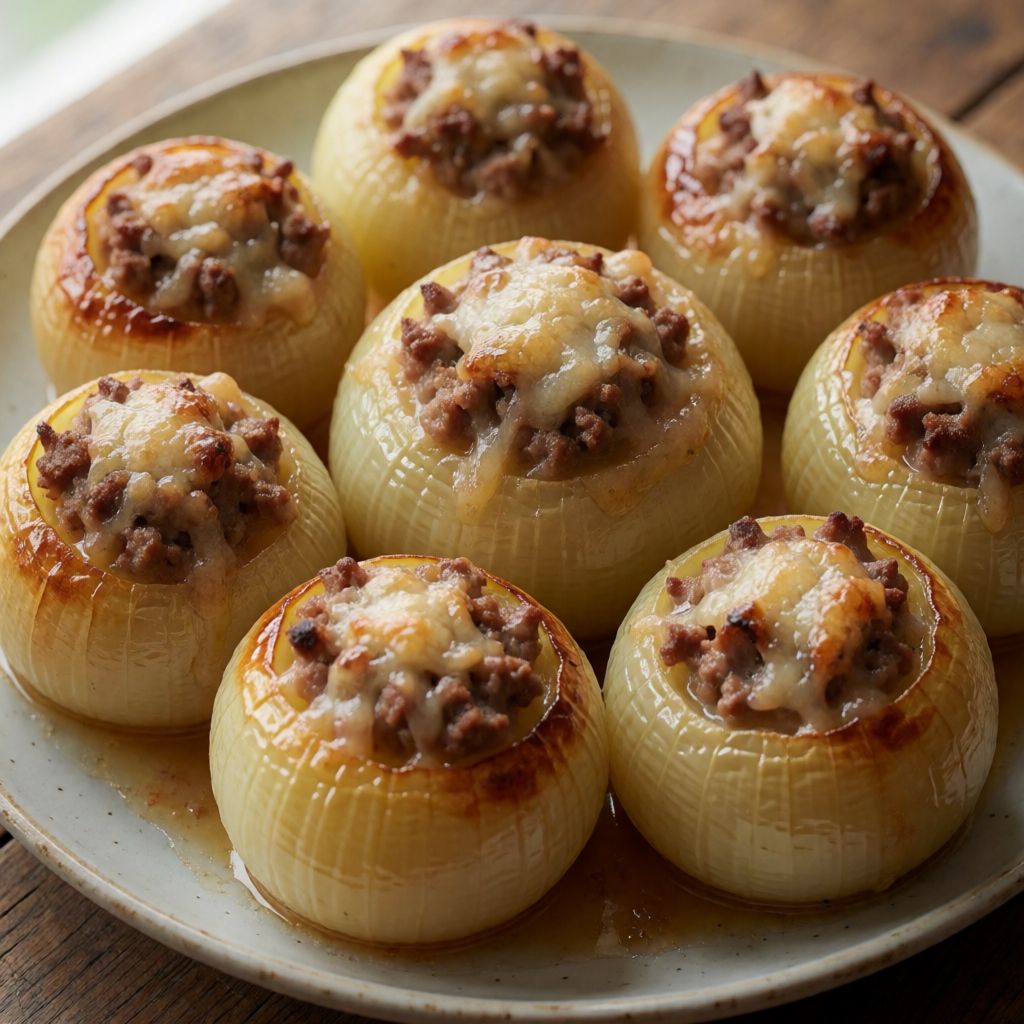
 AI photo
Stuffed Onions
A comforting side of onions filled with a savoury beef and sausage stuffing, baked until golden.
Labels are worked out automatically from the ingredients and can be wrong. Check the packaging if it matters to you.
Ingredients
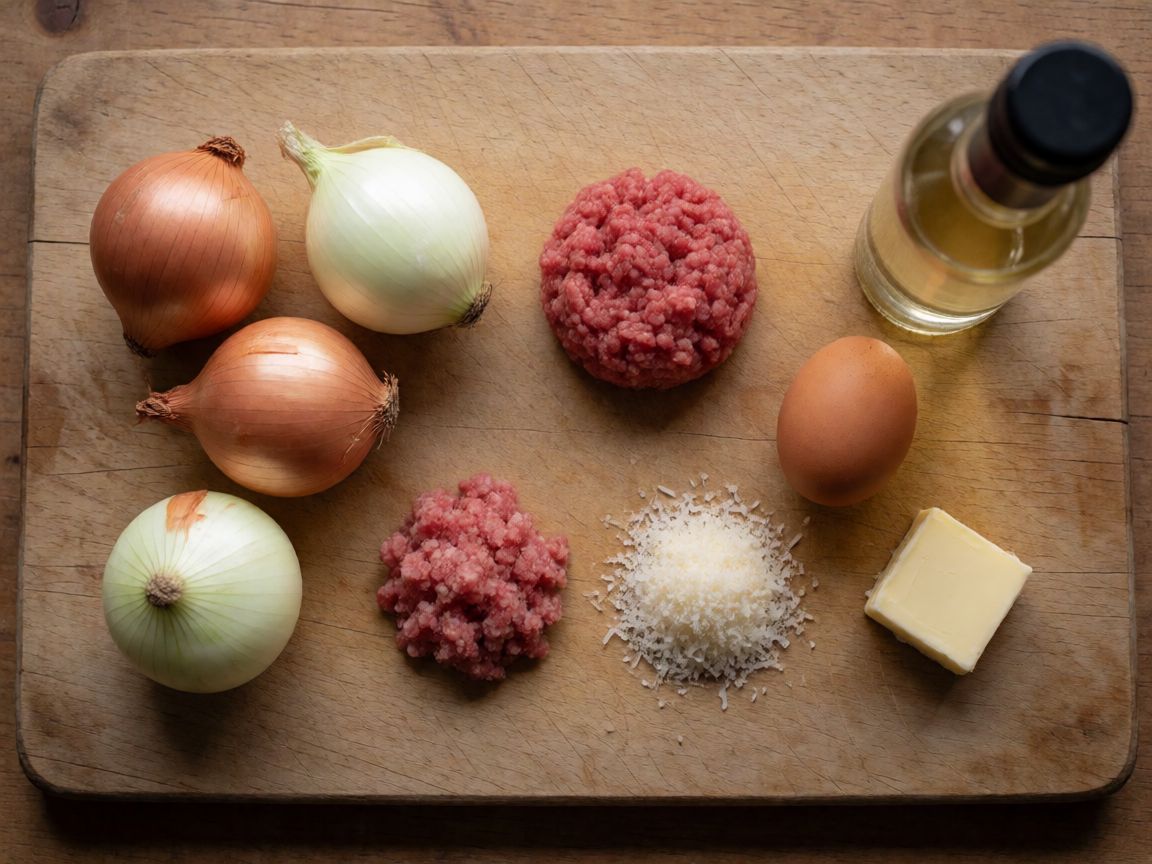
- 4 pcs Onion
- 50 g Beef mince
- 200 g Sausage meat
- 80 g Parmesan
- 1 pcs Egg
- Salt to taste
- Black pepper to taste
- Butter to taste
- 2 tbsp Vinegar
- Olive oil to taste










Steps
Peel the onions and boil them in salted water with the vinegar added
30 minFry the crumbled sausage meat and beef mince in a pan until dry and lightly browned
Let the meat mixture cool
In a bowl combine the cooled meat filling, egg, Parmesan, salt and black pepper, and mix well
Cut the onions in half, remove the centre leaving two layers, finely chop the flesh and add it to the filling
Fill the onions with the stuffing, place them in a dish greased with oil, season with black pepper and add the butter
Bake at 200°C.
Doneness: inside temperature reaches 71°C.
Serve immediately with a seasonal side dish
This is the onion playing the role of a baking dish. You take out its middle, leave a cup of two layers, and drop a meatball's worth of filling into that cup — it's a stuffing ball that cooked itself a container instead of needing a tray or a sheet of foil. Put it beside a Sunday roast and nobody will blink; it does exactly the job a stuffing ball does, just with its own crockery.
What decides whether it works is settled before the oven ever gets involved: the onion has to arrive at baking already half-tamed. Raw onion is sharp, wet inside, and needs real time to soften — bake it from raw alongside meat that only needs twenty-odd minutes to reach a safe core, and you get one of two failures: burnt-crusted meat sitting on a still-raw, biting onion, or an onion finally gone soft while the filling has dried to a brick. So the onion is boiled first, with vinegar in the water. That's not seasoning, that's chemistry — the acid firms the pectin in the walls just enough that the onion holds its cup shape instead of collapsing into onion soup the moment you try to fill it, while the heat has already taken the raw sting out and turned the sulphur-sharp bite toward something sweeter.
The second thing that decides it is dryness. Fry the mince and sausage meat until it's actually dry and a little coloured, not just cooked through — because whatever moisture is left in that pan goes straight into the onion cup during baking, and an onion cup has nowhere to drain it. A soggy-bottomed stuffed onion is not a seasoning problem, it's a 'you stopped frying too early' problem.
The onion itself needs to be a decent size — big enough that once you've hollowed it, two layers of wall still make a cup that won't buckle when you pick it up. Any cooking onion does; you don't want anything so small the cup is thimble-sized, and you don't want the papery kind that falls apart in its own layers before you've even got it in the water.
Mince and sausage meat together, not one or the other, is doing a specific job. Plain beef mince on its own, fried until dry, turns tight and a bit chalky — all its fat has gone into the pan. Sausage meat brings back the fat and the seasoning the mince just lost, so the filling stays rich instead of turning into dry rubble once it's spent twenty minutes drying out on the stove and another chunk of time in the oven. If you've no sausage meat to hand, buy ordinary sausages and strip the skins off — same thing, just sold differently.
The egg is the binder, and it only works if you let the meat cool first. Mix a hot egg into hot meat and it half-scrambles on contact, going lumpy and useless instead of coating everything evenly — you lose the thing that's meant to set the whole filling into one piece once it bakes. Cool the meat properly before the egg goes in; patience here is doing the binding, not the egg.
Parmesan isn't decoration, it's salt and savour that survives baking without turning the filling greasy — a hard, aged, salty cheese that grates fine and doesn't melt into a puddle of oil. Grana Padano or a firm pecorino will do the same work if that's what's in the shop.
The chopped onion flesh from the centre you removed goes into the filling rather than the bin — sensible economics, not a flourish. It also means the filling picks up the same sweetened, vinegar-settled onion flavour as the cup it's sitting in, instead of tasting like a different vegetable entirely.
Vinegar in the boiling water is any sharp acid you've got — lemon juice works the same way on the pectin. Butter on top at the end is there because the meat inside has already been fried dry; the butter gives it back some fat to baste in and a way to brown rather than just dry further under a domestic oven's fierce, dry heat. The 71°C you're reading for at the end isn't a flavour cue, it's the point where the meat is actually safe to eat — mince and sausage meat carry more risk than a whole cut, so that's the number that matters, not minutes on a timer. Serve them as soon as they come out; an onion cup holding its filling only stays neat for a little while before gravity and heat start arguing with it.