
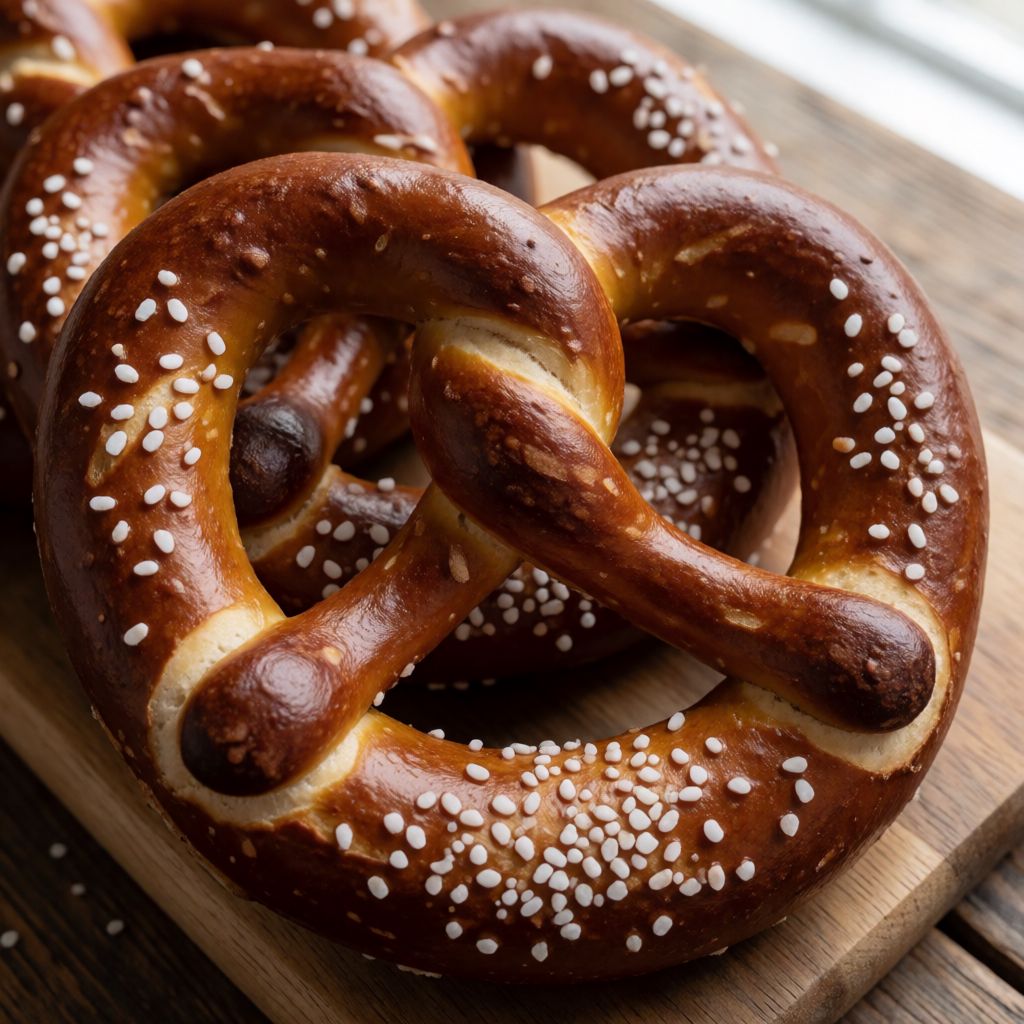
 AI photo
Pretzels (German Bretzels)
Classic German-style soft pretzels, boiled in a baking soda bath before baking for their deep golden crust.
Labels are worked out automatically from the ingredients and can be wrong. Check the packaging if it matters to you.
Ingredients
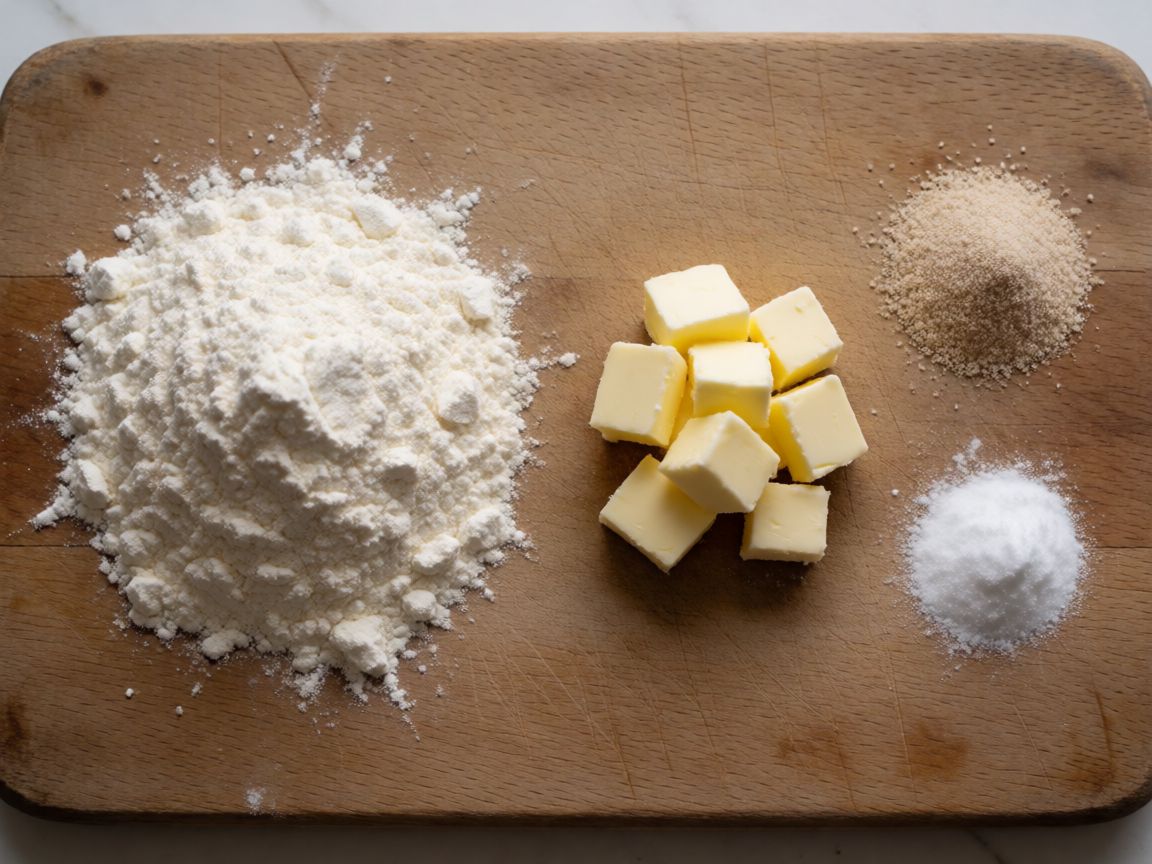
- 680 g Plain flour
- 370 ml Water
- 30 g Butter cut into small pieces
- 10 g Salt
- 12 g Yeast crumbled
- 35 g Bicarbonate of soda
- 2 l Water
- 1 pcs Coarse salt to taste






Steps
Knead the dough by hand or in a stand mixer: to the flour add the crumbled yeast and the butter, cut into small pieces. Gradually pour in the water and add the salt.
Knead the dough until it is smooth, well developed and no longer sticky.
Divide the dough into 10 pieces weighing roughly 90-100 g each.
Roll out each piece into a rope about 50 cm long, thinner at the ends.
Shape the classic pretzel form: cross the ends, twist them together and fold them inward.
Place the pretzels on a tray dusted with flour and let them rest at room temperature.
30 minPut the pretzels in the fridge.
60 minBring 2 litres of water to the boil and stir in the bicarbonate of soda.
Dip the pretzels one at a time into the boiling water for about 40 seconds, then lift them out with a slotted spoon.
Let them drain well and place the pretzels on a baking tray lined with baking parchment.
Using a sharp knife or bread lame, score the top of each pretzel and sprinkle with coarse salt.
Bake at 220°C for about 20 minutes, until done.
20 minTake out of the oven and serve warm.
A pretzel isn't a shaped bread roll, it's a bread that has been bathed — that's the whole trick. Before it ever sees the oven, it gets dunked in boiling water with bicarbonate of soda in it, and that bath is what gives you the thing a plain bread roll can never have: that dark mahogany, slightly bitter, faintly soapy-savoury skin with a shine to it, and a chew underneath. Without the dip, you'd just get a knotted bread roll. With it, you get a pretzel.
What decides whether it works is the dip and the fridge rest before it, not the kneading. Commercial bakeries use lye — proper sodium hydroxide, which is dangerous to handle at home and is why this recipe, sensibly, swaps it for bicarbonate of soda in the bath water. Some say bicarb is "just as good" — no, it isn't quite, the crust will be a shade paler and less sharply savoury than true lye gives you, because bicarb is a much weaker alkali. But it's the version you can do in a domestic kitchen without gloves and goggles, and it gets you 80% of the way, which for a Sunday morning is a fair trade.
The other thing that decides success is temperature discipline at two separate stages: the dough has to rest and then chill, and the water has to be properly, rollingly boiling when the pretzels go in — not simmering, not "hot enough". A lazy boil means the alkaline bath doesn't set the surface fast enough, and you get soggy, pale pretzels that never crisp properly in the oven. The 40 seconds only means anything once the water is actually boiling.
Flour first: plain flour, not strong bread flour, and that's deliberate. A pretzel wants a dense, close chew, not the open, airy crumb you'd want in a baguette — too much gluten development and the pretzel loses that satisfying density that makes it good with butter or mustard rather than good on its own. If all you've got is strong flour, it'll still work, just knead a touch less and don't expect quite the same tight crumb.
The yeast here is doing very little leavening work and a lot of flavour work — this is barely a risen dough, just a 30-minute rest at room temperature, then an hour in the fridge. That cold rest isn't about flavour development the way a slow sourdough rise is; it's about firming the dough enough that the shaped pretzels hold their twist and don't slump when you drop them into boiling water. Skip the fridge and you'll watch your careful pretzel knots blur into vague loops the moment they hit the pot.
The butter is there for tenderness and a touch of richness under that hard crust — without it you get something closer to a bagel's chew all the way through, which isn't wrong, just a different animal. Any neutral fat works as a substitute, but butter's faint dairy note suits the slightly bitter alkaline crust better than oil would.
Now the two waters, and they are not interchangeable despite both saying "water" on the label. The 370 ml goes into the dough — ordinary tap water, nothing to overthink, just don't use it icy cold or you'll fight the yeast unnecessarily. The 2 litres is the bath, and this is where the bicarbonate of soda earns its place: dissolved in boiling water, it raises the pH of the dough's surface in those 40 seconds, which does two things at once — it gelatinises the starch on the outside almost instantly, giving you that glossy, slightly tacky skin, and it encourages the Maillard browning reactions in the oven to run harder and darker than they would on an untreated crust. That's the entire difference between a pale bread roll and a proper pretzel-brown one. If you can source actual food-grade lye and know how to handle it safely with gloves, you'll get a more authentic depth of colour and flavour — but bicarbonate is the right call for anyone without lab gear in their kitchen, and nobody should feel they've cheated using it.
Scoring the top before the oven isn't decoration. The alkaline-treated crust sets fast and stiffens; without a cut, steam trying to escape from inside the dough during baking has nowhere controlled to go, and you get random blistering and tearing instead of that one deliberate split along the fat belly of the pretzel. A sharp knife or a proper bread lame matters here — a blunt knife drags and tears the skin rather than slicing it, which is the same mechanism as a bad crust split on any boiled-then-baked dough.
On the UK kitchen itself: 220°C is a proper domestic-oven ceiling for this, nothing exotic, and most fan ovens will hit it without fuss — just don't trust the dial blindly if yours runs hot or cold, since the skin needs real heat fast to go dark rather than just dry. You don't need a kazan or anything specialist for the boiling stage either; any wide pan or stockpot you'd use for pasta will do, so long as it's deep enough that the pretzel can be fully submerged and lifted out cleanly with a slotted spoon. Patience is the real ingredient twice over here — once in the cold rest that holds the shape, once in letting them drain properly before the oven, because a wet pretzel steams instead of crisping. Rush either stage and you'll have dough instead of a pretzel. Serve them the way you'd put out scones for tea, still warm, and they'll disappear before the kettle's even boiled again.