
 AI photo
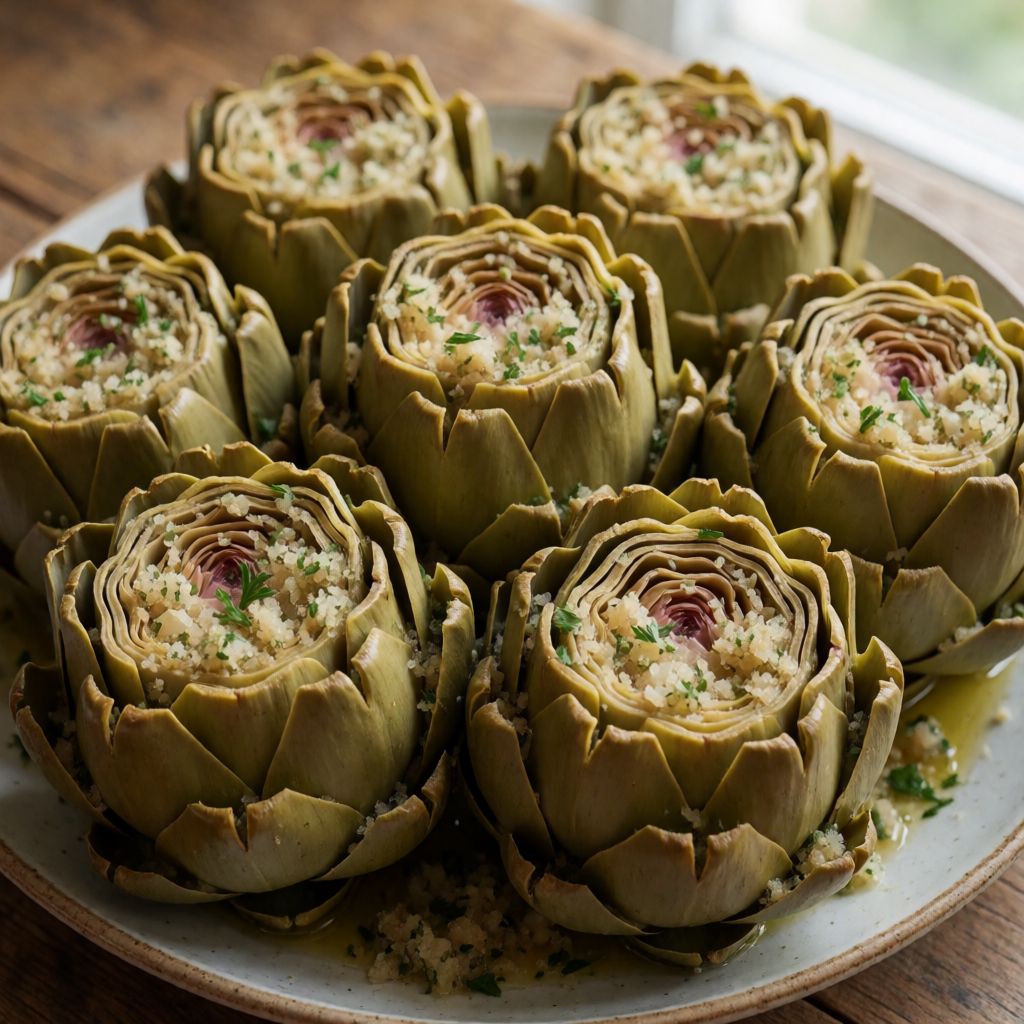
Roman-Style Artichokes
A classic Roman side dish of tender artichokes stuffed with garlic, herbs and breadcrumbs, slow-cooked until soft.
Labels are worked out automatically from the ingredients and can be wrong. Check the packaging if it matters to you.
Ingredients
- 4 pcs Artichoke
- 1/2 pcs Lemon
- 2 tbsp Breadcrumbs dried
- 1 clove Garlic
- Olive oil to taste
- 1 tbsp Parsley chopped
- 1 tbsp Mint
- Salt to taste
- Black pepper to taste









Steps
Clean the artichokes: remove the outer leaves, trim the tough tips, and trim the stems to about 5–6cm.
Fill a bowl with water, add the lemon juice, and submerge the trimmed artichokes.
Use a knife to even up the leaf tips, then scoop out the inner "beard" of each artichoke with a spoon.
Mix the parsley, mint, breadcrumbs, garlic, olive oil, salt and pepper, and fill the centre of each artichoke with this stuffing.
Arrange the artichokes tightly together in a pan, stuffing-side down.
Pour over a glass of water and 3 tablespoons of olive oil, cover with a lid and cook over moderate heat for about 1 hour.
60 min
Four artichokes, stood on end in a pan just wide enough to hold them shoulder to shoulder, filled with garlic and herb crumbs, and left in a shallow puddle of water and oil for an hour under a lid. That's the whole idea: cook them upside down in a kind of self-basting steam box, so the crumb at the bottom picks up a little colour and flavour from the oil while the leaves above soften without ever touching direct heat.
What decides whether it works is not the hour on the clock - it's three things done early and quietly, before the pan even gets hot. First, how fast you work from the knife to the lemon water: a cut artichoke starts browning within minutes, the same enzyme that turns a sliced apple grey, and the acid is what slows it down, not some old polishing trick. Second, how completely you scoop the hairy choke out of the centre - leave a shred and you'll know it, because it catches in the throat like a mouthful of thistle, which is exactly what this plant is. Third, how tightly you pack the artichokes in - loose ones tip over, spill their stuffing, and end up with one side sitting in the liquid and the other dry against hot metal, which is how you get a scorched cheek and a raw heart.
Turning them stuffing-side down before they go in is the part people skip because it looks backwards. The open, stuffed face sits down in the shallow braise, so the crumb catches heat and flavour from underneath, while the closed stem end stands up into the steam the lid traps above. That's the whole mechanism in one line: a little frying at the base, steaming for everything else.
Choose artichokes that are heavy for their size, with leaves closed tight enough to squeak slightly when you press them. If they're fanning open on their own, they're old and dry inside no matter how fresh the stall looks. The big globe artichokes you'll find in a UK supermarket aren't the small purple ones grown around Rome, and you lose a bit of their local bitterness for it - but you gain a more tender base and far less fiddly trimming, which for a first go is no bad trade.
The lemon's job is to keep the water acidic enough to stop the cut flesh oxidising before it reaches the pan. Any acid with no agenda of its own does the same job - a splash of vinegar works, but it carries its own smell into a dish that doesn't ask for one, so lemon stays the sensible choice. Rub the spent half over the cut stems too, while it's there.
Use dried breadcrumbs, not fresh, and that's not fussiness. Dried crumb drinks the braising liquid slowly and holds its shape through the hour; fresh crumb turns to paste almost immediately and slides out of the artichoke before the lid's even gone on.
One clove of garlic is plenty because it's never fried or browned - just chopped raw into the stuffing and left to soften over an hour of gentle, moist heat. That's a different kind of mellowing from what happens in a hot pan, which is why one clove reads so much quieter here than it would in a quick sauté.
The olive oil, in both the stuffing and the braising liquid, is there to be tasted, not just to carry heat - one of the few places where a flavourless oil is the wrong substitution. If you haven't got a fruity extra virgin, reach for another cold-pressed oil with some character of its own, rather than a neutral refined one that will leave the crumb tasting of nothing. The water alongside it - a glass, roughly a teacup's worth - should come partway up the artichokes, not drown them. This is a braise, not a boil, and too much liquid turns a lightly toasted base into a boiled one.
The mint is the giveaway that this is Roman rather than, say, Sicilian: wild mint grew free along the riverbanks around Rome and found its way into the cheapest, most everyday cooking there, artichokes included - not a decorative flourish, just what was growing outside the door for nothing. Ordinary mint from a UK greengrocer does the job fine; it's a touch sweeter than the wild kind, which isn't a fault, just a different accent on the same word. And treat the hour itself as an ingredient - the lid stays on, the heat stays gentle, and nothing about scooping the choke properly or packing the pan tightly can be rushed without it showing later.