
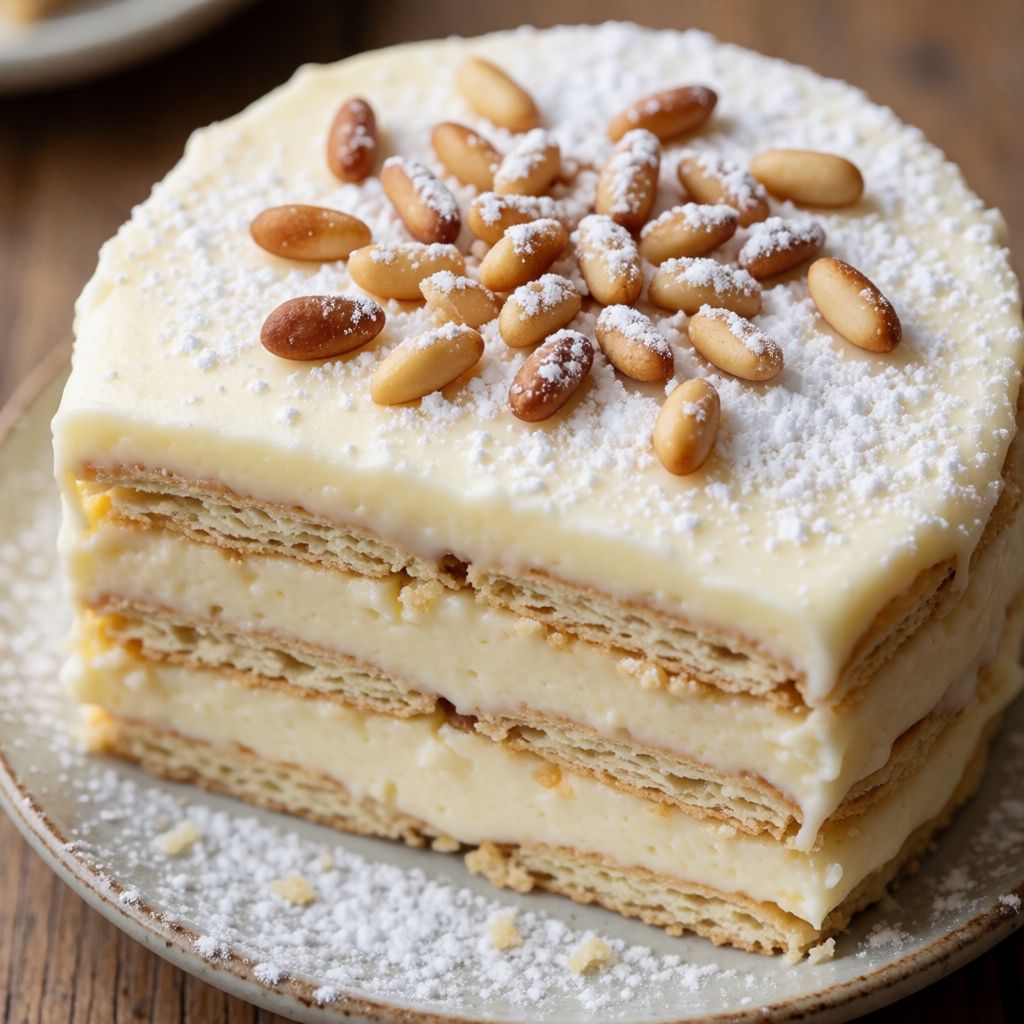
 AI photo
No-Bake "Nonna" Cake: Custard Cream and Pine Nut Dessert
A no-bake biscuit cake layered with vanilla custard cream, finished with pine nuts and icing sugar.
Labels are worked out automatically from the ingredients and can be wrong. Check the packaging if it matters to you.
Ingredients
- 300 g digestive biscuits
- 150 g Butter
- Pine nuts to taste
- Icing sugar to taste
- 3 pcs Egg yolks
- 100 g Caster sugar
- 40 g Plain flour can be replaced with corn starch
- 500 ml Milk
- 1/2 pcs Vanilla pod






Steps
In a sturdy saucepan, bring the milk to the boil with half a vanilla pod for flavour.
Separately, whisk the egg yolks lightly with the sugar.
Gradually add the sifted flour or corn starch and mix well.
Remove the vanilla pod and pour the egg mixture into the boiling milk.
Stirring constantly, cook over low heat until the custard thickens.
Remove the custard from the heat, transfer to a container and let it cool.
Blitz the biscuits in a blender and mix in the melted butter thoroughly.
Press about two-thirds of the mixture into a 20-22 cm springform tin, smoothing it with the back of a spoon.
Put the tin in the fridge for at least 30 minutes.
30 minSpread the custard cream over the base, level with a spoon and cover with the remaining biscuit mixture.
Leave to chill in the fridge for 4-5 hours.
300 minBefore serving, decorate the top with pine nuts and dust with icing sugar.
This is a cheat's version of torta della nonna — the real Tuscan grandmother's cake is a shortcrust tart with pine nuts baked into a lattice top, an hour in the oven, flour on your hands. This one skips the oven entirely and builds the same idea — crumb, custard, crumb, pine nuts — out of crushed biscuits and butter instead of pastry. What decides whether it works isn't skill, it's patience: the custard has to actually set, and the base has to actually harden, and neither of those things happens because you want them to.
The engineering is simple once you see it. You're making a cheesecake with crème pâtissière instead of cream cheese, and a biscuit crumb instead of a baked pastry case. The crumb base does the job that shortcrust does in the oven version — it gives you something firm enough to cut a slice off, without an oven to set it. Butter is the glue; cold is the oven. That's the whole trick, and it's not a new one — British fridge-set cheesecakes have worked this way for decades, which is why this translates so easily into an ordinary UK kitchen with a springform tin and nothing else special.
Biscuits: digestives are the right choice because they already carry a little salt and a little fat of their own — that's why British fridge-cake culture leans on them so hard, they're built for crumb work. The criterion for substitution is simple: any plain, not-too-sweet biscuit that turns to sand rather than paste when crushed — rich tea, Hobnobs for more texture, even graham crackers if you're abroad. Avoid anything chocolate-coated or heavily iced; the sugar coating melts into the butter and you lose the crumb structure that's meant to hold the layers apart.
Butter: melted, not softened, because you need it liquid enough to coat every crumb evenly — a softened lump will clump with some biscuit bits dry and others sodden. Choose unsalted if you can, since digestives already bring salt; if all you've got is salted, fine, just don't add more. The whole point of the butter-crumb press is to mimic what baking does to pastry — binding under heat — without the heat. That's why the fridge step before you add custard isn't optional faff: give it less than 30 minutes and the base is still soft when you press cream on top of it, and it slumps rather than holds. Thirty minutes is the floor, not a target; a shallow UK fridge running warm from being opened all day might need longer.
Egg yolks: three yolks for 500ml milk is a thickening ratio, not a flavour one — whites would only dilute that starch-and-protein job and add a rubbery bite you don't want in a custard. If you're squeamish about three leftover whites, meringue or a simple pavlova base uses them up — no waste, just another pudding.
Flour vs cornstarch: flour gives a slightly matte, more "set" custard with faint cereal taste if undercooked; cornstarch gives a glossier, cleaner-tasting set and thickens at a lower temperature, so if you go that route, pull the pan off the heat the moment it thickens — cornstarch custards can thin back out if you keep cooking them past the point, the opposite problem to flour ones. Either works; choose cornstarch if you want a more translucent, modern-looking cream, flour if that's what's in your cupboard already.
Vanilla pod: half a pod infused in hot milk gives you actual vanilla seeds and oil, not just the smell of vanilla essence, which is why you fish the pod out rather than throw the whole thing in blitzed — the pod itself is tough and bitter, only its steeped flavour and the seeds you scrape out are worth keeping. No pod in the cupboard? A teaspoon of good vanilla extract added once the custard's off the heat does the job — add it early and the alcohol cooks off along with most of the flavour.
Pine nuts: traditionally they're baked into the Tuscan tart's filling and scattered on top, giving a toasted, resinous crunch against the soft custard — here, raw and scattered at the end, they're mostly textural and decorative since there's no oven step to toast them. If you want that roasted edge, five minutes in a dry frying pan over low heat until they just turn gold (watch them — pine nuts go from pale to burnt fast, there's barely a window) will get you closer to the real thing. They're expensive in the UK for what they are, so flaked almonds toasted the same way are a fair economic substitute if pine nuts feel like a splurge for a no-bake pudding.
The long chill — four to five hours, no shortcutting — is where this dessert is actually made. Everything before that is assembly; the fridge does the real work of turning soft custard and loose crumb into something that holds a clean edge when you cut it. Rushing this step doesn't save you time, it just moves the failure from your kitchen to the dinner table, where a slice collapses sideways on the plate instead of standing up. That's the whole deal with no-bake cakes: you've traded an hour of oven heat for several hours of standing still in the cold, and there's no way to speed that transaction up.