
 AI photo
Nutella Crostatini
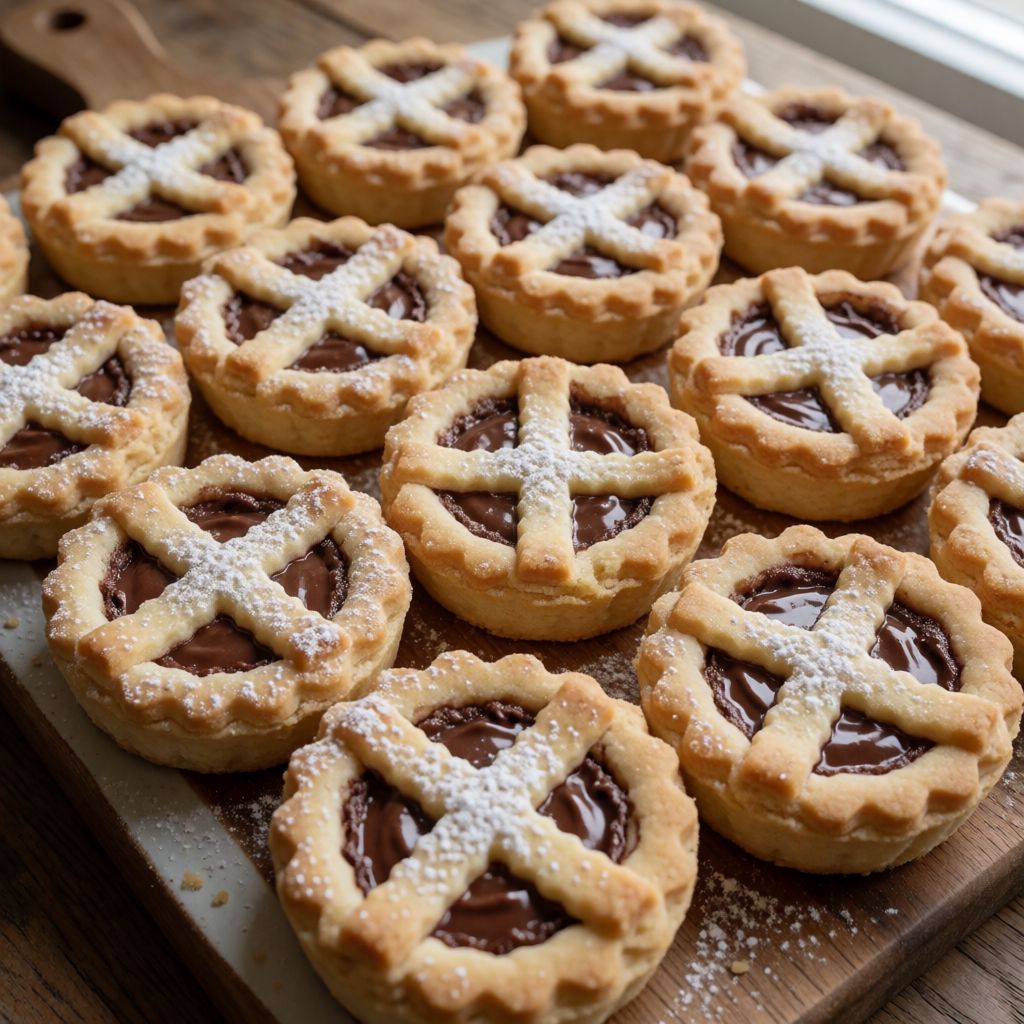
Sweet shortcrust tartlets filled with Nutella and finished with a lattice of pastry on top, baked until golden.
Labels are worked out automatically from the ingredients and can be wrong. Check the packaging if it matters to you.
Ingredients
- 500 g Plain Flour
- 200 g Butter soft, cut into cubes
- 3 pcs Eggs
- 200 g Caster Sugar
- 1 tsp Vanilla Extract
- pinch Baking Powder
- pinch Salt
- 250 g Nutella








Steps
On a work surface, pile the flour into a mound, make a well in the centre and add the eggs, sugar, salt, baking powder, vanilla extract and the soft, cubed butter.
Knead the dough until you get a smooth, even ball. Wrap it in plastic film.
Leave the dough to rest in the fridge.
30 minTake the dough out of the fridge. Set aside a third of it for the decorative strips.
Roll out the rest of the dough to about 5 mm thick. Cut out rounds with a round cutter about 8 cm across.
Press the pastry rounds into the tartlet tins, pushing them against the edges, and prick the base with a fork.
Spoon a generous amount of Nutella into each tartlet. Warm the Nutella slightly if needed.
From the reserved dough, cut thin strips and cross them over the tartlets to form a lattice.
Bake the tartlets in a preheated oven at 180°C, static (conventional) setting.
20 minRemove from the oven and let cool slightly before serving.
This is a crostatini — little cousin of the crostata, that lattice-topped jam tart Italians have been making for generations. Swap the jam for Nutella and you get something closer to a childhood treat than nonna's Sunday tart, but the mechanics underneath are identical: a short, egg-rich pastry built to hold a soft filling without going soggy at the base or collapsing at the rim.
What decides whether it works is the dough's temperature at two different moments, not one. Soft when you mix it — so the butter blends evenly into egg and sugar without you having to knead the flour hard, which would develop gluten you don't want. Cold again when you shape and bake it, so the butter doesn't just melt and run before the pastry's structure sets. Skip that second stage and you get a tart that shrinks thin in the tin and pools grease underneath the filling — not a flaw in the recipe, a flaw in skipping the fridge.
Doneness has nothing to do with the Nutella — it never visibly "cooks" the way a custard does, it just goes glossy and loosens. Watch the pastry instead: the exposed edge of each lattice strip and the rim round the filling. When that turns an even pale gold — not deep brown, because the sugar in this dough darkens fast once it starts — you're done. Twenty minutes is the floor here, not the answer; ovens and tin sizes argue with recipe times more than people admit.
Flour here is plain, nothing stronger, because you're not after chew, you're after short and a little sandy. The mound-and-well method — piling flour and working the wet centre outward by hand — isn't fussiness, it's just an old way of controlling how fast liquid gets absorbed, by feel rather than by a mixer that doesn't know when to stop. Overwork the outer dry flour once it's already wet and you build gluten you don't want; this dough should feel done well before your arms are tired.
Butter: soft, not greasy. Press a cube with a finger — if it dents without smearing onto your skin, it's at the right point. Skip spreadable margarine for this; the water content is too high and the dough turns tacky rather than short. A firm butter alternative works if you give it longer to soften first. Either way, the butter you cut in soft today is the same butter you want solid again before it meets the oven — that's the whole reason for the rest.
Eggs and sugar aren't just sweetness and binding. Sugar is also what gives you your doneness colour — that pale gold at the rim comes from sugar caramelising at the surface, which is exactly why you watch the edges rather than guessing by the clock. Eggs bind the dough and give it a slight bite, the thing that separates a proper crostata pastry from a dry biscuit base.
Baking powder is a pinch because this isn't meant to rise, just to lift the crumb enough that it isn't dense. Vanilla and salt do quieter work: salt especially, cutting both the sugar in the dough and the sweetness of the Nutella — leave it out and the whole tartlet tastes flatter than you'd expect from one small pinch.
Nutella itself is mostly fat and sugar carrying cocoa and hazelnut, and what matters when you fill the cases is viscosity. Warm it slightly so it spreads into the corners instead of sitting there as a stiff dollop that leaves gaps under the lattice — but don't take it to liquid, or it seeps under the pastry edge and leaks in the oven. Any thick spread with a similar fat content will stand in: dulce de leche, a firm chocolate ganache, a stiff curd if you'd rather go in a British direction with the teapot already on the table. The criterion is simple — it has to hold its shape warm, go glossy, not runny.
The lattice on top is an old habit of wasting nothing: the strips are cut from the scraps left after you've punched out the rounds, so nothing from the dough gets binned, and it happens to look decorative as a side effect, not the point of it. Nutella's presence here follows the same logic one step further — it was invented in post-war Italy to stretch costly cocoa with cheap hazelnuts, and using it as a crostata filling is that same economy inherited onto a modern tray. In an ordinary flat you don't need proper tartlet tins at all — a muffin tray or a bun tray holds the dough and the filling just as well. And if your oven is fan-assisted rather than genuinely static, drop the temperature a touch and check the lattice earlier than twenty minutes — a fan colours exposed pastry faster than the still, even heat the recipe is written for. Then let them sit before anyone bites in: the Nutella holds its heat inside the shell long after the crust feels cool to the touch, and that's the one place patience actually protects you, not just the finished pastry.