
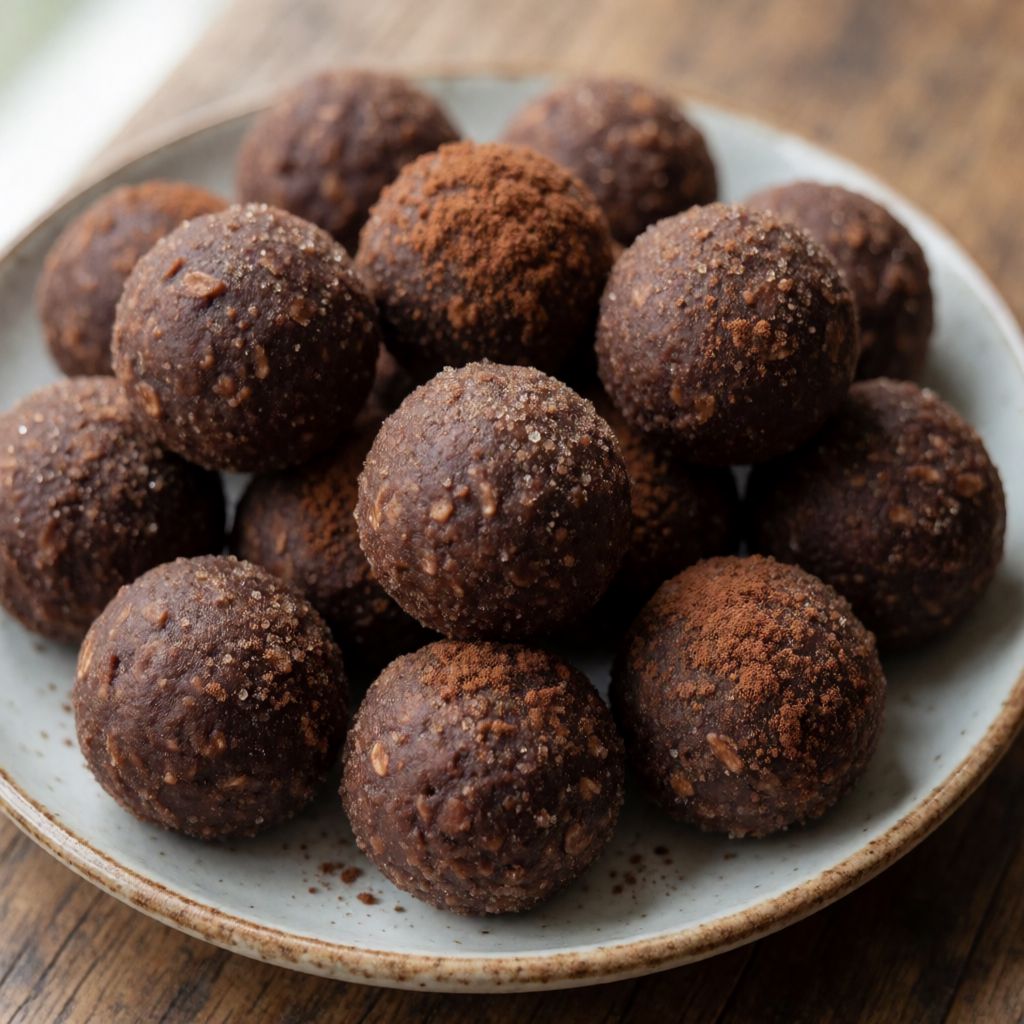
 AI photo
Oat Balls
No-bake oat and cocoa balls flavoured with coffee and rum, or with orange juice for an alcohol-free version.
Labels are worked out automatically from the ingredients and can be wrong. Check the packaging if it matters to you.
Ingredients
- 250 g Porridge oats
- 150 g Sugar
- 50 g Cocoa powder
- 150 g Butter
- 100 ml Coffee strong
- 1 tbsp Rum
- 75 g Coconut flour
- 50 ml Orange juice freshly squeezed





Steps
Put all the dry ingredients in a bowl, crumble in the butter, then add the coffee with rum for one version or the orange juice for the other.
3 minIf the mixture is too sticky, add a little more porridge oats or coconut flour. If it's too dry, add a little more coffee or orange juice.
2 minShape into small balls and roll them in coconut flour.
15 min
There's no oven here and no saucepan — which is the first thing worth saying, because most people reach for "no-bake" and assume it means "no skill." No — because the judgement that usually happens by heat and smell now has to happen by touch. This is a shortbread dough logic borrowed into dessert territory: fat rubbed into dry crumbs first, so every oat flake and sugar grain gets a thin coat of butter before any liquid arrives. Rub it in cold or just-soft, never melted — melted butter runs between the crumbs instead of coating them, and when it cools back down it sweats out as grease, leaving you with a mixture that separates rather than holds. Cold, crumbled butter behaves like pastry fat: it clings.
Once the fat is worked through, the liquid's only job is to bring the crumb together into something you can squeeze into a ball — it's not cooking anything, it's gluing. And here the recipe quietly offers you two different desserts under one name: coffee and rum make a grown-up, bitter-dark version where the coffee pulls extra depth out of the cocoa (the same pairing as mocha, nothing mystical about it), while orange juice gives a bright, alcohol-free version for a table with children or teetotallers on it. Neither is the "real" one. They're two answers to two different rooms.
Porridge oats, not instant oats — this matters more than it looks. Instant oats have already been steamed and rolled thin so they collapse into mush at the first contact with liquid; in a cooked porridge that's the point, here it's the opposite of the point. You want oats that keep their shape and give the finished ball a bit of bite, some texture under the chocolate, not a uniform paste. If all you have is instant, it'll still set — just softer, with less to chew on.
Cocoa powder here means plain, unsweetened cocoa — not a drinking-chocolate mix, which already carries its own sugar and milk powder and will throw out every other ratio in the bowl the moment you swap it in. Sugar is doing exactly one job: sweetening, nothing structural, so caster or granulated both work; it'll dissolve a little into the liquid and the rest sits as fine grit, which is fine — this isn't meant to be glassy-smooth.
Butter is the binder, and the only hard rule on it is temperature: cool enough to crumble between your fingers like you're making a pastry, not so cold it won't break down, not soft enough to smear. If you're using a substitute, judge it by the same test rather than by name — any fat that's solid and crumbly at room temperature will do the same job, which is why coconut oil (solid, cool) works and a bottle of sunflower oil (liquid at any kitchen temperature) will not: liquid fat can't be rubbed into a crumb, it just pools.
Coconut flour appears twice and does two different jobs. Inside the mix it's there to soak up whichever liquid you've chosen and thicken the paste — and it earns its place over ordinary wheat flour because wheat flour is raw starch here, with nothing to cook it, and raw flour tastes exactly like what it is: pasty and a bit chalky. Coconut flour has no such raw taste and is naturally absorbent and faintly sweet, so it tightens the mixture without announcing itself. Outside, rolled on as a coating, its job is purely defensive: it stops the balls sticking to your hands and to each other on the plate, and gives the surface somewhere for your fingers to grip instead of leaving a fingerprint in soft chocolate crumb.
Coffee and rum, or orange juice — pick by occasion, not by authenticity. The coffee should be strong because you're adding a small amount and want it to actually register against sugar and cocoa; a weak brew just adds water with no character. The rum is there for aroma and a little preservative effect, the way spirits have always been used in no-cook mixtures long before refrigeration made that unnecessary — any dark spirit with a smell you like (brandy, whisky) does the same work. The orange juice route needs to be fresh squeezed for the same reason the coffee needs to be strong: it's a small quantity carrying the whole flavour, and bottled juice carries less of it, more sugar-water than citrus.
None of this needs a thermometer or a timer worth trusting — it needs your hands telling you whether the crumb is ready to hold its shape, and your patience to roll out all 120 of them evenly. That's the whole mechanism: fat first, liquid second, judged by feel, finished by coconut flour standing guard against stickiness.