
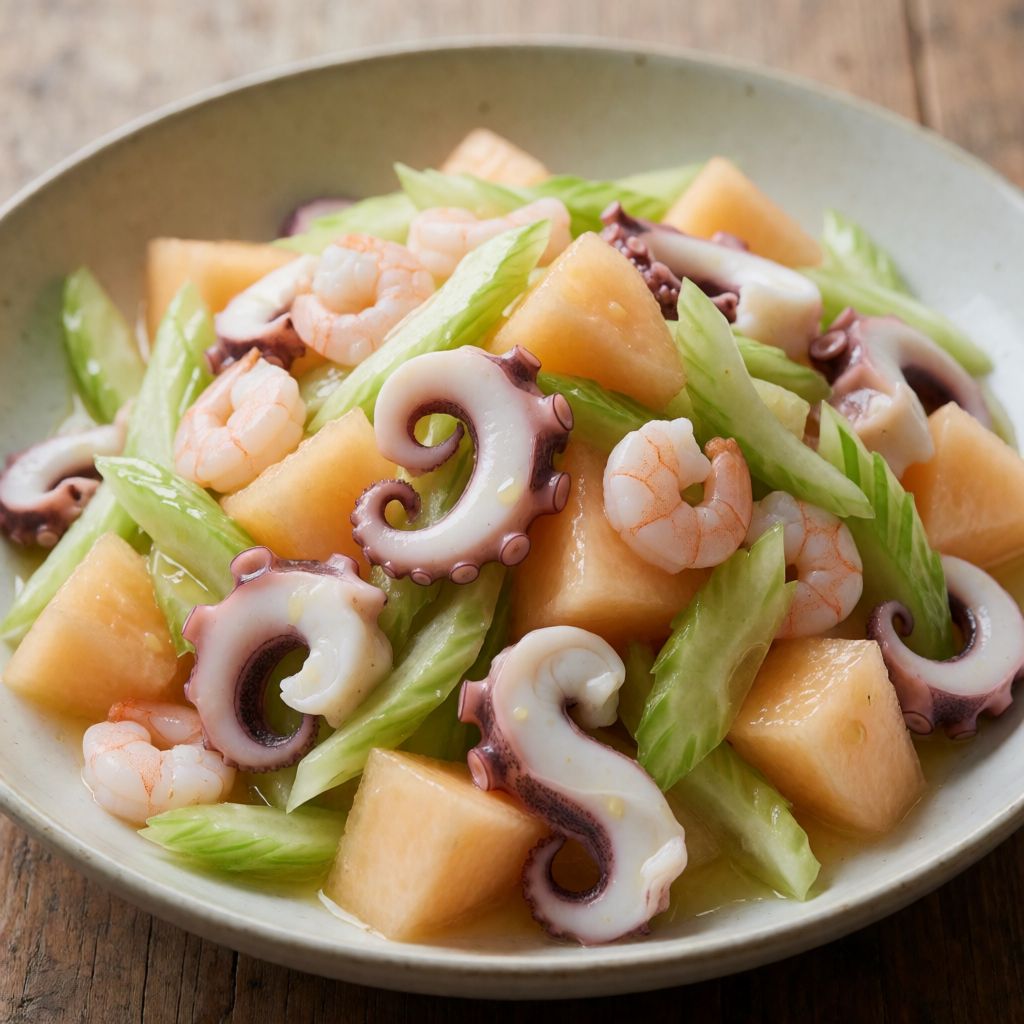
 AI photo
Octopus and Melon Salad
A refreshing summer salad combining tender octopus carpaccio with sweet melon, prawns and crisp celery.
Labels are worked out automatically from the ingredients and can be wrong. Check the packaging if it matters to you.
Ingredients
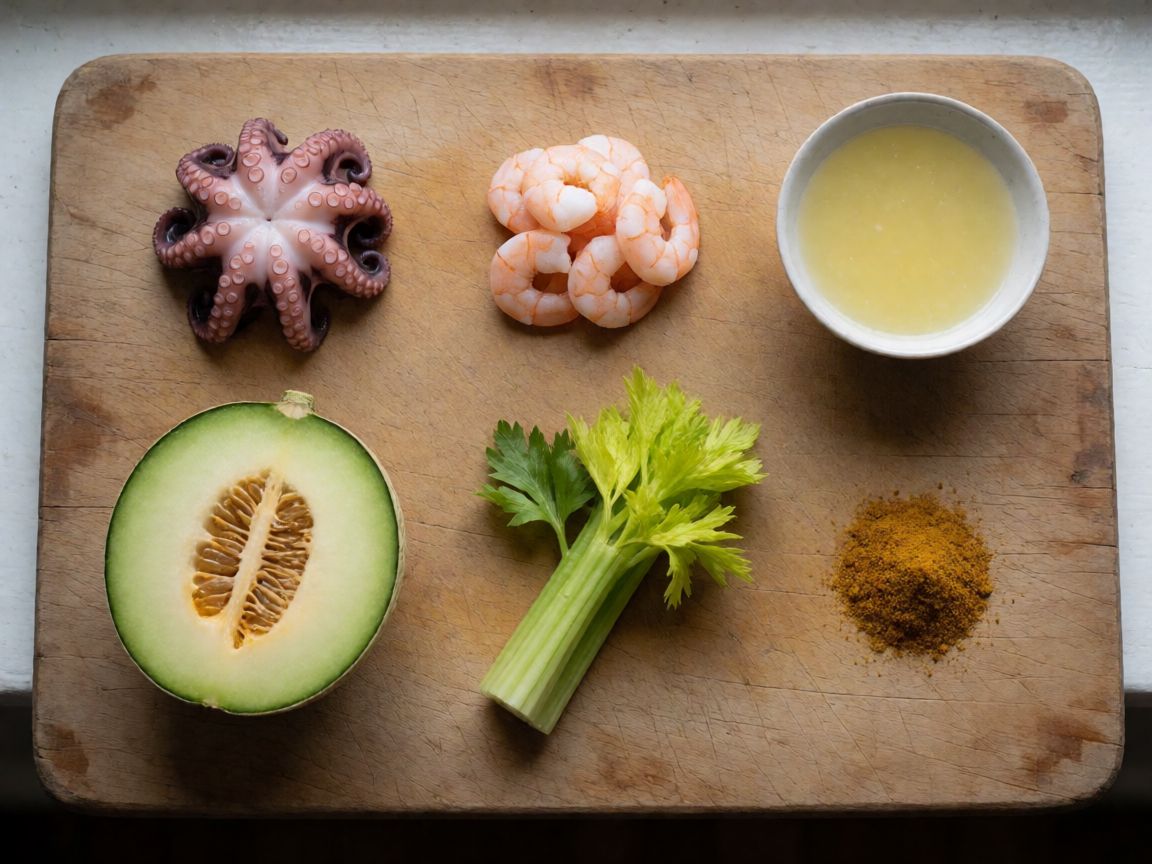
- 200 g Octopus carpaccio
- 80 g Prawns
- 0.5 pcs Melon
- 1 pcs Celery stalk
- 1 pcs Lemon juice juice of 1 lemon
- Curry powder to taste
- Olive oil to taste
- Salt to taste
- Black pepper to taste









Steps
Peel the melon, removing the seeds and the stringy flesh inside. Cut half of the melon into thin slices, then into small cubes.
Wash the celery stalk thoroughly under running water and cut it into thin rings.
In a large bowl, combine the melon, prawns and celery, add the octopus carpaccio and gently mix everything together.
Squeeze the lemon and mix the juice with the olive oil, curry powder, salt and black pepper.
Pour the dressing over the salad and mix well.
Serve immediately, optionally accompanied by bruschetta and Marie Rose sauce.
This is not a cooked dish — it's an edit. Octopus, prawns, melon, celery: nothing here meets heat, so the entire skill moves from timing a stove to timing a knife and a fridge. What decides whether it works is not what you do to the ingredients but what state you catch them in before you touch them.
Melon is the heart of it and the one thing you can get wrong without noticing until it's on the plate. A green, hard melon brings crunch where you want give, and no sweetness to argue against the salt of the seafood. You want it ripe enough that the stalk end softens under a thumb and gives off scent through the skin — that's the melon doing its own cooking, slowly, on a windowsill, with no stove involved at all.
The seafood needs no further persuasion — octopus carpaccio and prawns here are already cooked before they reach your bowl, which is worth saying plainly, because "carpaccio" makes people think raw. It isn't. Octopus carpaccio is boiled octopus, pressed into a tight roll while still warm so the flesh fuses, chilled hard, then sliced paper-thin — the technique borrows the name from Venice but not the rawness. What you're assembling is already finished; your job is contrast and timing, not transformation.
Start with the octopus, because it carries the most myth. "Carpaccio" borrowed from beef means thin and raw. Applied to octopus it means thin, full stop — the octopus is boiled until a skewer slides through the thickest tentacle without resistance, then rolled tight in film while hot so the natural gelatine glues it into a dense log as it cools, then sliced across the grain so thin you can read through it. If you can't find it ready-made, poach a small octopus yourself and press it the same way, or substitute cooked squid sliced thin — the criterion is cooked, pressed or firm-textured seafood that holds a clean slice, not any particular animal.
Prawns in this salad are the pre-cooked kind, the pink ones sold cold in every British supermarket chiller, not raw ones that need their own pan. That matters because there's no cook step in this recipe at all — if you buy raw prawns by mistake, you've bought yourself an extra job the recipe never asked for. Dry them well after they come out of their pack; wet prawns water down the dressing the same way an unripe melon dries it out — same defect, opposite cause, both fixed by paying attention before the bowl, not after.
Melon: any variety with a high water content and floral sweetness works — honeydew, cantaloupe, Galia. Watermelon is the wrong kind of wet; its flesh falls apart into fibres rather than holding a cube, and it lacks the perfume that's doing the actual work against the salt. Cut it close to serving, not ahead, because melon sitting cut on a board starts sweating immediately, and that sweat is exactly the diluting water you were trying to avoid with the prawns.
Celery earns its place by being the one thing in the bowl that isn't sweet or rich — it's there to interrupt, with a clean bitter snap, the softness of everything else. Wash it properly; the inner curve of a celery stalk collects grit the way a gutter collects leaves, and no amount of dressing disguises sand.
The dressing is where the digression lives. Curry powder in a seafood salad looks like a nod to India, but it isn't one — curry powder itself was invented in Britain, blended by merchants to sell a single jar that approximated many regional Indian spice mixes to a public that wanted the idea of curry without learning the cooking. It's a British larder staple with a borrowed name, which is also roughly the story of Marie Rose sauce suggested alongside this — mayonnaise, ketchup and a dash of something sharp, stitched together in a British kitchen in the mid-twentieth century to dress prawns for a dinner party. Serve the two side by side and you're not cooking a fusion dish; you're serving two generations of the same British habit — taking something from elsewhere and making a jar out of it.
Lemon and oil need no more care than any dressing: use an oil with no character of its own so the curry and lemon are what you taste, not the oil fighting them — a light olive oil, or a neutral vegetable oil if that's what's in the cupboard. Squeeze the lemon just before mixing; juice sitting in a cup loses its edge the same quiet way the melon loses its water, through time doing nothing useful to either. This feeds four as a starter, not a main — a dish built on contrast in small mouthfuls, the way melon and ham at the start of a meal is meant to wake the appetite rather than satisfy it.