
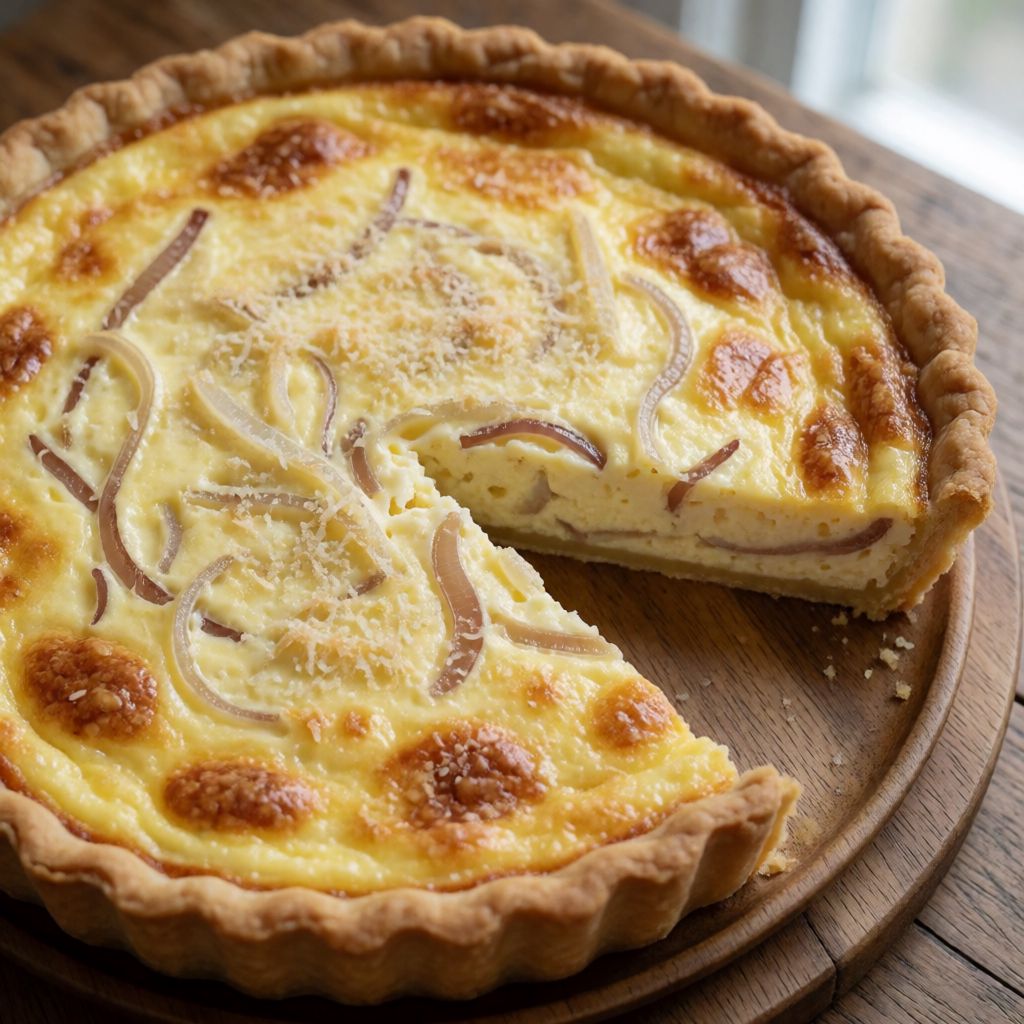
 AI photo
Onion Quiche
A savoury onion and cheese tart baked in a puff pastry case.
Labels are worked out automatically from the ingredients and can be wrong. Check the packaging if it matters to you.
Ingredients
- 1 pcs Puff pastry
- 1 kg Onion
- 4 pcs Eggs
- 200 ml Double cream
- 2 tbsp Parmesan
- Olive oil to taste
- Salt to taste
- Black pepper to taste
- 1 tbsp Breadcrumbs dried
- 100 g Fontina diced
- 1 tbsp Parsley










Steps
In a pan with 1 tbsp of olive oil, fry the onion for a few minutes, taking care it doesn't burn.
In a bowl, whisk the eggs with the cream, Parmesan, a pinch of salt, pepper and parsley, then stir in the diced Fontina.
Add the cooled onion to the egg mixture and mix well.
Line a tin with baking paper, lay in the puff pastry, prick the base with a fork, and sprinkle with breadcrumbs.
Pour the egg and onion filling onto the pastry.
Fold over the pastry edges and bake at 180°C for 30 minutes.
30 minServe warm.
What was changed
Double cream was swapped because double cream is the standard cream found in local shops.
A quiche is really just a custard held up by pastry — the whole exercise is getting that custard to set without curdling and the pastry to hold without going soggy. One kilo of onion against four eggs tells you where the weight of this dish sits: this is an onion tart that happens to have egg in it, not an egg tart with onion as garnish.
What decides whether it works is the onion stage, done first and separately, and the breadcrumbs under the filling, done last before pouring. Fry the onion gently enough that it goes soft and translucent rather than brown and sweet — you want it collapsed, not caramelised, so it melts into the custard instead of sitting in it as separate sweet threads. Some say onion for a quiche needs long slow caramelising like for French onion soup — no, because that's a different dish solving a different problem: there you're building sugar and colour over an hour, here you just need the onion to give up its water and go limp in a few minutes, so it won't dump liquid into your custard later and turn it watery.
The breadcrumbs are not seasoning, they're plumbing. Sprinkled on the pricked pastry base before the filling goes in, they sit between pastry and custard and soak up the first moisture that would otherwise turn the bottom of your tart into wet cardboard. Pricking the base does similar work from a different angle — it lets steam escape through the dough instead of ballooning it up mid-bake, which is the usual reason a blind base puffs into a dome and then collapses into a crater.
On the ingredients: eggs and cream are the custard, and their ratio is what you're actually managing. Four eggs to 200ml cream is a loose enough ratio that the custard stays tender rather than rubbery — more egg relative to cream and you edge toward a firm, slightly bouncy set, closer to a baked omelette than a quiche. If you've only got whole milk, use it, but expect a thinner, less silky set; cream's fat is what gives you the slight wobble you want when the tart comes out.
Fontina is there for pull and mild savoury depth — it's a semi-soft alpine cheese that goes properly molten rather than greasy when baked. If you can't get it, any cheese that melts smoothly without weeping oil does the same job: a young Gruyère, a mild Cheddar cut small, even mozzarella in a pinch, though mozzarella gives you stretch rather than richness. Parmesan is doing something different — it's not there to melt, it's there for salt and umami stirred straight into the raw custard, so a pre-grated supermarket parmesan substitute with similar sharpness works just as well as the real wedge.
Puff pastry here is bought, not made, and that's not a shortcut to apologise for — making your own butter-laminated puff pastry is a half-day job of folding and resting, and shop-bought puff has been reliably good in the UK for decades precisely because the lamination is mechanical and repeatable at scale. Use it straight from the fridge, cold, because warm pastry is soft pastry, and soft pastry tears when you line a tin and won't hold its folded edge.
Olive oil for frying the onion is just "to taste" because its job is lubrication, not flavour — any neutral or mild oil does the same work; you're not building an olive-oil-forward dish here, so don't reach for an expensive extra virgin and waste its character on a pan of softening onion.
A note for a UK kitchen: a 180°C setting assumes a conventional oven, so if yours is a fan oven, drop it roughly 20°C or the top will set and colour before the centre has fully firmed — check by nudging the tin, the centre should wobble gently like a worktop jelly, not slosh like raw egg. And patience is doing real work twice here: once while the onion softens unhurried in the pan, and once while the baked tart rests a few minutes out of the oven, letting the custard finish setting on its own heat before you cut it — slice it straight from the oven and you'll get a puddle, not a wedge.