
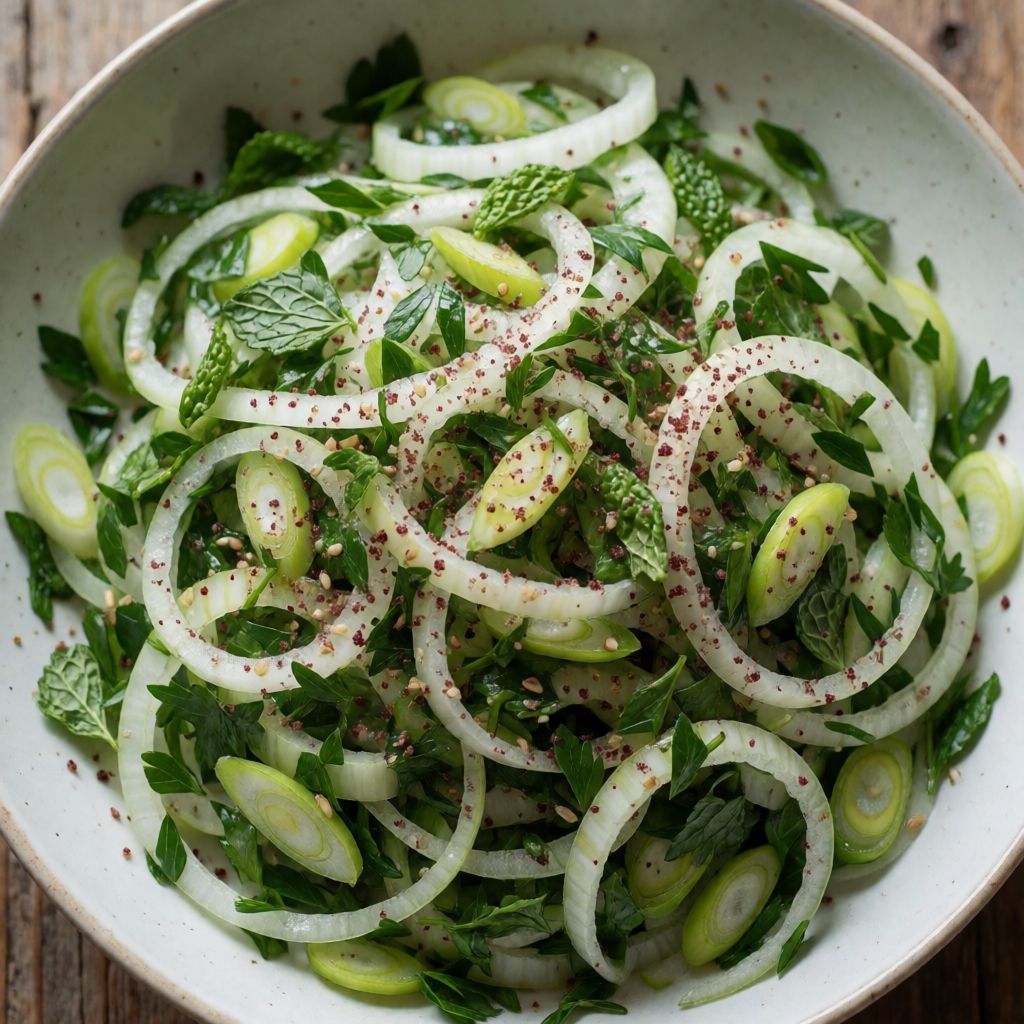
 AI photo
Onion Salad
A fresh raw onion salad with herbs, sumac, cumin and coriander, dressed in olive oil and lemon juice.
Labels are worked out automatically from the ingredients and can be wrong. Check the packaging if it matters to you.
Ingredients
- 2 pcs Spring onion
- 1 bunch Parsley roughly chopped
- 1 bunch Mint roughly chopped
- 1 pinch Sumac
- 1 tsp Ground cumin
- 1 pinch Ground coriander
- 2 tbsp Olive oil
- 1 tsp Lemon juice
- 1 tsp Freshly ground black pepper









Steps
Mix the spring onion rings in a bowl with the lemon juice, olive oil, sumac, cumin, coriander and 2 tbsp of finely chopped parsley leaves.
Toss gently so everything is well coated.
Leave to marinate for 20-30 minutes.
25 minBefore serving, remove the onion rings and drain off any excess liquid.
Arrange the salad on a plate, sprinkle with mint leaves, the remaining chopped parsley, and finish with a generous grind of freshly ground black pepper.
What was changed
We've used Freshly ground black pepper here, as pink peppercorns can be hard to find at the local greengrocer, and it gives the dish the same lovely peppery bite.
This isn't a leaves-and-dressing salad. It's a fistful of onion and herbs built to sit next to something rich — in a kebab shop that something is grilled meat, on your table it works just as well next to a Sunday roast, doing the job mint sauce usually does but with more happening on the plate. Whether it works comes down to one thing: what happens to the raw onion in the twenty-odd minutes before it's served.
Raw onion out of the bag bites — that's cut cell walls releasing sulfur compounds, the same ones that make you cry at the chopping board. Some say rinse the rings under cold water to calm them. Don't bother: water only washes what's sitting on the surface, it doesn't reach what's locked inside the layers. Acid does that job. Lemon juice sitting against the onion for half an hour works its way through the tissue and actually changes those compounds, softening the sting from the inside rather than rinsing it off the outside.
That's also why you lift the onion out and let it drip before plating. By the end of the marinade it's given up water and drunk in lemon juice — tip all that liquid onto the plate with it and you've made onion soup, not onion salad. Drain it properly and the crunch survives the journey from bowl to plate.
Spring onion is the reason this works without a long fight. It's pulled young, before the bulb has built up the concentrated sulfur stores a mature storage onion carries through winter, so it starts milder and needs less taming. If all you've got is a regular onion, slice it thin and give it the full half hour, maybe five minutes more — same mechanism, just a harsher starting point to work against.
Parsley and mint are doing different, complementary jobs. Flat-leaf parsley if you can find it — it packs more flavour per handful than the curly kind, which is mostly water and stem. Mint brings a cool, almost menthol edge against the warmth of cumin and coriander, a pairing you'll see right across the Caucasus and eastern Mediterranean table, because mint and sharp acid are the standard answer to fat on a plate. If you've no mint, leave it out rather than reaching for basil to fill the gap — basil changes the character of the dish instead of just standing in for mint's coolness.
Sumac is a different kind of sour from the lemon — dry, fruity, almost like a dusting of tart dried berries, where lemon is wet and sharp. No sumac in the cupboard: anything dried, sour and without bitterness will do the job — dried lime powder (loomi), or a pinch of citric acid rubbed with the smallest touch of sugar. Don't reach for vinegar instead; vinegar's sourness is flatter and wetter, it won't sit on the onion the same way.
Cumin and coriander are both better bought as seed and ground just before you need them, because the aromatic oils in both fade within weeks of grinding — a jar that's sat in the cupboard a year smells mostly of nothing. Pre-ground isn't a disaster, just use a little more than stated to make up for what's already gone.
Oil here only needs to carry flavour and coat the onion, so any oil with no smell of its own would physically work — a flavourless sunflower or rapeseed will do the job. Olive oil earns its place because its own faint bitterness sits well against sumac's sourness, a small extra layer you'd lose with a neutral oil. The black pepper goes on at the very end, never into the marinade — pepper's aroma is volatile, and half an hour in lemon juice flattens it to plain heat with none of the lift you get from grinding it straight onto the finished plate.
Herbs and onion cost next to nothing next to meat, which is the real reason a salad like this exists — it's not decoration, it's how a kitchen stretches a plate. The twenty to thirty minutes of marinating is the one ingredient here that can't be rushed: hurry it and the onion still bites, leave it sitting for hours and it goes grey and tired instead of tender. Taste a ring at twenty-five minutes — if it still makes you wince, give it another five, and check again.